NEW YORK: The UN General Assembly is not merely a platform for world leaders to deliver speeches or listen to others. Short conversations, chance encounters and informal contacts outside formal programmes can also shape the course of international relations. Sometimes, even a five-minute meeting can carry a significant diplomatic message.
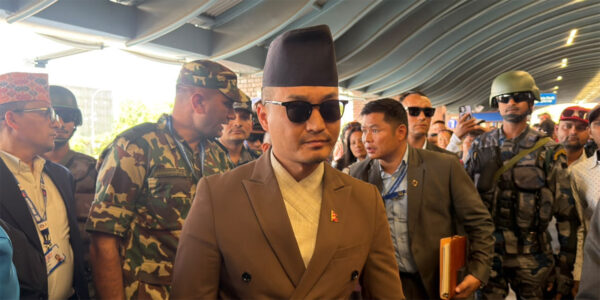
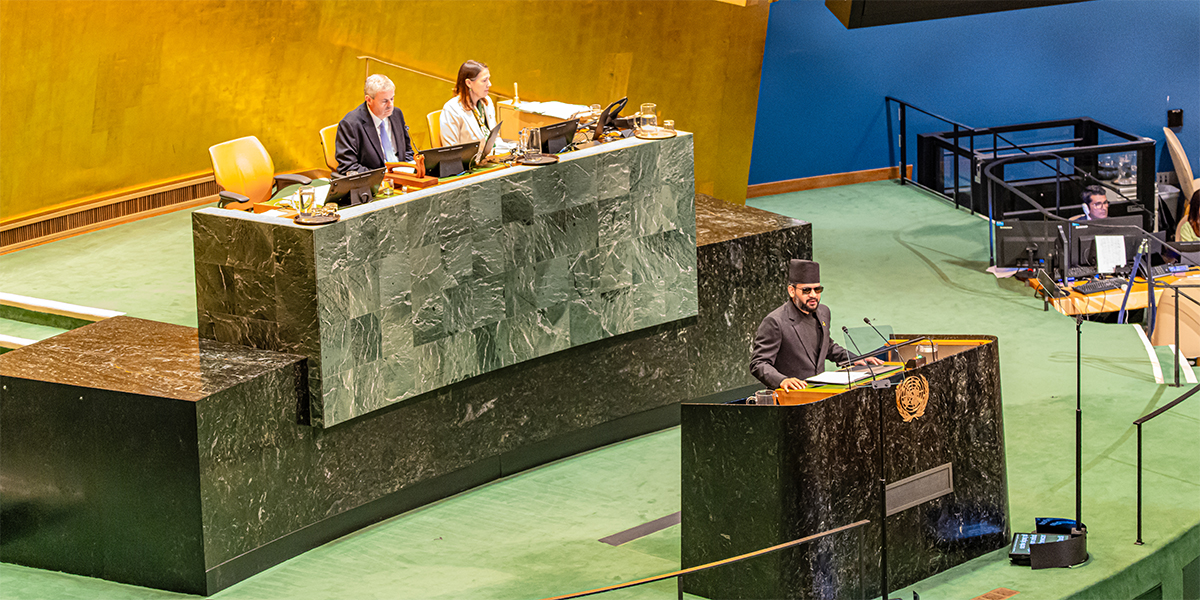
Prime Minister Balendra Shah’s presence in New York this time therefore should not be understood solely through his address to the General Assembly or his meeting with UN Secretary-General Antonio Guterres. His decision to keep his own engagements limited while assigning Minister for Foreign Affairs Sishir Khanal to take the lead on the diplomatic front is also significant.
Shah did not meet anyone individually during his trip and appeared determined to avoid situations that could become politically controversial.
His formal program was clear: attend the General Assembly, address the high-level session and meet Secretary-General Guterres. Beyond that, his schedule remained tightly controlled. He stayed at a Hyatt hotel in the Grand Central area, attended only scheduled programs and spent much of his remaining time at the hotel preparing for his address. He did not even visit Nepal’s permanent mission.
Nepali community representatives, well-wishers and various individuals had tried to meet him. Supporters of his party and others made efforts, while some even tried to create an environment for meetings. None of these efforts materialized.
According to sources, some foreigners also sought meetings with the prime minister, but those efforts were unsuccessful.
Why did this happen?
One explanation is that Shah was wary of the way meetings and photographs could be used politically. In the age of social media, even a single photograph with the prime minister can quickly acquire political meaning. There were also efforts by some people to position themselves as close to him by arranging photographs or other forms of access.
For that reason, Shah appears to have chosen to avoid almost all informal and individual meetings.
A prime minister’s foreign visit is traditionally measured partly by the number and nature of meetings held: whom the leader met, at what level, what issues were discussed and what new relationships were developed.
Shah’s approach in New York was different.
A meeting with an Indian official could generate one kind of political interpretation, while a meeting with a Chinese or American official could generate another. Even meetings at the level of a foreign minister or deputy minister could have prompted questions about why the prime minister himself was not involved.
Shah therefore left much of the diplomatic engagement to the foreign minister, who held a large number of meetings and participated in several programs during the visit.
This approach can be understood from two perspectives. First, it helped the prime minister avoid the appearance of giving special preference to any particular country, group or individual. Second, limiting such contacts also narrowed opportunities for informal diplomatic exchanges that could have been useful at a multilateral gathering such as the UN General Assembly.
That tension is perhaps the most interesting aspect of Shah’s visit.
The question is whether diplomatic engagement should be led personally by the prime minister or carried out primarily through the government’s diplomatic machinery. Shah’s approach appears to have placed greater emphasis on the latter.
He also appears to have been cautious about the activities of Nepali diplomatic mission and consulate in New York. The scene at the Nepal Consulate General following his departure, where a large crowd gathered for a program involving the foreign minister, illustrated how easily such events can turn into opportunities for photographs and social-media exposure.
A hall designed for around 40 people reportedly had about 150 attendees. People were seen trying to get close to the minister and take photographs. The episode may have reinforced Shah’s reluctance to participate in similar gatherings.
A Different Approach
Multilateral forums are also important venues for bilateral diplomacy. The UN General Assembly, in particular, provides opportunities for leaders to establish contacts outside formal meetings.
Shah’s decision to restrict his meetings may have helped him control the political messages surrounding his visit, but it also meant that some potential diplomatic opportunities were left unexplored.
One notable exception came through an accidental encounter with the Australian prime minister in a holding room. It was not a scheduled bilateral meeting, but a brief informal conversation. Such an exchange can sometimes open space for future relations and may have relevance for issues concerning the Nepali community in Australia.
The encounter also showed that Shah was not completely opposed to dialogue. Rather, he did not appear interested in turning every contact into a formal diplomatic engagement. When an opportunity arose, he spoke informally, without making it a separate political event.
He did not reject contact altogether; he simply did not expand informal contact into an institutionalized list of meetings.
Distance From the Nepali Community
It was not unusual for members of the Nepali community in New York to seek a meeting with the prime minister. Nepalis gathered around his hotel, and there were efforts to have him address supporters.
Shah did not choose that route.
He was seen greeting Nepalis he encountered along the way with a smile, folded hands or a hand placed on his chest. There was no deliberate distancing in those brief encounters. But there was no effort from his side to turn them into formal meetings either.
He did not completely isolate himself from the public. Instead, he accepted brief, unplanned and ordinary interactions while preventing them from developing into political engagements.
An even more interesting aspect was that Shah did not hold separate meetings with some of his close associates and advisers in New York either.
If the sole objective had been to avoid controversial contacts with foreign officials, there would have been little reason to avoid meetings with his own people. This suggests that he was concerned more broadly with controlling the visual and political narrative surrounding his visit.
In today’s social-media environment, a single photograph can become a political news story. For a public figure, a meeting itself can become a political message. Shah’s conduct in New York can therefore be viewed in the context of this changing nature of political communication.
‘Fewer Meetings’ Is Also a Message
The most notable aspect of Shah’s New York stay was not simply that he met fewer people. More important was the apparent effort to control the political meaning of his meetings.
Two characteristics of his approach stand out. First, he appears to take public perception seriously. Second, he appears to want tight control over the political signals generated by his interactions.
The long-term impact of this approach, however, cannot be determined yet.
Diplomatic success is not measured simply by the number of meetings held. Likewise, holding fewer meetings is not in itself an achievement. What matters is what those meetings produce, what relationships are developed and what results they generate for the national interest.
Shah attended the General Assembly, addressed the international community and met Secretary-General Guterres. But his presence in sideline diplomacy was limited, while the foreign minister took on a much more active role, holding more than 20 meetings and attending events during the visit.
This made Shah’s New York trip different from a traditional prime ministerial foreign visit. There were fewer meetings, but the decision to limit them itself carried political meaning.
He did not appear to give priority to any particular side, which helped maintain a certain balance. At the same time, that approach meant that some potential diplomatic contacts were not pursued.
Both sides need to be considered to understand the nature of Shah’s New York visit.
He largely travelled between his hotel and scheduled engagements and did not seek out many additional meetings. Perhaps that is the central political message of his visit: in diplomacy, the list of people a leader does not meet can sometimes say as much as the list of those he does.
The consequences of that approach, however, will only become clear over time. Diplomatic results often take years to emerge.