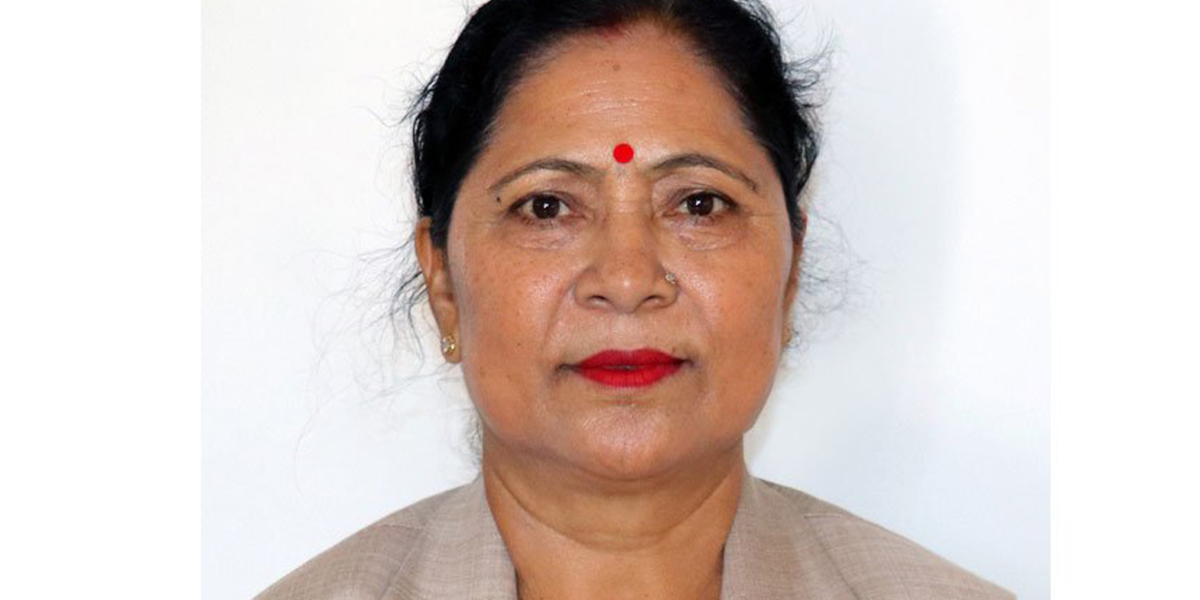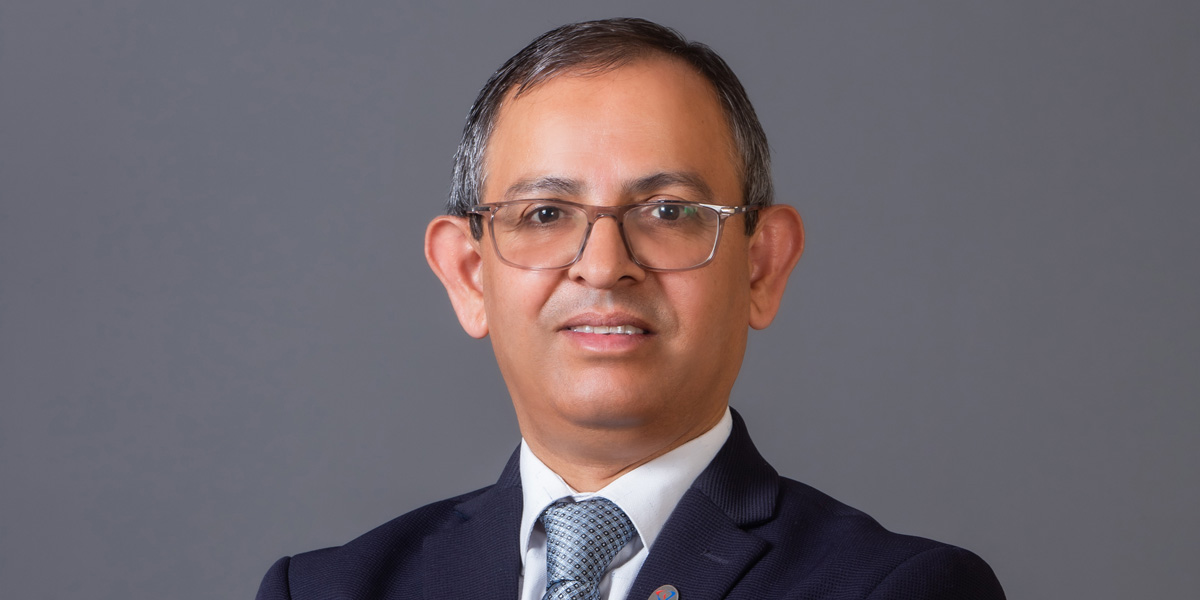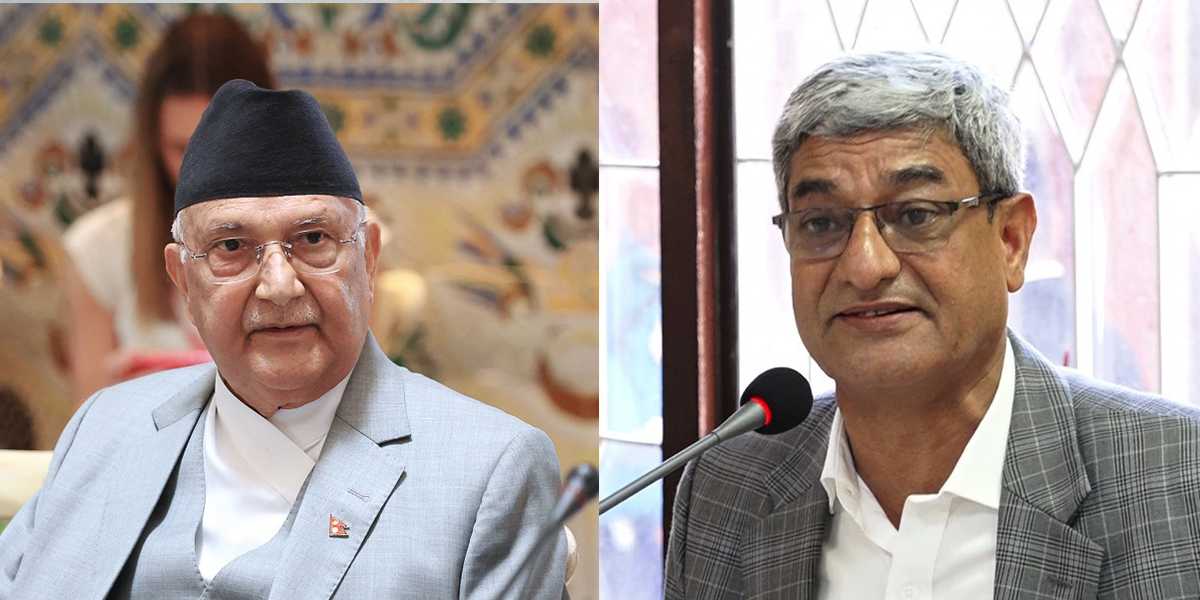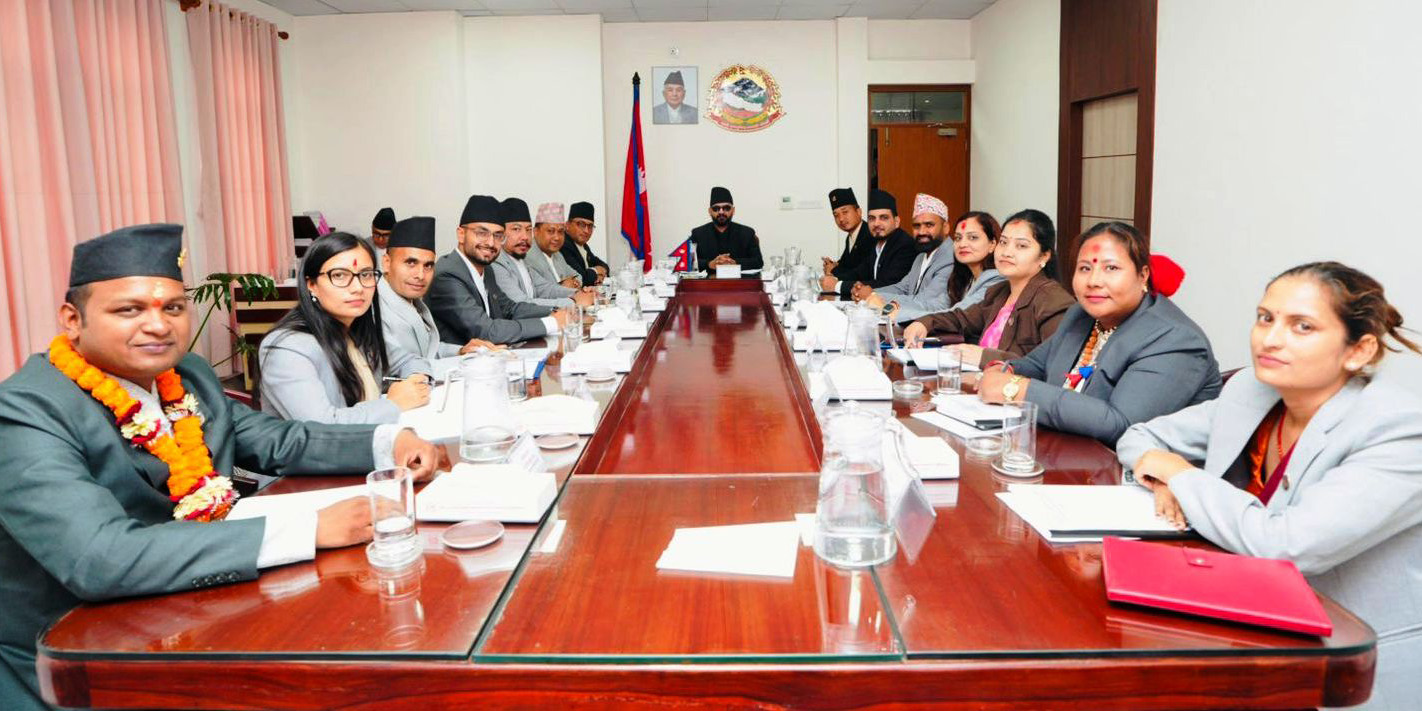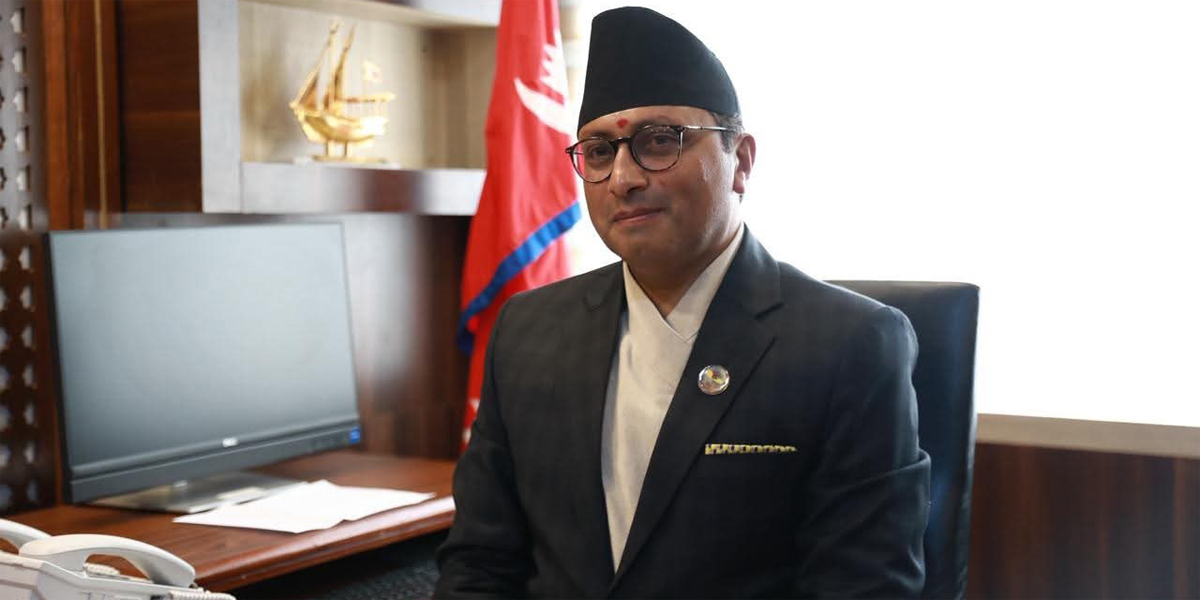
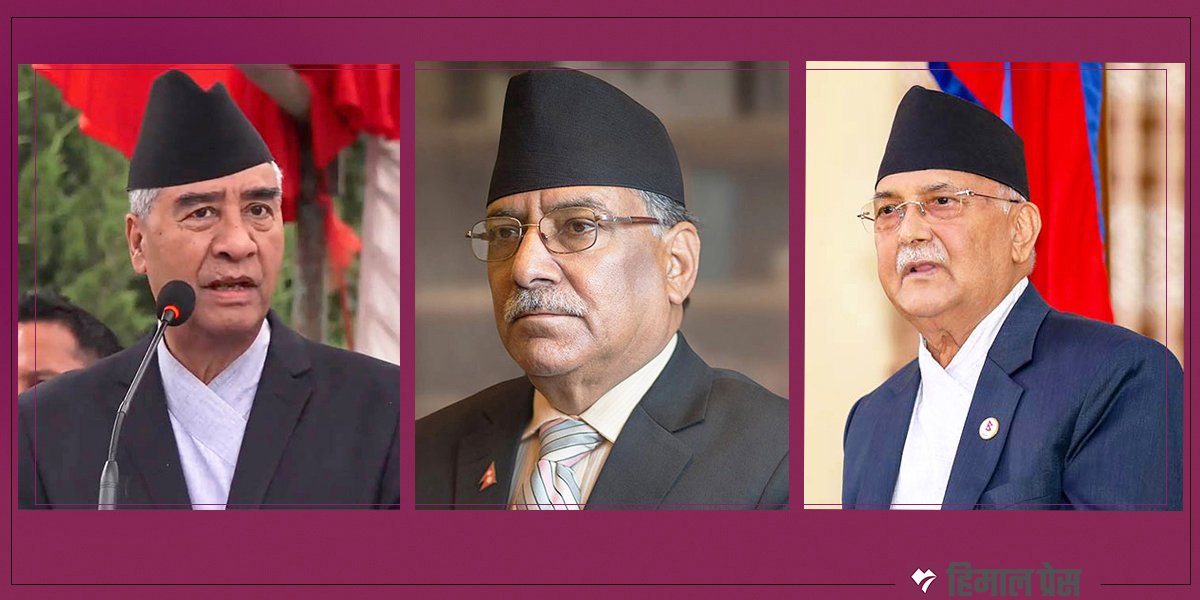
 This combo pictures shows, from left, NC President Sher Bahadur Deuba, Maoist Center Chairperson Pushpa Kamal Dahal and UML Chairperson KP Sharma Oli.
KATHMANDU: Though Nepal’s Constitution regards political parties as the backbone of democracy, these very institutions are increasingly plagued by institutional decay, factionalism, and a leader-centric culture.
Rather than being guided by ideology or policy, most parties now revolve around individual leaders. Party direction, strategy, and policy are often shaped by the personal will of the top figure. This has turned political parties into near-private enterprises, with leaders as owners and members as employees.
This personality-driven culture has sidelined policy debates in favor of loyalty and flattery. Intra-party discussion is rare, dissent is often viewed as rebellion and criticism is discouraged. The statement of the top leader is considered the ultimate truth.
Major parties like the Nepali Congress (NC), CPN-UML and CPN (Maoist Centre) are also undermining internal democracy by delaying their national conventions which are supposed to facilitate leadership transitions.
The failure to hold conventions on the dates mandated by party statutes, leaders waiting for a time that suits them, manipulating delegate selection through backdoor dealings, and using conventions merely as tools for leadership endorsement, without actual leadership change, are recurring trends across all major parties and their sister organizations. Rather than serving as genuine democratic exercises, conventions have been reduced to formalities that legitimize power. These practices are steering political parties away from rule-based governance, turning them instead into leader-centric structures driven by personal convenience.
Deuba looking for favorable successor
The four-year term of the NC’s 14th Convention is expiring in December. If the party were serious about holding the convention on time, preparations would have already begun. However, it is now evident that the convention will not be held within the stipulated timeframe.
The dispute over active membership remains unresolved. Likewise, there has been no progress toward holding district- and provincial-level conventions. This indicates that party president Sher Bahadur Deuba is likely to extend his tenure as permitted by the party statute. According to the statute, a four-year term can be extended twice by six months each, allowing a one-year extension.
Party insiders say it is for this reason that Deuba is in no rush to initiate the convention process.
Leaders close to Deuba suggest two main reasons for the delay: his desire to wait for a more favorable time, and his uncertainty over a suitable successor. Since Deuba cannot run for a third term as party president, he is now focused on identifying a successor who aligns with his interests.
“Our party was supposed to hold the general convention by December, but no preparations have begun,” says Central Working Committee member Ajay Babu Shivakoti said. “The leadership is simply not focused on the convention.”
Some leaders, including Shekhar Koirala, have openly insisted that the convention be held on time. But Deuba has remained silent, indicating that he is in no mood to hold the convention anytime soon.
“Deuba prefers to hold the convention while he is in power. He believes doing so would give him greater control over the outcome,” political analyst Krishna Pokharel said. “He is looking for a successor who will remain loyal to him. This is one of the main reasons for the delay.”
Some leaders even argue that the convention should be held only after the 2027 general elections. According to party insiders, the leadership is deliberately stalling to create a favorable environment for themselves.
“Holding the convention after the 2027 elections would make it legally invalid. Despite this, some leaders are still pushing for it,” Shivakoti said. “Even the constitution doesn’t allow us to go beyond May 2027.”
According to party sources, the timing of the convention now hinges entirely on Deuba. He is reportedly unwilling to set a date until he finds a preferred candidate for party president. With Deuba himself ineligible to run, second-tier leaders are pressuring him to endorse a successor.
Deuba-aligned leaders like Bimalendra Nidhi, Prakash Man Singh, Krishna Sitaula, Gopalman Shrestha, Shashank Koirala and Purna Bahadur Khadka have expressed interest in the presidency. On the other hand, leaders outside Deuba’s faction—such as Gagan Thapa and Shekhar Koirala—are also preparing to contest.
The Nepali Congress is approaching the end of its current four-year term, following the 14th General Convention held in December 2021. The next convention is due by December 2025, but preparations have yet to begin.
Oli eyes early convention to secure his grip
Nepal’s second-largest parliamentary party, the CPN-UML, is also gearing up for its general convention. The party plans to hold its 11th General Convention by mid-May next year.
“This will be an important year for us—we are preparing for the General Convention,” said Kashinath Adhikari, a Standing Committee member and head of the Organization Department. “The date will be finalized by the statute convention.”
The UML has scheduled its statute convention for September. While it is customary to hold the general convention within six months of the statute convention, there is no legal obligation to do so.
“We are planning to hold the General Convention within six months of the statute convention, so it will definitely happen this year,” Adhikari added.
According to party leaders, UML Chairperson KP Sharma Oli is looking to schedule the convention between November this year to March next year.
“Even if the convention is held as early as November, it shouldn’t come as a surprise,” said a UML leader. If held by May, the convention would be a year ahead of schedule, as the five-year term of the current term ends in May 2027.
There is no legal or organizational urgency for the UML to hold the convention right away. However, party leaders cite several reasons, including Oli’s desire to remain party chair, for advancing the timeline. Leaders close to Oli claim he fears the emergence of internal challengers if the convention is delayed.
“Oli seems worried about the growing influence of President Bidya Bhandari, who has made no secret of her desire to return to active politics,” said a UML official. “That is why Oli appears determined to hold the convention this year and secure a unanimous endorsement for another term.”
Bhandari, who is close to many UML leaders, has also been traveling widely across the country. “She has already toured much of the country and is now preparing to visit Karnali Province,” a UML leader said.
Political analyst Pokharel said Oli wants to extend his stay at the helm. “He fears that delaying the convention could give Bidya Bhandari the momentum to mount a challenge,” Pokharel added. “Bhandari’s increasing public engagements suggest a desire for leadership. Her activities have unsettled Oli.”
Dahal on Deuba’s path
Maoist Center Chairperson Pushpa Kamal Dahal is no different when it comes to sticking to power. He is in favor of postponing the convention by any means.
Maoist Center, which held its eighth convention in 2021, had planned to hold a special convention within a year. However, even four years after the last convention, the party has not been able to schedule the next one.
In the central committee meeting held last December, Dahal had assured that the convention date would be set soon. Instead of fixing a date, he announced a six-month campaign and said that the central committee would decide on the convention date after the campaign ends.
It is now certain that the Maoist Center convention will not take place for at least another year. According to leaders, Dahal is planning to keep internal party disputes under wraps. He is facing challenges from Deputy General Secretary Janardan Sharma within the party.
Factions led by Dahal and Sharma were evident in the recently held election of the party’s sister organizations. Leaders say that if this situation persists, Sharma could gain strength against Dahal. This is why Dahal is delaying the general convention.
In the previous convention, Dahal faced difficulties in finalizing the office bearers. The internal dispute surfaced when he was indecisive about appointing the General Secretary, the second executive position in the party.
“The Maoist Center emerged from a military structure, and remnants of that mindset are still visible. Dahal is waiting for an opportune moment to hold the convention,” analyst Pokharel said. “A party run by a commander naturally revolves around the commander.”
Smaller parties are no different
The trend of delaying general conventions and consolidating leadership power is not limited to the major parties; it has also taken root in smaller parties. Even the newly formed Rastriya Swatantra Party (RSP) has shown signs of adopting these old political habits.
A Central Committee meeting of the party held in October last year had decided to hold its general convention by mid-May. However, after party president Rabi Lamichhane was arrested in early April, the party postponed the convention to March 2026.
“We were compelled to postpone the convention after our central figure was jailed,” RSP leader Manish Jha told Himal Press.
A similar pattern is unfolding in the Rastriya Prajatantra Party (RPP) – the fifth-largest party in parliament. The four-year term of the current leadership is ending in December. However, party chair Rajendra Lingden is seeking to extend his term by a year. Leaders from the rival faction, however, are insisting that the convention must be held within the current timeframe.
Other parties like the Janata Samajbadi Party (JSP) Nepal and Loktantrik Samajbadi Party (LSP) Nepal are also looking to delay their conventions.
LSP Nepal, which had scheduled its convention for May, has since postponed it to August, citing a lack of preparation.
This persistent pattern of postponing leadership transitions and prioritizing individuals over institutions is eroding public trust in political parties and their leaders. When personal interests overshadow ideology and policy, and factional power takes precedence over internal democracy, the result is continued political instability and poor governance.
There is growing concern that this trend threatens the very soul of democracy as envisioned by the Constitution. To safeguard democratic values, parties must hold their conventions on time, ensure leadership transitions through institutional processes, and foster a culture that respects internal dissent and diverse viewpoints.