

KATHMANDU: A sudden flood in Lhende Khola River, near Rasuwagadhi on the Nepal-China border, in Rasuwa has caused heavy physical damage and loss of human lives, according to Nepal Police.
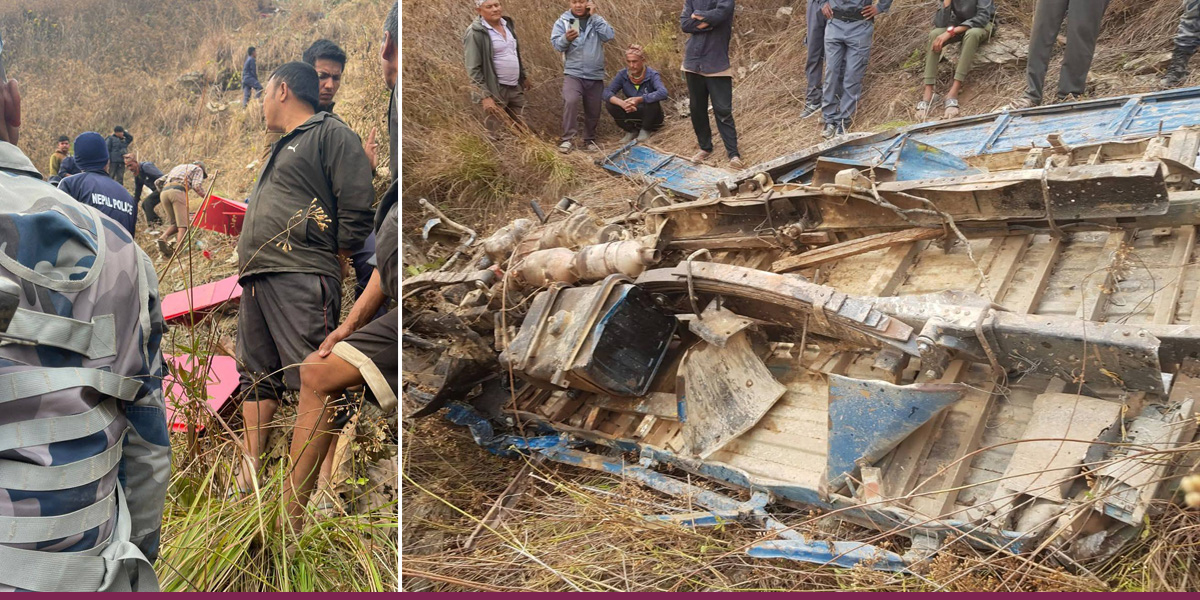
The flood hit Rasuwagadhi in Gosainkunda Rural Municipality-2 early Tuesday morning. At least 18 people are missing and over a dozen vehicles have been swept away, police inspector Prakash Pandey told Himal Press. Among the missing are 12 Nepalis, including three police officers, and six Chinese nationals.
The flood also swept away the concrete bridge at the Rasuwagadhi border point. The bridge served as a key infrastructure for Nepal-China trade. Several hydropower plants along the Trishuli River have suffered damage, according to the District Administration Office, Rasuwa. Local authorities have issued high alerts in downstream areas of Rasuwa, Nuwakot, Dhading and Gorkha districts.
No rain, sudden flood
Officials from the Department of Hydrology and Meteorology said the flood did not result from local rainfall. At 3:40 am, the water level at the Bhotekoshi monitoring station in Syafrubesi was recorded at a normal 5.37 meters. But by 6 am, the flood had intensified significantly. Similarly, the water level in the Betrawati River rose sharply from just 1.63 meters at 5 am to 4.18 meters within 50 minutes.
Satellite-based data from the World Meteorological Organization’s flash flood guidance system showed no rainfall in the Bhotekoshi watershed over the past 24 hours. Local weather stations in Rasuwa also recorded only light and scattered rain.
“We are trying to figure out what triggered such a large flood without any local rainfall,” said meteorologist Hari Prasad Dahal. “There is a strong chance something happened on the Chinese side.”
GLOF suspected
Experts suspect a glacial lake outburst or dam failure in Tibet may have caused the flood. Meteorologist Dharma Raj Upreti said there had been no heavy rainfall in the Chinese border areas recently, suggesting a glacier may have burst. “There are big dams on the Chinese side of these rivers. If one of them failed, it could easily cause a flood of this scale,” he added.
Locals in the flood-hit areas said the ground shook as the flood arrived, similar to an earthquake, supporting the theory of a glacial lake outburst flood (GLOF). Some experts also suggest that a cloudburst in the catchment area of the river could have triggered the flood.
According to a 2019 study by Simon Keith Allen, Guoqing Zhang, Weicai Wang, Tandong Yao and Tobias Bolch, six of the ‘most dangerous’ 30 glacial lakes in the Tibetan plateau lie in Jilong county which is the catchment area of Kerung and Lendhe rivers that meet at Rasuwagadhi to form Bhotekoshi River. Four of them lie in the catchment area of the Lendhe River.