 Himal Press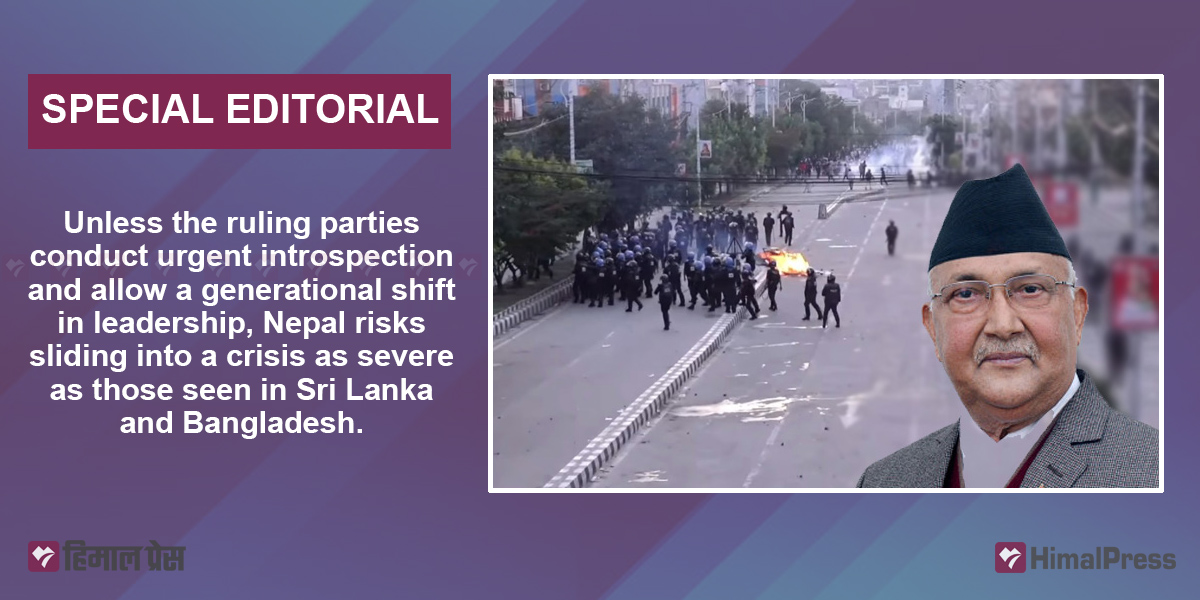
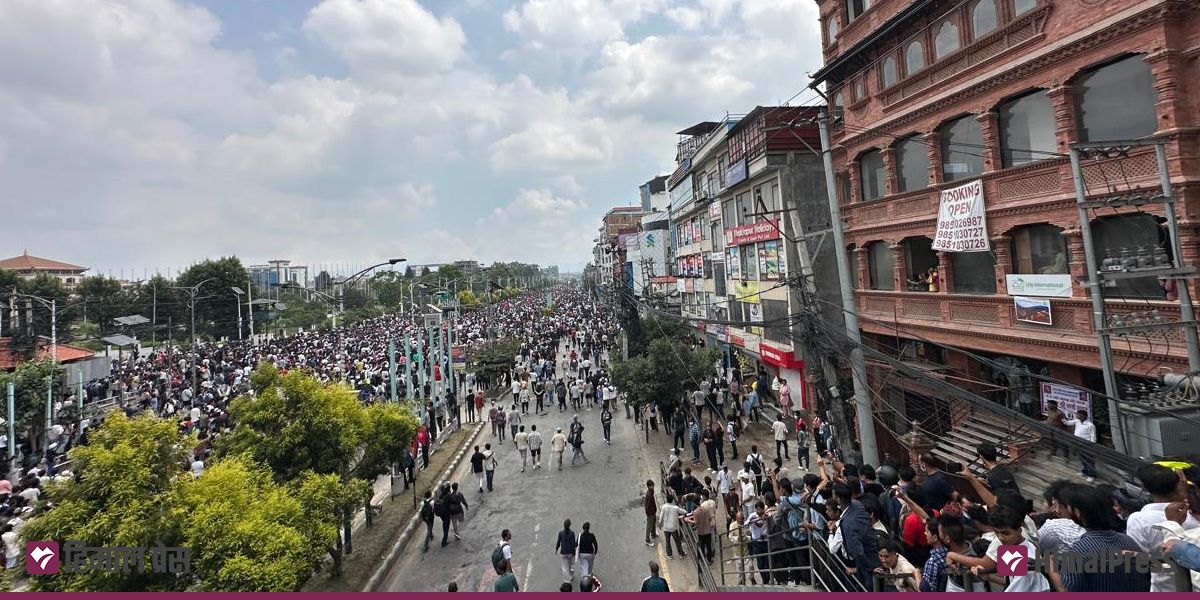
The government has responded with shocking brutality against young people who took to the streets on Monday. Graphic footage from Kathmandu shows police deliberately aiming and firing at protesters. The government has unleashed a massacre by killing at least 17 young people. For the first time in the democratic era, the state has staged such an act of terror in the heart of the capital.
Although the social media shutdown acted as the spark, underlying frustrations reflect broader concerns over governance failures, rising corruption, and widespread accusations that the children of political leaders monopolize opportunities. These are charges long directed at the coalition government led by Prime Minister KP Sharma Oli of the CPN-UML and the Nepali Congress (NC). The Gen Z protesters rose against these distortions, only to be met with extreme violence. Hundreds were injured by police gunfire, and disturbing scenes emerged of police personnel storming the Civil Hospital to beat injured demonstrators. For these atrocities, September 8 will go down as a black day in Nepal’s history.
By crushing young voices with bullets, the ruling coalition has set itself on a path toward steep political consequences. The fact that young protesters have defied curfew orders and continued demonstrations shows they see no future in the ruling parties. Protests have spread to major cities across the country, underscoring the depth of anger against those in power.
This uprising is not just about social media, as has been reported by several international media. It is an explosion of despair at political arrogance and betrayal. The government has failed to deliver governance, development, or job opportunities. Instead, it bows to middlemen who exploit ordinary citizens. Everyday life has grown unbearable—take, for example, eggs that cost Rs 7 in India are sold for Rs 23 in Nepal because of profiteering. Such daily injustices fuel the public rage.
The youth did not erupt in anger without cause. They have watched politicians’ children shielded from accountability while ordinary citizens face jail for the same offenses. They have seen corruption scandals pile up and government appointments traded like commodities. Though the Panchayat monarchy was overthrown, the rise of a new class of republican “maharajas” has deepened resentment. This frustration is shared across society—the youth are simply the ones in the streets.
Until recently, these young people expressed dissent only on social media. Once that outlet was shut, they felt gagged—and when speech was denied, they turned to the streets. For many, social media is not just a platform for expression but also a source of livelihood. Cutting it off has only heightened their anger.
Of course, infiltration cannot be ruled out in any mass movement. But the government’s decision to treat the entire crowd as enemies and adopt a policy of lethal force is nothing short of starting its own countdown to collapse.
What is needed now is reflection: how is public opinion shaping, and what course of action can restore stability? Leaders must recognize the sentiments of this generation, which demands change and generational transfer of leadership. Youth no longer tolerate the same old faces swapping power while corruption thrives unchecked. The laws to probe corruption already exist—what is lacking is the courage to apply them without political influence.
Though Nepal has witnessed many political movements, this is perhaps the first of its kind: an uprising led not by party slogans but by a generation disillusioned with those who came after past revolutions. They have watched leaders enrich themselves while the lives of ordinary people remain stagnant. Their anger also extends to the lavish lifestyles of politicians’ children, funded by taxpayers’ money. Gen Z is not blind—they are aware that corruption and exploitation lie at the root of Nepal’s stagnation.
The duty of the police is to manage protests, not to gun down unarmed demonstrators. Shooting young protesters who had secured prior approval for their march is cowardly and criminal. Such actions are utterly unacceptable. Responsibility does not rest solely with UML and Prime Minister Oli, Home Minister Ramesh Lekhak and his party, Nepali Congress, share equal accountability.
By banning social media and unleashing violence on the youth, the government has struck at the very heart of democracy and human rights. It has picked a dangerous fight with the generation that represents Nepal’s future. Instead of silencing them with bullets, leaders should have listened. The Gen Z movement has delivered a clear warning: a government entrenched in corruption, nepotism and misrule is no longer acceptable.
Unless the ruling parties conduct urgent introspection and allow a generational shift in leadership, Nepal risks sliding into a crisis as severe as those seen in Sri Lanka and Bangladesh. The only moral option left is for Prime Minister KP Oli to resign and pave the way forward.