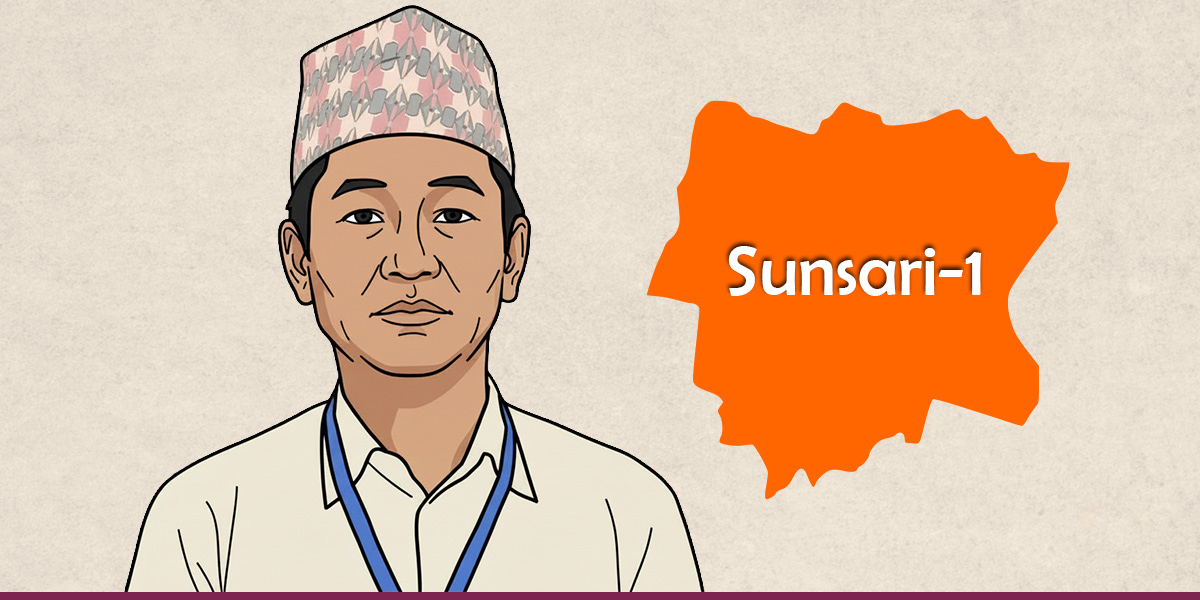
ITAHARI: A total of 26 candidates, including Harka Raj Rai aka Harka Sampang of Sharam Sanskriti Party (SSP), are in Sunsari-1 in the House of Representatives election scheduled for Thursday.
Harka, who was elected mayor of Dharan Sub-metropolitan City as an independent candidate, has entered the parliamentary race before completing his term. Observers say Harka is eroding his voter base due to sharp criticism of other parties
Among traditional parties, the CPN-UML has long had the strongest organization in this constituency. Of the four constituencies in Sunsari, Sunsari-1 is considered UML’s strongest base. UML, however, appears defensive in this election.
In the 2022 general election, Ashok Rai of the Janata Samajwadi Party (JSP) Nepal won the seat with UML’s backing. Although UML leader Manoj Kumar Menyangbo contested the election as an independent candidate and secured over 5,000 votes, UML managed to secure victory for JSP Nepal’s Rai. This time, however, UML is weak in the constituency, especially with Harka himself in the race.
Rastriya Swatantra Party (RSP) candidate Goma Tamang (Sarin), who narrowly lost to Rai in 2022, is running again. With RSP’s popularity rising nationwide and the influence of its prime ministerial candidate Balen Shah growing in Sunsari-1, Sarin is seen as a strong contender.
Another key challenger is Surya Bahadur Bhattarai (Manoj) from the Nepal Communist Party (NCP). Viewed as an alternative to both the RSP and SSP, he is becoming popular, particularly among Dharan’s business community.
Political analyst Prof Dr Rajendra Sharma says the campaign of traditional parties appears relatively slow, while new political forces look more aggressive in Sunsari-1. “While UML and Nepali Congress (NC) look defensive, Harka, Sarin, and Manoj are campaigning aggressively,” he said.
Sharma argues that if Harka tones down his criticism of others and corrects his weaknesses, he could perform well in the election. “RSP appears to be a leading force in discussions, while Manoj has emerged as a strong contender,” Sharma added.
UML has performed well in the constituency over the past few elections, while NC has dominated urban centers. This time, however, Manoj’s popularity within the business community has grown. Sharma believes the main contest is among the SSP, RSP, and NCP.
“The UML will remain competitive if it retains its core vote. But the situation is not as comfortable as before for the party. Current trends suggest RSP and NCP may be ahead of UML,” he added.
Unlike previous elections, when entire families voted for the same party, this time, votes are likely to be split within households. Returnee migrant workers are reportedly supporting newer forces. Likewise, there is no bulk vote among landless people, laborers, or farmers, which traditional parties could bank on this time.
Some analysts speculate that if traditional parties see no chance of winning, they may adopt strategic voting — possibly backing one new party to block another.
In the last election, RSP was the only alternative to traditional parties. This time, the rise of parties like the SSP and Ujyalo Nepal Party (UNP) could divide the alternative vote and affect RSP’s prospects.
Along with Rai, Sarin, and Manoj, Tikaram Limbu of CPN-UML, Sujendra Tamang of NC, Uddhav Shrestha of Rastriya Prajatantra Party (RPP), and Dambar Lawati of UNP, among others, are also in the race.
In 2022, Rai of JSP Nepal was elected from Sunsari-1 with 17,005 votes, while RSP’s Sarin secured 16,606 votes.
In the proportional representation vote that year, UML received 20,098 votes, while RSP received 17,271, NC got 11,750, and the then CPN (Maoist Centre) secured 4,656.
Sunsari-1 has 150,393 registered voters. The constituency covers all 20 wards of Dharan Sub-Metropolitan City, Wards 1–5 of Barahakshetra Municipality, and Wards 6 and 7 of Ramdhuni Municipality.