 Himal Press
  Representative image created by Grok
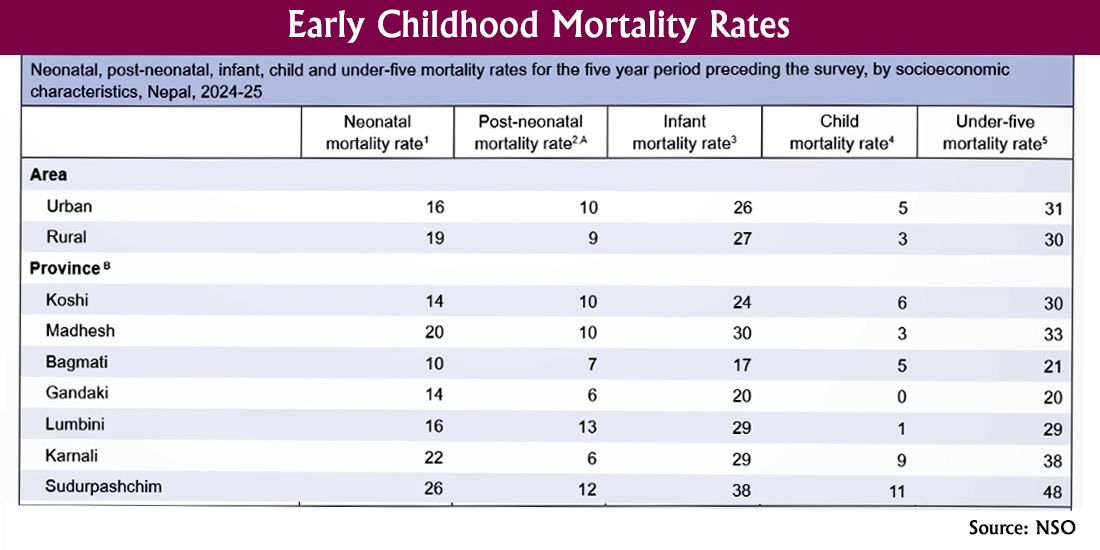
KATHMANDU: Sudurpaschim Province has the highest neonatal and child mortality rates in the country, according to a recent survey.
According to the Nepal Multiple Indicator Cluster Survey (NMICS) 2024–25, the child mortality rate in Sudurpashchim Province stands at 38 per 1,000 live births, and the under-five child mortality rate at 48 per 1,000 live births.
Bagmati has the lowest child mortality rate of 17 per 1,000 live births, while Gandaki has the lowest under-five child mortality rate of 20 per 1,000 live births.
The survey conducted by the National Statistics Office (NSO) provides a comprehensive picture of the status of women, children, and households across the country.
The NMICS 2024–25 is Nepal’s fourth such national survey and forms part of the seventh global round of the Multiple Indicator Cluster Survey, according to a statement issued by the NSO. The survey was conducted with technical and financial support from UNICEF.
According to the NSO, the survey aims to support planning, policy formulation, monitoring of development programs, tracking of Sustainable Development Goals (SDGs), and measurement of multidimensional poverty at the federal, provincial, and local levels.
Data were collected from 12,960 households selected from 540 clusters nationwide—304 urban and 236 rural. Similarly, information was gathered from women and men aged 15–49, children aged 5–17, and children under five. For the first time, data on mental health among adolescents aged 15–24 were also included in the survey.
According to the survey, about 96.7% of households have access to a reliable electricity source. Province-wise, Gandaki has the highest access of 99.5%, while Karnali (80.8%) has the lowest.
Similarly, 95.5% of households have telephone access (including mobile and fixed lines). Bagmati leads with 9.71% households having telephone access. Sudurpashchim has the lowest with 92.6%.
The study shows that four out of five surveyed households have internet access. As many as 81.6% of women in the 15-59 age group own a personal mobile phone. A total of 9.04% of men in this age group own a personal mobile phone.
The survey shows that early initiation of smoking before the age of 15 was reported by 7.6% of men and 2.1% of women.
According to the study, the total fertility rate is 1.9 births per woman in the 15-49 age group. About 85% of women who gave birth in the two years preceding the survey received at least four antenatal check-ups, while over 90% delivered at health facilities and with skilled birth attendants.
According to the survey, among children under five, 24.3% are underweight, and 31.5% are stunted, while 7.6% are wasted. Exclusive breastfeeding for the first six months was practiced by 69.7% of mothers. Similarly, full immunization coverage among children aged 12–23 months stands at 80.7%.
The proportion of out-of-school children is 4.5% at the primary level (grades 1–5), 3.6% at lower secondary (grades 6–8), and 13.2% at the secondary level (grades 9–12).