 AI-generated image
SURKHET: Children in the Raji community not only struggle to speak their mother tongue, Raji, but also face difficulty in understanding their elders. With declining usage among the younger generation and an absence from school curricula, the Raji language is facing a crisis of generational shift.
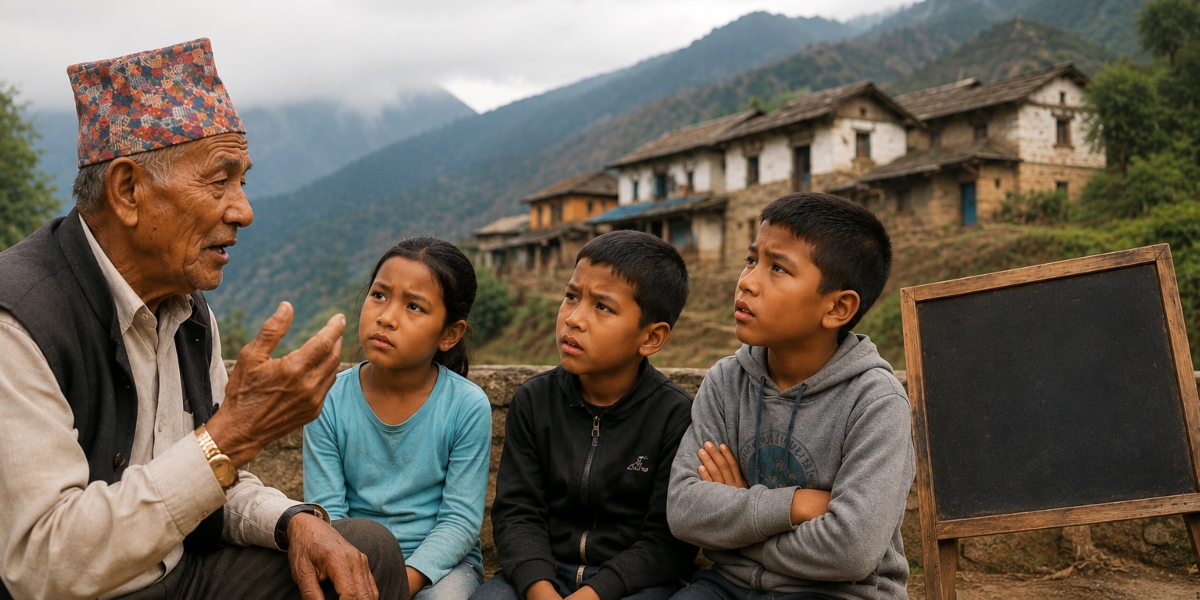
Man Bahadur Raji of Bheriganga Municipality-12, Surkhet, always tries to speak Raji with his children and grandchildren. However, they barely comprehend a few words. The language, rarely heard inside the home, has become alien to them.
”When we were young, everything at home, in the forests, and during gatherings was spoken in Raji,” he said. “Now, the number of speakers is declining. I fear the language will die with us.”
Although community-led language classes were run for the younger generation, he said the initiative did not achieve much success.
The local community ran language classes with the support of the Bheriganga Municipality in the last fiscal year. But children reverted to speaking Nepali outside the classroom. A lack of practice at home and in the community prevented the native tongue from taking root.
Man Bahadur’s concern is linked to the identity of the entire community. The endangered Raji indigenous group’s mother tongue is now facing an existential struggle. Despite the implementation of federalism aimed at linking local languages, culture, and knowledge with school education, Raji has not been able to find a place in local curricula. Under federalism, local governments have the authority to incorporate regional language, culture, history, skills and traditions into education to preserve local identity. However, for the Raji community in Karnali Province, this opportunity has yet to be realized.
Recognized by the government as an endangered indigenous group, the Raji people possess a distinct language, attire, rituals and culture. However, they lack a written script.
According to the 2021 census, the Raji population stands at 5,125-2,483 males and 2,642 females. Nearly half of the population resides in Kailali, while Surkhet and Bardiya account for roughly 21% and 11%, respectively.
Ganga Bahadur Raji, also from Bheriganga-12, attributed the decline primarily to fading usage among the young. “Children only speak Nepali now. How can it survive if it isn’t spoken at home?” he asked. “Local government initiatives also lack effective, long-term strategies.
Ganga Bahadur believes that including Raji language and culture in the local curriculum would enable children to learn about their community’s history, language and identity.
“Once the language is taught in schools, children will learn it, and once they learn it, the language can gradually survive,” he said. “At present, the responsibility of preserving the language rests solely on the shoulders of the elderly, and that is not enough.”
According to the 2021 census, the Raji population stands at 5,125-2,483 males and 2,642 females. Nearly half of the population resides in Kailali, while Surkhet and Bardiya account for roughly 21% and 11%, respectively. The Raji population is divided into three clans: Naukalya, Bahrabandali, and Sutur Pande. All share the same mother tongue, a Tibeto-Burman language in the Raji-Raute group of the Sino-Tibetan family.
The 2021 census recorded 4,876 Raji speakers—representing 82.1% of the ethnic population. The Raji people are historically nomadic. Although they have transitioned to settled life, their linguistic footprint is shrinking gradually.
Realizing that intercaste marriages have posed serious challenges to the preservation of the Raji language and culture, the community has been making efforts to organize marriages within the community, as well as the preservation of their language, traditional attire and cultural practices. Although they have also been conducting awareness campaigns and cultural preservation activities through the Raji Salm Society, these efforts have not been sufficient, according to Ashok Raji, general secretary of the Raji Salm Society.
The international linguistic organization, Ethnologue, has listed Raji as an “endangered” language due to weak intergenerational transmission and absence from school instruction.
A decade-old study in a Raji settlement in Thauri of Surkhet found that out of 45 people across 12 households, only 18 individuals—all over age 40—could speak Raji fluently. The study found that although the younger generation understood a few words, they were found to be unable to speak the language.
“Only our surnames remain Raji; we have lost everything else,” lamented Birkha Lal Raji, a member of the Raji community.
Man Bahadur Raji, who can still sing traditional songs and recount folklore in his mother tongue, fears the language will die by the time of his grandchildren. “We are old now. Who will speak the language after us?” he asked.
Absence from Local Curricula
Although local governments have designed customized curricula under the federal system, even local governments with a substantial Raji population have not included the language in their local curricula. Birendranagar Municipality has prepared a local curriculum, but it has nothing related to the Raji language.
“We organize one or two programs for the Raji community every fiscal year, but nothing has been done yet to include the community’s language in the local curricula,” said Tanka Prakash Lamichhane, the information officer for Birendranagar Municipality.
Bheriganga Municipality has prepared local curricula for Grades 1 through 5. But here also the curricula lack dedicated chapters for the conservation and study of Raji language.
Gajendra Kumar GC, head of the Education, Youth, and Sports branch at the municipality, said they were facing difficulty due to the community’s small population. “Including only the Raji language in the curriculum might lead to demands from other communities,” he said. “Although there is some information about the community, there are no dedicated chapters for the Raji language. Maybe we can add something while revising the curricula.”
Ashok Raji of Raji Salm Society criticized all levels of government for failing to conduct comprehensive studies on the community’s realities.
“The Raji community is one of the marginalized and minority indigenous groups. There is not enough content about our language and community in the local curriculum. This is a result of the failure to reach the community and of the way our community is perceived,” he said. “Merely holding basic interactions won’t save a language.”
He demanded targeted budget allocations for dictionaries, teaching materials and school programs.
Although the Language Commission has prepared a Raji grammar reference book, practical implementation remains non-existent. “The grammar exists in books, but not in schools,” Ashok Raji said. “If children cannot read it, how will the language survive?”
Man Bahadur Raji, who can still sing traditional songs and recount folklore in his mother tongue, fears the language will die by the time of his grandchildren.
“We are old now. Who will speak the language after us?” he asked.