 Himal Press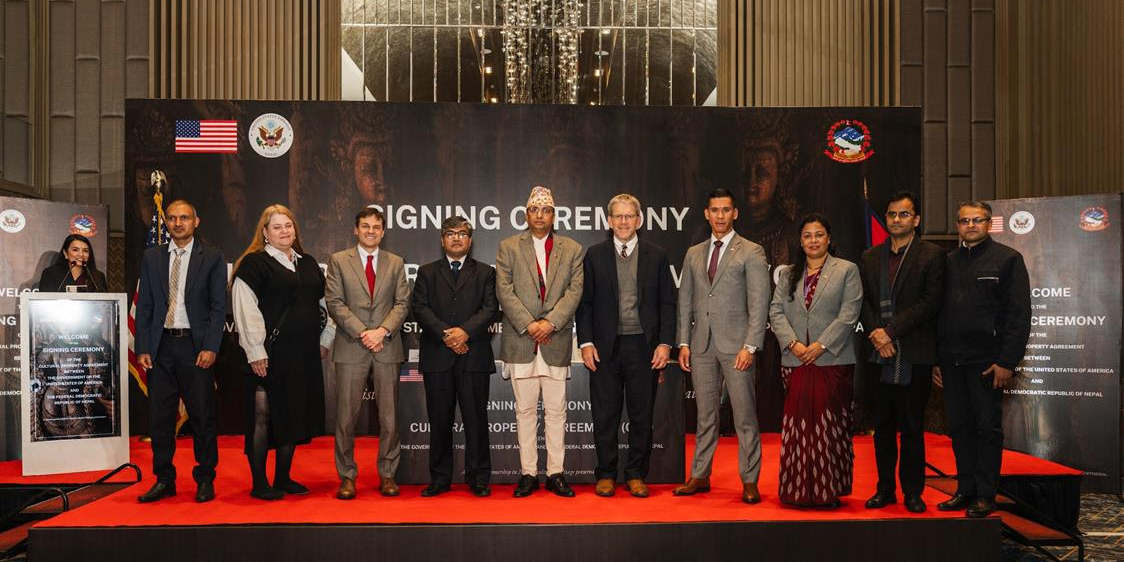
KATHMANDU: Nepal and the United States have signed a bilateral Cultural Property Agreement (CPA) aimed at safeguarding Nepal’s cultural heritage and preventing the illicit trafficking of artifacts.
Joint Secretary at the Ministry of Culture, Tourism and Civil Aviation Dr Suresh Suras Shrestha, and U.S. Ambassador to Nepal Dean R. Thompson signed the agreement at a ceremony in Kathmandu on Thursday.
Under the agreement, the U.S. will, in line with its domestic legislation, restrict the import of certain archaeological and ethnological materials from Nepal unless they are accompanied by a valid export certificate issued by the Government of Nepal. The agreement covers archaeological materials dating from the Paleolithic period, around 32,000 BCE, through 1770 CE, and ethnological materials from the 13th century to 1950 CE. These include religious architectural elements, ceremonial objects, and manuscripts listed in a designated inventory to be published by the U.S. government.
The CPA aims to strengthen bilateral cooperation in curbing looting and illegal trade in cultural artifacts to help ensure that Nepal’s cultural heritage is preserved for future generations.
Speaking at the signing ceremony, Ambassador Thompson said the agreement reflects the respect of the U.S. government for Nepal’s cultural heritage. “The CPA underscores the deep respect the United States holds for Nepal’s cultural heritage. It strengthens cooperation to prevent illicit trafficking, supports lawful cultural exchange, and reinforces our shared responsibility to protect Nepal’s cultural heritage for future generations,” he said.
Also speaking on the occasion, Secretary at the Ministry of Culture, Tourism, and Civil Aviation Mukunda Prasad Niroula thanked the U.S. government for its continued partnership. He said the agreement builds on more than two decades of cooperation through the U.S. Ambassadors Fund for Cultural Preservation and reflects a shared commitment to protecting Nepal’s cultural heritage and preventing illicit trafficking.
According to the U.S. Embassy, the agreement will also facilitate collaboration with American institutions, universities, and researchers, while supporting Nepal’s cultural tourism sector by ensuring that historic and sacred artifacts remain in their original context.
The CPA with Nepal builds on longstanding U.S. support for cultural preservation in the country, including assistance for 28 projects under the Ambassadors Fund for Cultural Preservation over the past two decades, ranging from the restoration of historic monuments and manuscripts to the establishment of Nepal’s first modern conservation laboratory in Lumbini.