 Himal Press
KATHMANDU: Nepal has drawn the international community’s attention to the growing climate crisis in the Himalayas and the cross-border risks it poses by organizing a high-level regional dialogue in Bangkok, the capital of Thailand.
The dialogue brought together ministers, diplomats, scientists and disaster management experts from across the Asia-Pacific region to discuss climate-induced disasters in the Himalayas and their wider regional impacts.
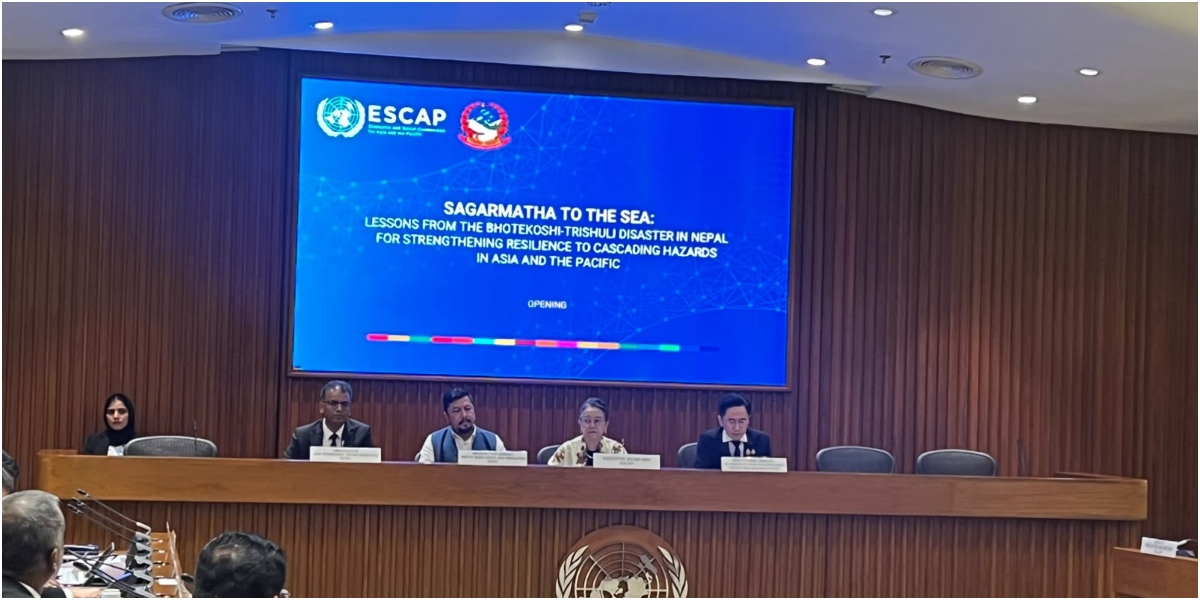
The government organized the dialogue on Thursday on the sidelines of the fifth United Nations Economic and Social Commission for Asia and the Pacific (UNESCAP) Ministerial Conference.
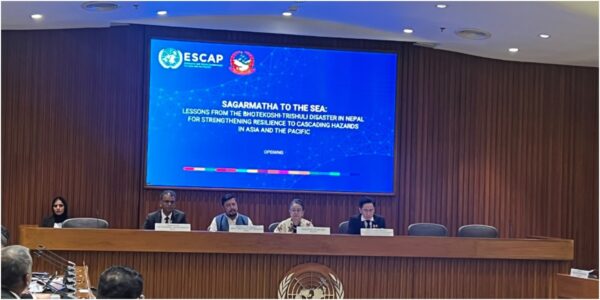
Titled “From Sagarmatha to the Sea: Lessons from Nepal’s Bhotekoshi-Trishuli Disaster for Strengthening Resilience to Cascading Hazards in Asia and the Pacific,” the event was held at the United Nations Conference Centre in Bangkok in collaboration with UNESCAP.
During the discussion, participants deliberated on the growing threat of disasters in the Himalayan region due to global warming and climate change, as well as their implications for countries across the region.
A massive landslide in Nepal’s high Himalayan region on August 26 triggered a series of disasters along the Bhotekoshi-Trishuli river corridor. The event caused extensive damage to hydropower projects, road infrastructure, cross-border facilities and community livelihoods.
Scientists have warned that such disasters are not confined to individual countries, particularly as efforts to limit global warming to 1.5 degrees Celsius face growing challenges. They highlighted the cascading risks extending from upstream Himalayan areas to downstream regions and communities across national borders, underscoring the need for regional cooperation.
Addressing the opening session, Minister for Energy, Water Resources and Irrigation, Biraj Bhakta Shrestha, said the Bhotekoshi-Trishuli disaster was a warning not only for Nepal but for the entire Asia-Pacific region. He stressed the need for international cooperation, the use of satellite and digital technologies, and the mobilization of adequate financial resources to address risks in the Himalayas.
Nepali Ambassador to Thailand Dhan Bahadur Oli and UNESCAP Executive Secretary Armida Alisjahbana emphasized the importance of regional data sharing and integrated early warning systems to protect interconnected ecosystems stretching from the mountains to the sea.
The dialogue focused on three key areas to strengthen disaster resilience. The first was conducting detailed assessments of interconnected risks arising from climate, cryospheric and geological changes. The second was ensuring the timely exchange of emergency data, hydrological measurements and risk information among neighboring countries during crises. The third was improving early warning systems through space technology, satellite-based mapping, artificial intelligence (AI) and youth-focused technological solutions.
Ministers and representatives from Thailand, Bhutan, Fiji, Samoa, Sri Lanka and Kyrgyzstan participated in the dialogue. Representatives of China’s National Development and Reform Commission, the Indian Space Research Organisation, the World Meteorological Organization, the International Centre for Integrated Mountain Development (ICIMOD) and the Asian Development Bank, among other institutions, stressed the need for a common regional action plan to strengthen resilience in the Himalayan region.
The government expects the dialogue to support its reconstruction and recovery efforts while contributing to policy guidance and the development of shared strategies for other countries in the Asia-Pacific region.