 Himal Press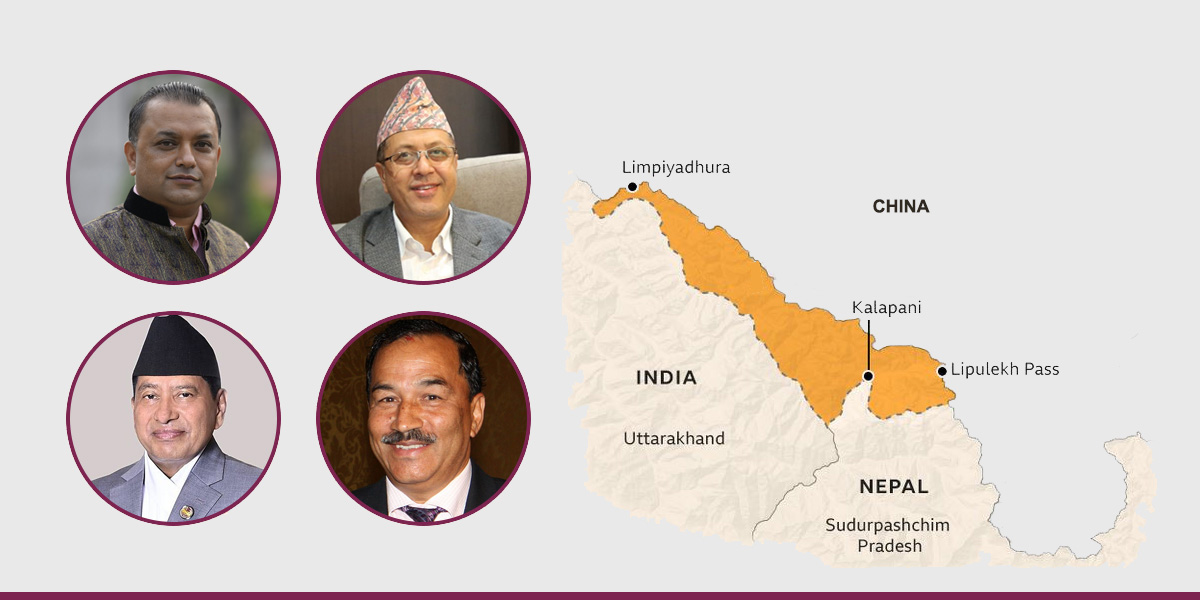
KATHMANDU: Major political parties have taken a common stance against the recent India-China agreement to conduct cross-border trade through Lipulekh Pass, which is claimed by Nepal as its territory.
Lawmakers from both ruling and opposition parties drew the government’s attention during the meeting of the House of Representatives on Thursday. They warned that Nepal must not allow trade between India and China through the disputed areas.
Responding to the agreement, the foreign ministry said on Thursday that Nepal’s position is clear, as its official map, which is already incorporated into the Constitution, includes the areas east of the Mahakali River as part of Nepal. “Nepal has already conveyed to its friendly neighbor China that the area falls within Nepali territory,” Foreign Ministry spokesperson Lok Bahadur Chhetri said in a statement.
While India has reacted sharply to Nepal’s statement, Beijing has remained silent.
Despite differences on other political issues, parties are united on Lipulekh. Lawmakers have suggested summoning the Indian and Chinese ambassadors to clarify the situation.
Nepali Congress (NC) General Secretary Gagan Thapa said India and China had ignored Nepal by reaching the agreement. Calling the agreement “objectionable and unacceptable”, he said all parties must act together. “We should not let this issue become a matter of domestic politics,” Thapa said. “Yesterday we stood together, today too we must stand together.”
CPN-UML chief whip Mahesh Bartaula reiterated that Lipulek is an integral part of Nepal, and said his party strongly opposes any agreement between India and China to use the territory without Nepal’s consent.
CPN (Maoist Centre) Chief Whip Hit Raj Pandey said the agreement between the two neighbors had hurt Mother Nepal and called for stronger government action.
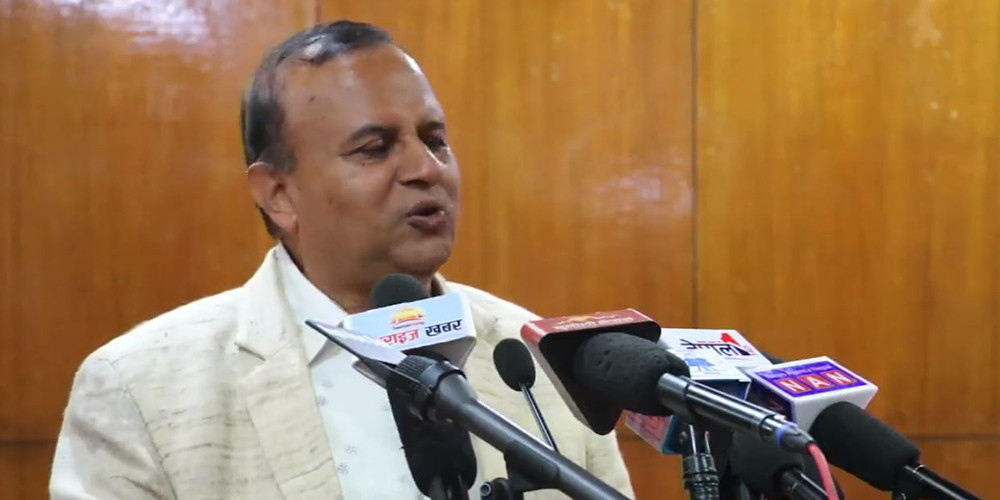
Senior Maoist Center leader and a former foreign minister, Narayan Kaji Shrestha, accused India and China of undermining Nepal’s sovereignty.
He said India had previously agreed to resolve the issue through discussions under a secretary-level bilateral mechanism, but is now making unilateral decisions. He said Nepal had sent a diplomatic note when the two countries reached a similar agreement in 2015. “At that time, Nepal had expressed its disagreement and objection, and sent a diplomatic note to both countries asking them to correct the matter,” Shrestha wrote in a social media post. “Yet now, India and China have repeated the same mistake, disregarding the concerns of a neighboring friendly country, and have caused serious damage to Nepal’s sovereignty, dignity and the feelings of the Nepali people.”
He said Nepal should strongly raise the matter during Prime Minister KP Sharma Oli’s upcoming visits to China and India.
Similarly, Rajan Bhattarai, UML Standing Committee member and former head of the party’s foreign affairs department, wrote in a social media post on Thursday that any agreement or understanding regarding Nepal’s territory made without Nepal’s consent cannot be accepted by Nepal.
Bhattarai was a member of the Nepal-India Eminent Persons Group (EPG), which was formed to find a solution to all issues between the two countries, including the border. However, India has refused to receive the EPG’s report.
Similarly, former foreign minister and Rastriya Prajatantra Party (RPP) Nepal Chairperson Kamal Thapa urged the government to strongly raise the issue with both China and India. “Under the 1816 Sugauli Treaty, all land east of the Mahakali River belongs to Nepal. Despite this, India has forcefully occupied Kalapani, Limpiyadhura and Lipulekh,” he wrote in a social media post.
Lipulekh is located in northwestern Nepal. It is the point where the borders of India, Nepal and China meet. While India considers this area part of its Uttarakhand State, Nepal has claimed it as its own territory.
The issue first emerged in 2015 when China and India signed an agreement to conduct bilateral trade through the Lipulekh Pass. Nepal quickly expressed objection to the agreement and sent diplomatic notes to both countries, asserting its claim to the area.
India later published a new political map in 2019 after the split of the Jammu and Kashmir state into two union territories. India included these areas claimed by Nepal in its new map.
Nepal swiftly requested that India correct the map. After its request went unheeded, Nepal published a new map in May 2020, including these territories. The country even amended the Constitution to incorporate the new map.