
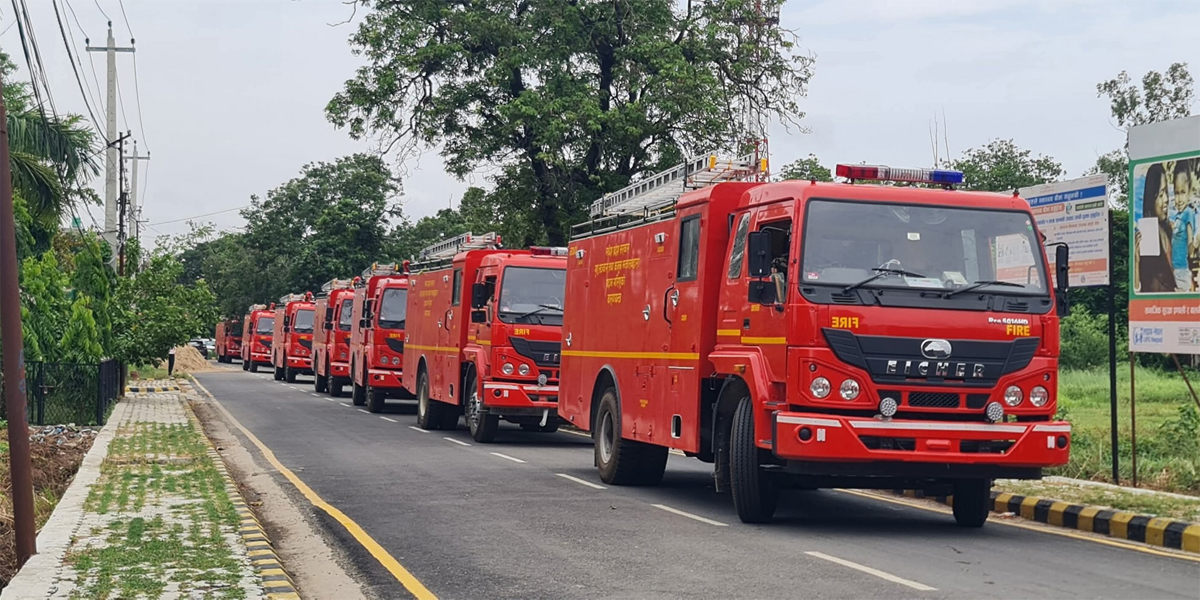
 Fire engines deployed to distribute drinking water in Parsa.
KATHMANDU: A drought during the peak monsoon season has disrupted daily life in Madhesh Province. With no rainfall in Nepal’s food basket, paddy transplantation has stalled, and there is a severe shortage of drinking water.
According to data published by the Department of Agriculture earlier this week, transplantation has been completed in only 33.78% of paddy fields in the province.
Paddy farming is done in 372,545 hectares in the province. However, transplantation has been done in only 125,888 hectares so far due to a lack of rainfall. By this time last year, transplantation had been transplanted in 61.5% of the paddy fields.
With water sources dried up due to the drought, drinking water is being supplied in some areas of the province using tankers and fire engines.
Jay Kumar Raut, an undersecretary at the Office of the Chief Minister, Madhesh Province Government, said they have been getting requests for water delivery from all districts of the province. “We have handed fire engines to the army. The army is now distributing drinking water in several districts using these fire engines and tankers,” Raut said. “Bara and Parsa have seen no rainfall at all this monsoon. As a result, tube wells have dried up and paddy transplantation has not been possible.”
The Department of Hydrology and Meteorology has forecast above-average rainfall this year, predicting that around 2 million people could be affected. However, most areas in Madhesh are experiencing drought.
Meteorologist Pratibha Manandhar said rainfall has been scarce in Madhesh and eastern Nepal. She added that the eastern parts of Koshi, Gandaki, and Lumbini Provinces have also seen below-expected rainfall.
“The Tarai is under drought conditions. There is no immediate sign of rainfall,” she said.
Nepal typically receives an average of 1,500 millimeters of rainfall during the monsoon. This year, the forecast was for above-average rainfall, around 1,800 mm. Bit as of mid-July, the rains have yet to arrive in many places.
This year, monsoon activity is stronger in the hills and mountains. Meteorologist Manandhar said that rain-inducing systems are not very active. “The monsoon cycle over Nepal is weak. That is why the Tarai has received less rainfall,” she explained. “The rainfall has been very light and confined to limited areas in Madhesh.”
Climatologist Dr Dharma Raj Upreti said the southern Madhesh region of Nepal and northern Bihar in India typically remain under high pressure (involving temperature and humidity differentials). “In such high-pressure conditions, hot air rises and moves north, west or south. This year, due to intense heat in the Tarai, the hot air created a vacuum effect and rose higher, resulting in rainfall mainly over the Chure hills and Bihar,” said Upreti.
He also said the misalignment between sea surface temperatures and neutral Indian Ocean temperatures, along with El Niño effects, has prevented rainfall in Madhesh. “High-pressure zones over the Tarai are obstructing rainfall. The rain is instead occurring farther north,” Upreti added.
Upreti said there is little chance of Madhesh receiving significant rainfall for a few more days. “However, there may be moderate rain in eastern Nepal on Sunday night and heavy rainfall in the western region on Monday,” he added.
Meteorologists and climate scientists say the monsoon pattern is shifting. As a result, the instruments and models used to measure and predict monsoon activity are proving less accurate.
Watershed expert Madhukar Upadhyay said the drought has brought disaster in the Madhesh Province. He, however, added that the state is not treating it with the seriousness it deserves. In his view, the government distributes relief only after a disaster strikes, but fails to investigate its causes.
“We are indecisive about everything. Floods are quickly declared disasters, but this drought has caused chaos in Madhesh. Should we call it a disaster or not?” he asks.