
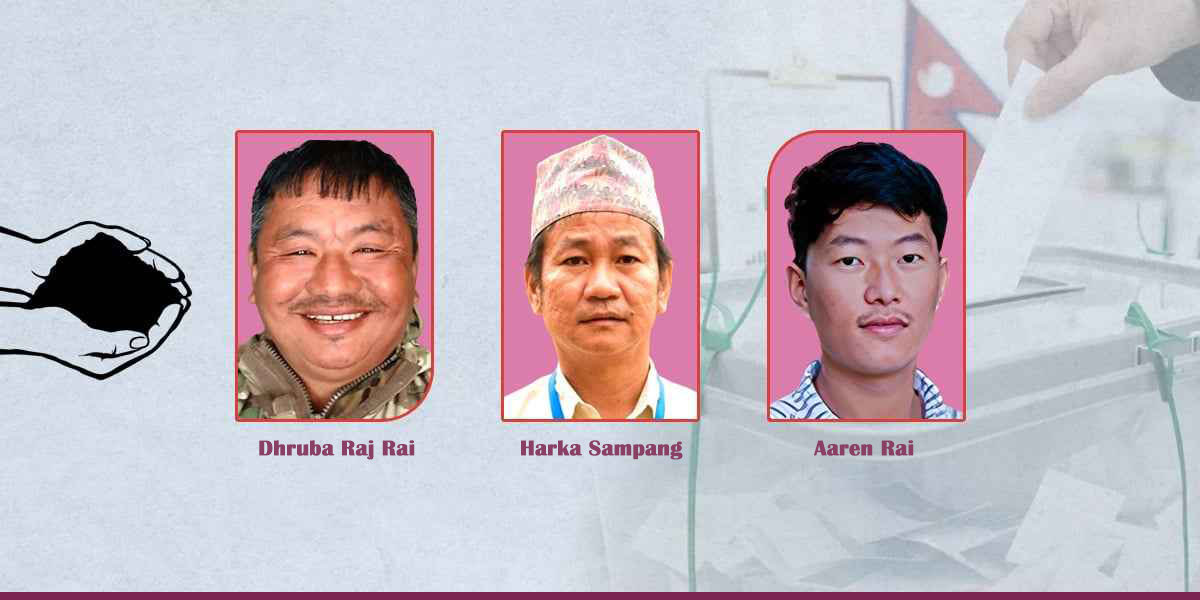
KATHMANDU: The results of the House of Representatives election have revealed a new political equation in the hill districts of Koshi Province, where the Shram Sanskriti Party (SSP), led by Dharan Sub-metropolitan City’s outgoing mayor Harka Sampang, has made an unexpected breakthrough.
The party, formed just three months before the elections, secured three seats under the first-past-the-post (FPTP) system. While the Rastriya Swatantra Party (RSP) has seen a nationwide surge, the Shram Sanskriti Party expanded its influence in the eastern hills by breaking the traditional strongholds of major parties.
The party has also crossed the electoral threshold under the proportional representation (PR) system, making it eligible for at least four more seats. Out of 10.54 million votes counted as of 6 pm on Tuesday, SSP has received 369,413 votes.
While voter support has largely consolidated around the RSP across the country, pushing parties such as the Nepali Congress (NC), CPN-UML, and the Nepali Communist Party (NCP) behind in many constituencies, the SSP has carved out its own base in the eastern hills.
SSP General Secretary Aaren Rai won the election in Khotang—a constituency long dominated by the NC and the UML.
In Bhojpur, which has long been considered a communist stronghold, Dhruva Raj Rai of the SSP defeated UML secretary and former Koshi Chief Minister Sherdhan Rai. Dhruva Raj, a long-time supporter of Sherdhan, had joined Sampang’s party only shortly before the election.
Sampang himself was elected from Sunsari-1. The SSP Chairperson, who secured 34,062 votes, defeated the RSP’s Goma Tamang. Tamang received 23,425 votes.
How far has Sampang’s influence spread?
SSP leaders say Sampang has been the driving force behind the party’s rise. According to SSP General Secretary Rai, Sampang remains the party’s central figure. “It would not have been possible without him. He is our senior leader,” Rai said.
Sampang had worked as a civic activist for years before entering politics. A resident of Dharan, he frequently spoke out against irregularities in the sub-metropolis. Sampang contested the mayoral election in Dharan as an independent candidate in the by-election held after Dharan mayor Tara Subba’s demise in 2019. He secured just 540 votes.
Undeterred by the result, he declared he would contest again and began building his political base. He intensified campaigns focusing on Dharan’s chronic drinking water shortage and led protests demanding solutions to various civic problems. During demonstrations outside the municipal office, he would challenge elected representatives, asking them to explain why water shortages persisted and why corruption had increased. At times, he was removed by police or detained during protests.
In the 2022 local elections, Sampang again ran as an independent candidate for mayor of Dharan and won with 20,821 votes. After becoming mayor, he encouraged Dharan locals to contribute labor at least once a week to address the town’s drinking water shortage.
According to General Secretary Rai, the party’s credibility comes from delivering on issues others merely talk about. “We believe in our work. People trusted us because we remained committed to our agenda,” he said.
The SSP has also secured significant proportional votes in the eastern hilly districts. It ranked first in Sunsari, Panchthar, and Khotang, and second in Jhapa-1 and Udayapur.
Its candidates also mounted strong challenges in several constituencies, including Panchthar, Ilam, and Udayapur.
Reasons behind Sampang’s growing influence
For years, identity-based political groups advocating the Limbuwan and Khambuwan movements have been active in the eastern hills. However, their influence had weakened in recent years.
Writer Rajan Mukarung says divisions among identity-based forces created a leadership vacuum in the region. “Those who claimed to represent identity politics themselves split and failed to earn the people’s trust,” Mukarung said.
Parties representing indigenous communities once commanded considerable support. However, larger national parties gradually absorbed that base. In the Koshi Provincial Assembly, the Janata Samajbadi Party (JSP) currently has only one member. Internal divisions have further weakened the party.
Writer Rajan Mukarung says divisions among identity-based forces created a leadership vacuum in the region. “Those who claimed to represent identity politics themselves split and failed to earn the people’s trust,” Mukarung said.
According to Mukarung, the Rai community in Koshi Province has historically rallied behind influential leaders from within the community. At different times, figures such as Gopal Kirati and Ashok Rai were regarded as key leaders. “But many of them eventually joined mainstream parties, creating a leadership crisis,” he said. “Now Harka Sampang has emerged, and a large section of people has begun to see him as their leader.”
Mukarung adds that Sampang’s popularity is not based solely on ethnic identity but also on his connection with ordinary workers and grassroots communities. “Koshi has long been a region shaped by the communist movement and its political schooling,” Mukarung said. “But many leaders who emerged from that movement drifted away from the grassroots. Harka Sampang remains close to the people.”
Recent movements such as the “No Cable Car” protest in Pathibhara of Taplejung and the “No Koshi” movement also weakened the positions of the NC and UML. In the Pathibhara case, NC and UML leaders supported the construction of a cable car project, which faced strong opposition from local activists.
Similarly, protests demanding that Koshi Province be renamed on the basis of identity also reshaped political sentiment in the eastern hills.
“These movements did not produce effective leadership, and that also contributed to the votes going to Sampang,” Mukarung said.
Can Sampang’s influence expand further?
Although Sampang formed the SSP only three months ago, its leaders claim the party could become a major political force in the next elections.
“We do not practise city-centred politics like other parties. We practise people-centred politics. If the public trusts us, nothing can stop us from becoming a major force,” General Secretary Rai said.
Mukarung believes the rise of Sampang also reflects the fragmentation of identity-based political leaders. He suggested that figures such as Sudan Kirati and Mahendra Lawati may need to unite if the identity-based political movement is to regain momentum.
Identity-based leaders remain divided
Leaders such as Kumar Lingden and Sanjuhang Palung have long been associated with identity politics in eastern Nepal. However, their organisations have frequently split or merged.
Similarly, leaders, including Khagendra Makhim, are now facing a political survival crisis.
Some identity-based leaders remain scattered across different parties. Ashok Rai is with the JSP, while Rakam Chemjong is associated with Janata Samajbadi Party Nepal, Gopal Kirati with the Nepali Communist Party, and Sudan Kirati with the Progressive Democratic Party.
According to Mukarung, the identity-based movement will gain momentum only if such leaders become united.