
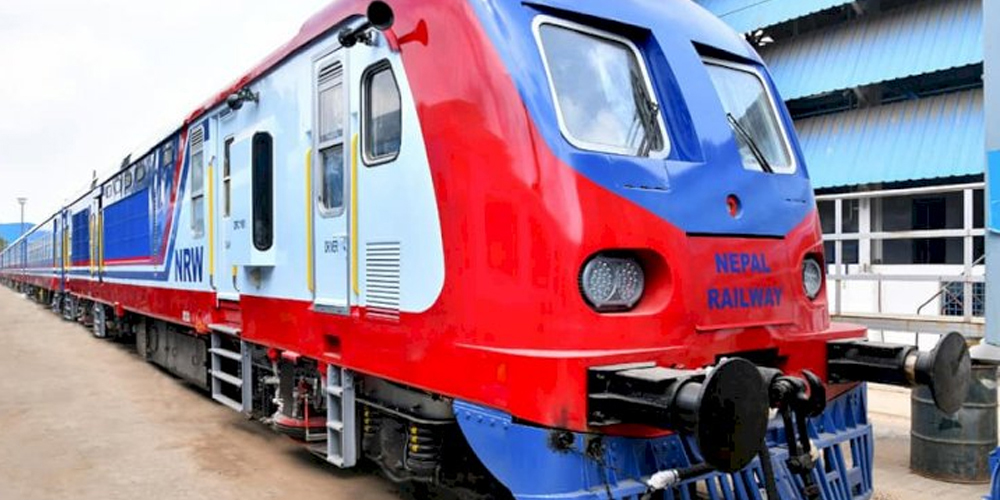
JANAKPURDHAM: The Jaynagar–Janakpur–Bijalpura railway service, launched with much fanfare four years ago, has now fallen into a state of disarray due to government neglect and weak management.
The Nepal Railway Company Limited formally launched the service in March 2022 after a long wait. However, even before completing four years of operation, the railway management has become completely chaotic. Although the company is spending tens of millions of rupees on staff salaries, a lack of permanent staff has pushed railway operations into disorder. Most of the railway staff are hired on a daily wage basis.
Lack of Leadership
The company has been without a managing director and a chief administrative officer since August. The post of managing director has remained vacant since Niranjan Jha completed his term. For a long time, an officiating chief administrative officer was at the helm of the company. Now, even the position of the chief administrative officer is vacant.
Tula Bahadur Dangi, the officiating chief administrative officer, has tendered his resignation. Even though his resignation has not been approved, he has stopped coming to the office. This has left the company with only two assistant-level officers – Kewal Bahadur Nepali and Uttim Lal Pandit – as permanent staff.
Although the company published a notice to appoint a managing director some two months ago, the process is stalled as the company’s Board of Directors has not been able to convene a meeting.
Three candidates, including the former managing director, have applied for the post.
The Ministry of Physical Infrastructure and Transport has delegated the authority of the company to Hari Kumar Pokharel, the director general of the Department of Railways. However, employees say that they need to carry files to the capital for routine administrative and financial decisions since Pokharel is stationed in Kathmandu.
Employees say that the leadership vacuum has forced them to travel to Kathmandu even for basic tasks.
“From paying staff salaries to buying a simple ballpoint pen, files have to be taken to Kathmandu. The company does not even have its own accountant. Work is overseen by an accountant deputed from the Financial Comptroller General Office and by wage-based accounting assistants who have no authority,” an employee told Himal Press on condition of anonymity.
Expenses Exceed Income
According to Nepal Railway Company’s business plan for the current fiscal year, the company earned Rs 192.1 million between fiscal years 2019/20 and 2023/24, while expenditures during the period reached Rs 673.7 million. Over five fiscal years, the railway has incurred a total loss of Rs 481.4 million.
In fiscal year 2021/22 alone, the loss stood at Rs 84.6 million. During the fiscal year, the company earned Rs 25.4 million while expenditures stood at Rs 110 million. The company logged losses of Rs 196.1 million and Rs 177.6 million in fiscal years 2022/23 and 2023/24, respectively.
Monthly Payroll of Rs 10 million
The company spends about Rs 10 million every month on staff salaries alone. A total of 23 Indian personnel have also been hired for railway operations. According to the company, salaries for Indian staff alone amount to Rs 9.4 million per month, while Rs 3 to 3.2 million is spent on 144 wage-based employees.
“We are made to work from 7 am to 9 pm, but are paid only between Rs 515 and Rs 1,100. Even engineers who work in 14-hour shifts receive just Rs 1,100,” one daily-wage employee said.
Nepali daily-wage workers say Indian staff, who come to work only occasionally, except for locomotive pilots, earn up to Rs 150,000 per month.
Nepal Railway has entered into an agreement with India’s Konkan Railway Corporation to operate services and develop skilled manpower until 2026. Indian personnel were brought in to train Nepali staff. However, as the company has not hired permanent staff, training aimed at producing skilled local manpower has yet to gain momentum.
The full implementation of the business plan could generate Rs 337.2 million in revenue in the first year itself, turning the company profitable. However, plans related to cost reduction, human resource development, scientific fare structures, and asset and infrastructure management have largely remained on paper.
Railway services are operating along a 52-kilometer stretch from Jaynagar in India to Bijalpura in Mahottari at present. Trains run on the route three times a day.
The long-term plan is to extend the service up to Baridbas, where the railway line meets the proposed East-West Railway.