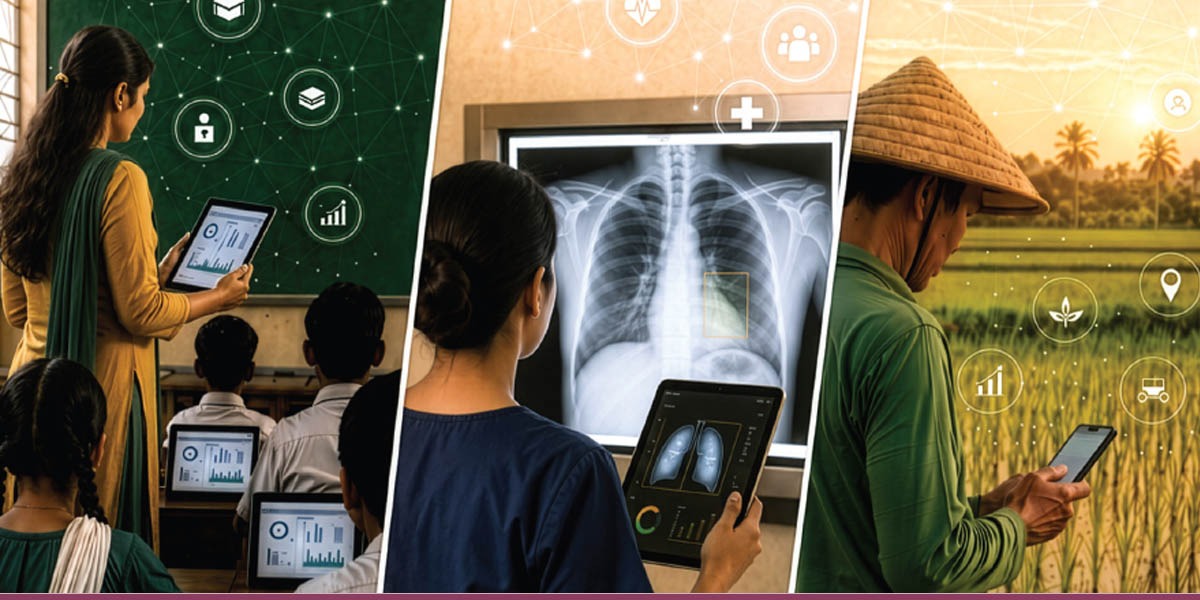

Artificial Intelligence (AI) is ushering in a new era in healthcare. It is transforming how medical services are delivered, improving clinical outcomes and enhancing patient experiences. From disease prediction and medical image analysis to intelligent monitoring systems and personalized treatment planning, AI is enhancing clinical decision-making, improving operational efficiency and driving innovation in medical technology.
Healthcare is one of the most demanding applications of AI because decisions can directly affect patient safety, treatment outcomes and quality of life. As a result, AI systems in healthcare require exceptionally high levels of accuracy, reliability, precision and regulatory compliance. The integration of AI into healthcare, therefore, demands not only advanced technical capabilities but also a deep understanding of medicine, ethics and patient care. As someone who has worked across clinical engineering, medical device development, healthcare technology management, software engineering and AI research, I have observed these advancements firsthand through direct involvement in clinical, technological and AI-driven research environments. I believe that the future of healthcare lies in the convergence of biomedical engineering and artificial intelligence.
The diverse professional journey of working in hospitals, medical device industries, research laboratories and academic institutions has provided me with a unique perspective on how engineering principles can be applied to solve healthcare challenges and how AI is increasingly becoming an integral component of modern medical technologies.
Traditional biomedical engineering has long relied on mathematical modeling and engineering analysis to understand physiological processes and support diagnosis and treatment. AI, however, has introduced a new paradigm by enabling machines to learn from large volumes of data, identify complex patterns and generate predictive insights that complement conventional engineering approaches.
The rapid advancement of AI is also reshaping the healthcare workforce. While AI is unlikely to replace doctors or nurses in the near future, it is already automating many routine and data-intensive tasks. This has created demand for new technical expertise.
For example, Microsoft’s Dragon Copilot utilizes ambient AI to listen to patient-clinician conversations and automatically generate clinical documentation. This has helped reduce documentation time by up to 50%. AI-powered diagnostic and imaging systems are also transforming medical decision-making. Google DeepMind, for example, has developed an AI system that can analyze retinal scans and detect more than 50 eye diseases with expert-level accuracy.
Similarly, AI-assisted radiology platforms can automatically identify and prioritize critical findings in CT and MRI scans, reducing specialist notification times from around 66 minutes to as little as six minutes. In pathology, AI platforms have received regulatory approval for prostate cancer detection. This has improved both efficiency and diagnostic accuracy.
The impact of AI also extends to drug discovery, with some platforms advancing candidates to clinical trials within months. Wearable technologies, such as smartwatch ECG features, have received regulatory clearance for atrial fibrillation detection. In operating theaters, AI enhances robotic systems and ultrasound imaging, while prosthetic and rehabilitation technologies are becoming smarter with AI-enabled real-time adaptation.
Emerging neurotechnologies are pushing boundaries even further. In 2024, Neuralink’s N1 implant enabled a paralyzed individual to control a computer cursor using neural signals. Meanwhile, similar brain-computer interface (BCI) systems in China are entering clinical trials and approvals, enabling severely impaired individuals to operate computers and assistive devices.
This curiosity led this scribe to pursue doctoral research focused on AI-driven healthcare technologies beginning in 2023. The PhD research involved advanced machine learning, deep learning, signal processing, medical imaging applications and human–machine interaction (HMI), including techniques such as the Short-Time Fourier Transform (STFT).
My involvement in biomedical engineering began long before my PhD. After completing my bachelor’s degree, I worked as a clinical engineering intern at a regional hospital in Louisiana, USA. Following my master’s degree, I joined a medical device manufacturing company in Houston, Texas, as a research and development engineer, where I got exposure to medical device design, validation and commercialization. I later collaborated with a nephrologist on vascular access monitoring projects for dialysis patients. Our work was presented at the American Society of Nephrology (ASN) Kidney Week conference in 2016. I have also worked as a remote software developer for a UK-based company, contributing to ultrasound-based blood flow monitoring projects. Likewise, I have supervised medical equipment repair and maintenance at Nepal Medical College Teaching Hospital while serving as a part-time faculty member at the College of Biomedical Engineering and Applied Sciences (CBEAS).
Research has remained central to my career. I have published journal articles and conference papers on physiological modeling, blood flow analysis and healthcare technologies. My professional experience has extended across the complete lifecycle of medical technologies from mathematical modeling and algorithm development to hardware implementation, software integration, product deployment, and technical support.
These experiences have reinforced my belief that biomedical engineering is one of the most important interdisciplinary fields in healthcare. It applies engineering principles to medicine, biology and physiology to improve patient care and develop innovative healthcare solutions. As healthcare becomes increasingly dependent on advanced technologies, biomedical engineers play a vital role in ensuring the safety, reliability, and effectiveness of these systems, particularly as they integrate with AI.
At the same time, AI opens opportunities beyond healthcare. Graduates trained in AI possess skills in machine learning, data science, computer vision, natural language processing, robotics and intelligent systems—skills that are in high demand across industries including healthcare technology, software development, finance, telecommunications, manufacturing, cybersecurity, agriculture, education technology, and research and development.
As organizations worldwide adopt AI-driven solutions, graduates can pursue careers as AI engineers, machine learning specialists, data scientists, AI researchers, automation engineers and technology consultants. With the rapid global expansion of AI, these fields offer strong career growth, international opportunities, and pathways for innovation and entrepreneurship.
The demand for biomedical engineers and AI professionals is growing steadily in Nepal. Opportunities exist in hospitals, biomedical equipment companies, healthcare technology industries, educational institutions, research organizations and public health agencies.
Looking ahead, the future of healthcare will be defined by the integration of biomedical engineering and AI. Technologies such as machine learning, deep learning, robotics, wearable sensors, advanced medical imaging, digital health platforms and personalized medicine will continue to change healthcare delivery. Biomedical engineers with expertise in AI will play a critical role in developing intelligent systems capable of supporting clinicians, improving patient outcomes and expanding access to quality healthcare.
Dr Bastola is an AI researcher, specializing in multimodal deep learning, signal processing, ultrasound image processing and biomedical engineering.