 Himal Press
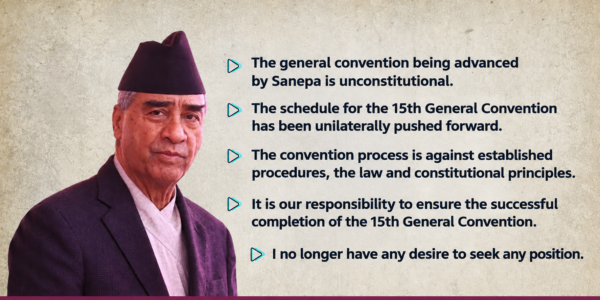
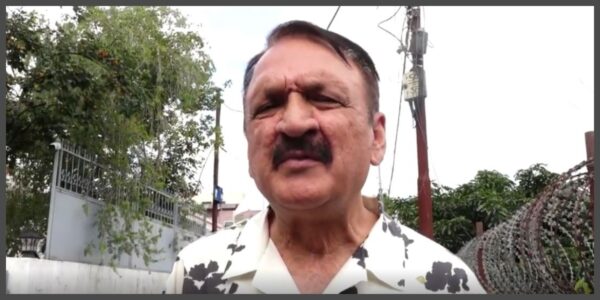
 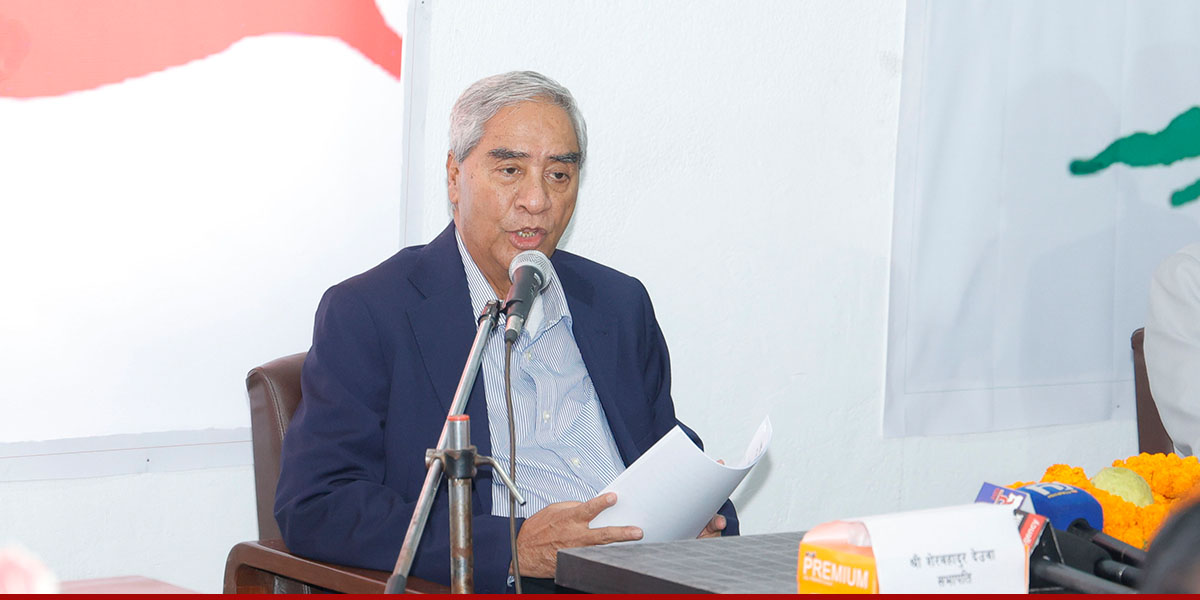 Sher Bahadur Deuba Photo: RSS
KATHMANDU: As the dispute over the Nepali Congress (NC) special convention deepens, leaders from the party’s establishment have said that party president Sher Bahadur Deuba will hold talks with General Secretaries Gagan Kumar Thapa and Bishwo Prakash Sharma.
Party spokesperson and head of the Publicity Department, Min Bishwakarma, said Deuba would engage in dialogue with the general secretaries to resolve the current crisis. He said the party president is positive about holding discussions with the general secretaries and other leaders involved in the special convention. “The plane has already taken off; now the issue is how to ensure a safe landing,” Bishwakarma said. “The party president will hold talks with the general secretaries and other leaders engaged in the special general convention.”
Bishwakarma said they have urged the party president, acting president, and office bearers to make every effort to keep the party united.
Central Working Committee member Ramhari Khatiwada also said discussions have been held with the party president on making every possible effort to save the party from a crisis. “The party president held talks with Dr Shekhar Koirala and Minendra Rijal on Monday and stressed the need to move forward in unity,” he said. “He has said he will make every effort to prevent a split and will hold talks with the general secretaries.”
The dispute over the general convention began following the Gen Z protest of September. Leaders close to the establishment faction insisted on holding the general convention after the House of Representatives elections scheduled for March 5, while General Secretaries Thapa and Sharma, who were also with the establishment faction, were for holding it before the elections.
Amid the tug-of-war over whether to hold the convention before or after the election, another proposal was registered at the party’s central office, demanding a special general convention. In the party’s eight-decade history, this was only the second such proposal. The first special convention was held in the 1950s. As a result, many senior leaders initially did not take the second proposal seriously. They believed the proposal was merely a tactic. Although Gururaj Ghimire and others were publicly leading the push for the special convention, General Secretaries Thapa and Sharma were seen as playing a key role behind the scenes. The proposal was initially understood as a pressure tool to force the party to hold the regular general convention in December.
When the regular general convention did not take place by the end of December, the Central Working Committee also showed little interest in the special convention. Instead, the Central Executive Committee decided to postpone the regular general convention scheduled for January and move it to May. Five members, including both general secretaries and one joint general secretary, registered a note of dissent against the decision.
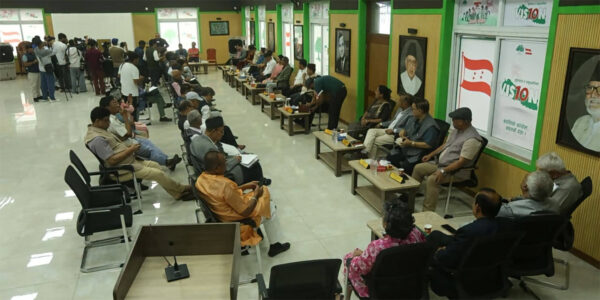
Following this decision, President Deuba and leaders close to the establishment believed the chapter of the special convention had effectively closed. Contrary to that belief, supporters of the special convention were already preparing to arrive in Kathmandu. The establishment faction assumed that a majority of convention delegates would not attend. However, more than 60% of delegates turned up at Bhrikuti Mandap.
The special general convention, which was inaugurated on Sunday, held its closed-door session on Monday. After the closed-door session endorsed procedures to dissolve the Central Working Committee and elect new leadership, tremors were felt within the establishment faction.
President Deuba intensified his discussions not only with establishment-aligned leaders but also with leaders, including Dr Shekhar Koirala and Minendra Rijal. During the talks, Koirala urged Deuba to prevent a party split. According to a leader, Koirala also asked Deuba to attend the special convention venue and take ownership of the process.
However, Joint General Secretary Mahendra Yadav argued that a special convention not owned by the Central Working Committee cannot be legitimate. He said only a special convention convened by the Central Committee has legal validity. “The party statute clearly states that a special convention must be convened by the Central Working Committee,” Yadav said after meeting Deuba. “If, for some reason, the Central Working Committee cannot convene it, who will verify the convention delegates? This is not legitimate, and it cannot gain legal validity either.”
While establishment faction leaders raise legal and constitutional concerns, the convention supporters argue that the statute mandates a special convention if 40% or more of convention delegates demand it with stated reasons. They claim the current special convention has been held in accordance with this provision.
Shyam Ghimire, former Chief Whip of the Nepali Congress, said the general secretaries involved in the special convention are trying to ensure that the selection of new leadership does not lead to legal complications. He said efforts were underway to reach a “win-win” understanding. Ghimire added that even if the special convention announces new leadership, the matter is likely to end up in court.
Central Committee member Mohan Basnet said further steps would be taken after seeing the decisions made by the closed session of the special convention. “The Central Working Committee will take necessary steps after observing their actions,” he added.