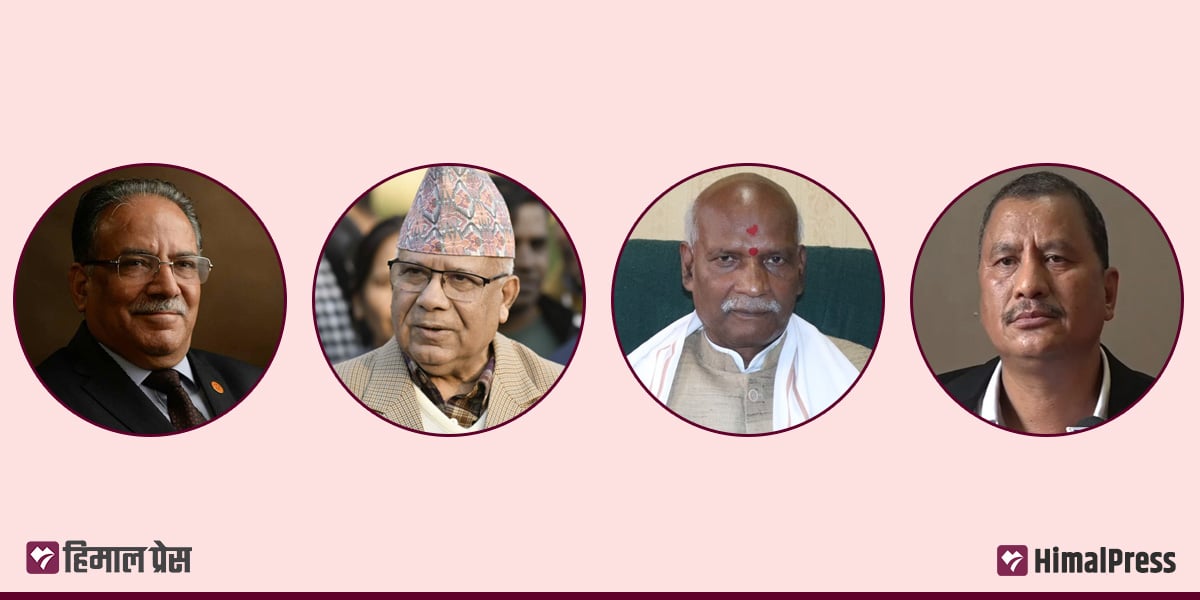
KATHMANDU: Amid the pressure of the Gen Z Movement, internal instability and a search for political relevance, four leftist parties — the CPN (Maoist Center), CPN (Unified Socialist), Nepal Socialist Party (NSP) and the Communist Party of Nepal (CPN) led by Netra Bikram Chand — have intensified efforts for party unity.
The process, initiated by Maoist Center Convention Organizing Committee Coordinator Pushpa Kamal Dahal, is said to be moving toward the expansion of the Socialist Front and ultimately the formation of a single united party, according to leaders.
However, some leaders of this alliance believe that Dahal’s unity push is more about his political survival than ideological alignment. According to a Unified Socialist leader, the Maoist Center, under pressure following the Gen Z Movement, is pursuing this leftist merger primarily to protect Dahal’s leadership position and maintain his political dominance.
The four parties had earlier formed the Socialist Front as a precursor to unity. Now, unity talks have resumed with greater seriousness. At a Maoist Center meeting on Monday, Dahal briefed leaders about his plan to expand the Front and advance party unification.
If unity is achieved soon, the Maoist Center’s general convention could be postponed. At the October 8 Standing Committee meeting, Prachanda said that if unification occurs before the convention, the situation would take a new turn, adding that it remains uncertain whether the convention will take place in December as planned.
Some leaders say the four parties had planned to make the announcement on the Constitution Day. However, the changing political circumstances after the Gen Z Movement delayed it. They now say preparations for party unification are moving forward.
How did the unity effort begin?
The Maoist Center, as the largest member of the Socialist Front, has been the driving force behind the unity bid. Progress slowed recently as Dahal’s relations with some leaders from other parties soured.
During the Maoist Center Standing Committee meeting on August 3, Dahal told members that unity talks with Madhav Kumar Nepal and Netra Bikram Chand had reached the final stage. Dahal’s announcement, however, caused a stir in both parties.
The unity proposal has sparked within Unified Socialist, while Chand publicly claimed immediate unification was not possible.
“We are moving forward with the understanding that unity is necessary. Minor issues are natural,” said Unified Socialist leader Taj Mohammad Miya.
On September 19, the Unified Socialist issued a statement calling on all leftist and socialist forces to unite in defense of Nepal’s communist movement, national sovereignty and revolutionary gains. Following that, other parties renewed their unity push. On September 23, CPN’s Central Committee met in Kathmandu and formed a team — led by spokesperson Khadga Bahadur Bishwakarma and including Anil C, Shilu C, Sushil C, Chiran, and Jitendra C — to hold talks with ideologically aligned groups like the Maoist Center.
Chand has reportedly expressed readiness for immediate unity with the Maoists in light of recent political changes. Similarly, Mahendra Raya Yadav of NSP is also said to be on board with the process.
Although the unity process is advancing, leaders say no detailed framework has been finalized, with many discussions kept confidential to avoid derailing the momentum.
According to Miya, the proposed structure will follow the “NCP model” — with dual chairpersons, as seen in the former Nepal Communist Party formed after the unification of the Maoist Center with the CPN-UML. Reliable sources say both Dahal and Nepal are likely to serve as co-chairs after the merger.
“For now, the model is designed to move both parties forward together,” said a Maoist Center leader. The new party name has not been finalized, but consensus is forming around including the word “Socialist” — signaling the Maoist Center’s likely decision to drop “Maoist” from their name.
“The general understanding is that the term ‘Socialist’ should unify the four parties,” said an NSP leader, adding that even the existing Socialist Front structure supports this branding.
The proposed guiding principle of the new party is expected to be “socialism with Nepali characteristics”.
Leaders insist that the unification process is ongoing and aim to complete it before the Maoist Center special convention scheduled for late December, which could then serve as a unity convention for all four parties.