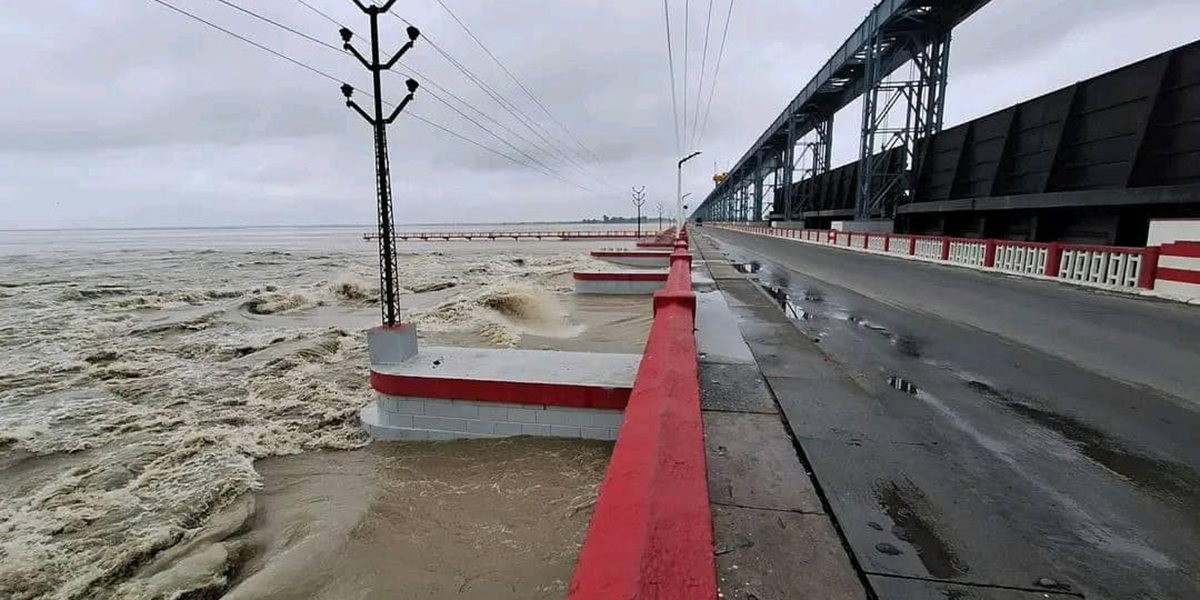

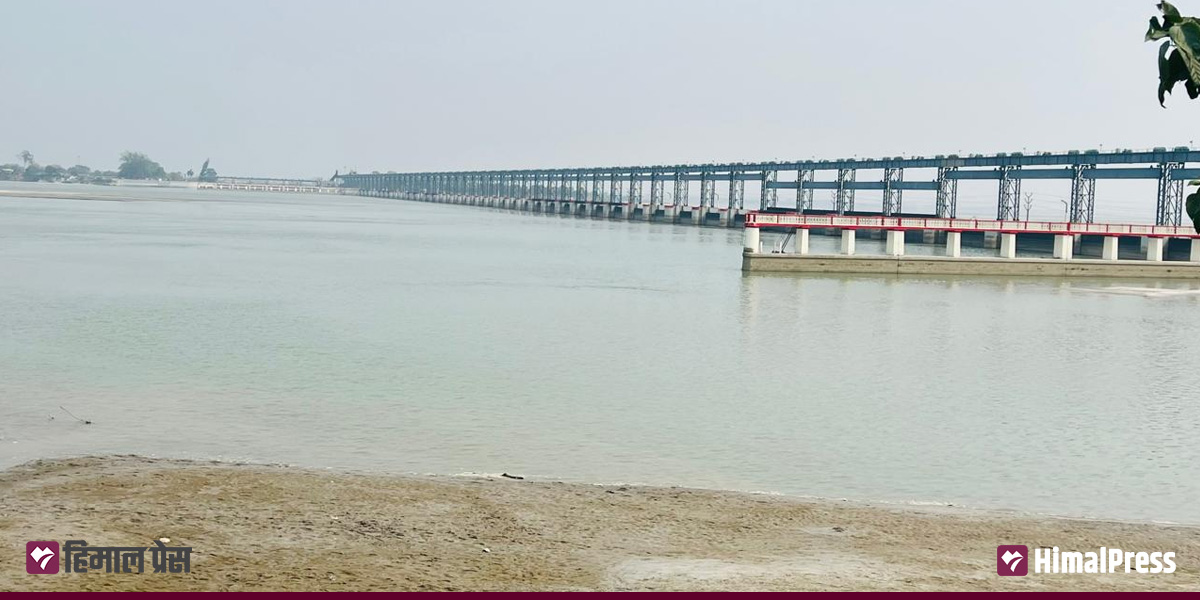
 This undated photo shows Koshi Barrage on Saptakoshi River. Photo: Bibek Bibash Regmi/Himal Press
ITAHARI: The Saptakoshi River, often called Bihar’s sorrow, turns ferocious every monsoon. Water level rises due to heavy monsoon rains, placing the Koshi Barrage and its bridge under severe strain and people living nearby in a state of fear.
Every report of rising water level sparks panic among locals, who fear that the bridge might collapse or that the river might breach its banks and flood their settlements. Such fear persisted from Saturday morning through Monday as relentless rain lashed the region.
After the river’s water level rose sharply due to heavy rainfall in the catchment areas, officials halted movement across the bridge. The danger has now subsided, as water levels have begun to recede.
Locals complain that the state appears to awaken only after disasters strike. They say that officials visit Koshi merely for inspections when the river swells, but take no lasting action to mitigate risks.
Researcher and hydrology expert Krishna Prasad Bhattarai warns that obstructing a river’s natural flow inevitably causes damage. Although a new bridge should have been built long ago by demolishing this existing bridge, neither the Nepali nor the Indian government has shown interest. “Engineers have already declared that the bridge has outlived its lifespan. However, the government keeps patching and painting it instead of rebuilding,” Bhattarai said. “Since the cement and iron have weakened, it can collapse anytime.”
The Koshi is among the rivers that carry the highest sediment load in the world. However, since the accumulated sand is not extracted or utilized during the dry season, the riverbed has continued to rise, pushing water levels dangerously close to the surface.
“While it is not possible to remove all the sediment, controlled extraction could lower the water level. Sand accumulation is filling the riverbed, intensifying flood risks,” Bhattarai added.
Human encroachment has further constrained the river’s path, according to Bhattarai. “Floodwaters carry debris, trees and silt from the hills. The Koshi’s banks are choked with sand. There’s no alternative now but to build a new barrage bridge,” he said. “Renovations have kept it standing, but the gates are thinning and the structure is decaying.”
The 1954 Koshi Agreement
Nepal and India signed the Koshi Agreement in 1954. The agreement granted India control over the river up to 32 kilometers north of the barrage—extending to the area then known as Mahendranagar Shukrabare. Nepal can use the river independently only beyond that point.
As per the agreement, Nepal cannot implement flood-control measures in the lower sections of the river. India, which holds responsibility, has also failed to act effectively. Despite being aware of the barrage’s risk, both governments have remained indifferent.
Bhattarai said Nepal should press India diplomatically and insist on immediate action. He also criticized disaster-management committees at both national and local levels for being reactive rather than proactive. “If these committees worked regularly and maintained disaster-response equipment year-round, we would have been better prepared,” he says. “Elsewhere, preparedness and monitoring are an ongoing phenomenon. In Nepal, action begins only after disaster strikes.”
Whose Interest Does the Koshi High Dam Serve?
There are talks of building a high dam on the Koshi River. However, experts argue that it primarily benefits India, not Nepal.
Researcher Keshav Dahal said that Nepal has yet to formulate a coherent national strategy for water use and river management. “Nepal entered water agreements with India without any plan or understanding of its own needs,” Dahal said. “The Koshi Agreement promotes India’s investment and requirements, not Nepal’s long-term interests.”
According to him, the agreement envisioned flood control, irrigation, hydropower generation and erosion prevention on Nepal’s eastern banks. Nepal was to utilize water as needed, while India would operate the barrage for irrigation and power generation.
Feasibility studies estimated the dam’s lifespan at 100 years. Experts believe that multiple small dams can help store monsoon water, thereby reducing flood risks and maintaining desired water levels in the Ganges during the dry season.
Rising Sediment Aggravates Risk
A 2009 ICIMOD report described the Saptakoshi as a fast-flowing, deep river with heavy sedimentation, carrying over 100 million tons of silt annually. This sediment raises the riverbed, which causes flooding.
Researcher Rabin Ghimire said the government’s inaction on sediment management has made floods worse. “In 1967, the Koshi’s discharge reached 900,000 cusecs but didn’t flood settlements,” Ghimire recalled. “This year, even before reaching 500,000 cusecs, the water almost overflowed the bridge. This is because the riverbed had less sand back then.”
He identifies accumulated sand as the main reason the river’s surface keeps rising.
The Koshi Barrage, constructed under the 1954 agreement and operational since April 30, 1959, was once hailed as a milestone in Nepal’s infrastructure development. It was inaugurated jointly by King Mahendra and Indian Prime Minister Lal Bahadur Shastri. Initially, the barrage was meant to serve for about 50 years.
After its construction, canals extended irrigation to Sunsari, Morang, Saptari, and parts of Bihar. Also, it connected eastern Nepal to the national road network.
However, locals say the barrage has brought more suffering than benefit.
Since the barrage is fully under India’s control, decisions to open or close its sluice gates rest solely with Indian authorities. Consequently, during every monsoon, thousands of residents in Sunsari, Udaypur and Saptari are displaced as their homes, farms and livelihoods are submerged. The repeated inundations, they say, are the long-term consequences of the Koshi Agreement.