 Himal Press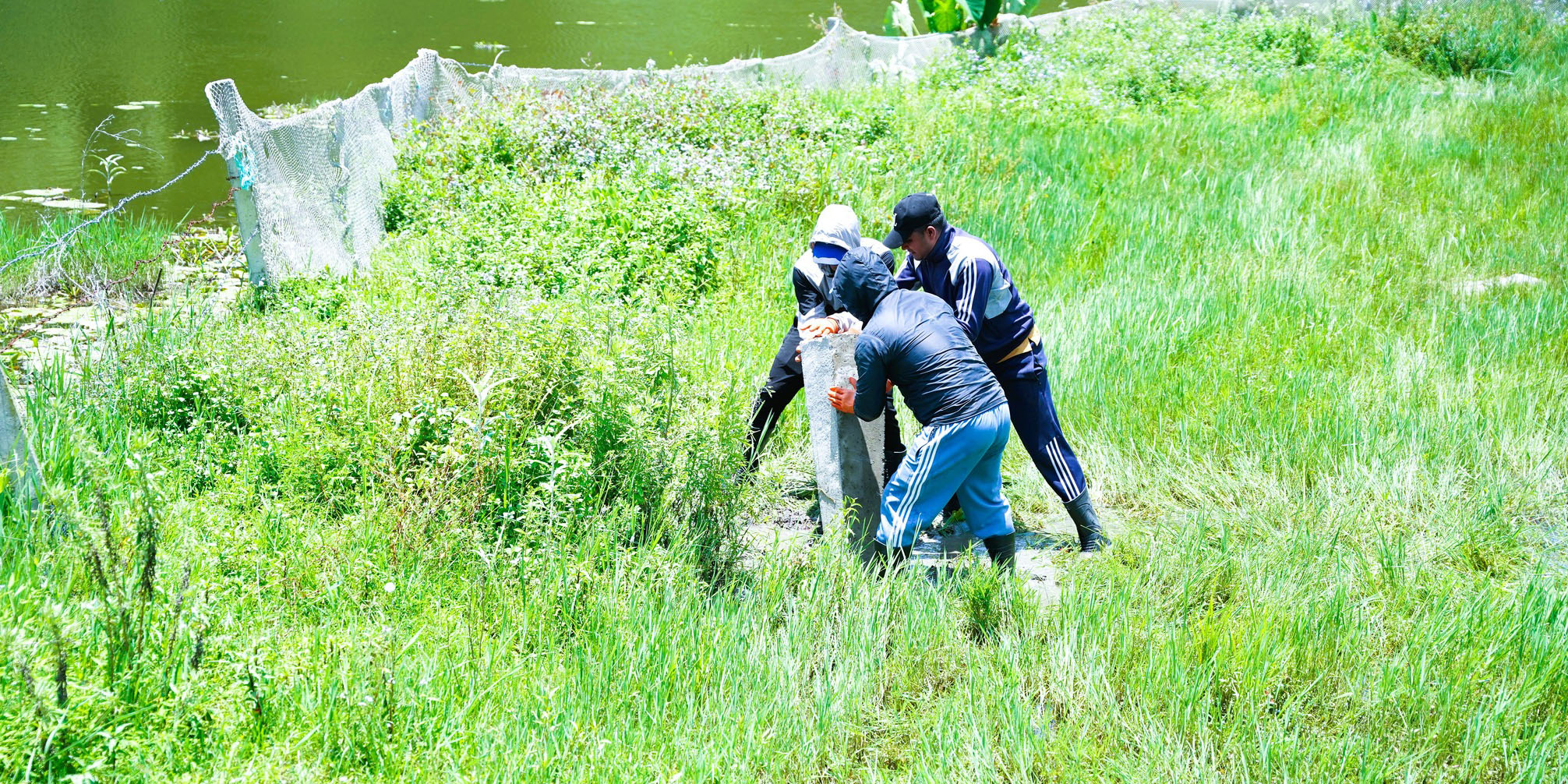
POKHARA: As many as 360 boundary pillars have been installed around Phewa Lake over the past month as part of a joint effort of the Pokhara Metropolitan City, Gandaki Province Government and the federal government.
The three tiers of government are working in the conservation of the lake’s area as per a Supreme Court directive to demarcate and protect the lake through the installation of boundary markers.
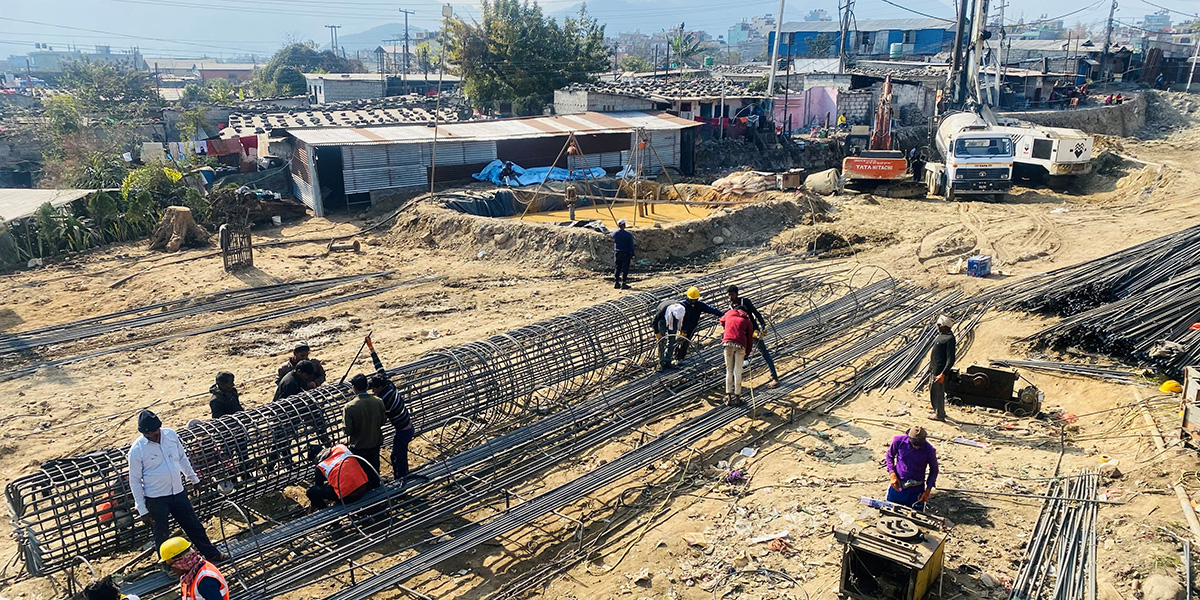
Prakash Subedi, chief of the Pokhara Valley Urban Development Committee, said a total of 360 boundary pillars had been erected as of Thursday. On the same day, Pokhara Mayor Dhanraj Acharya inspected ongoing work in the Bhakunde-Machhapokhari area. He said that the metropolis, in coordination with relevant agencies, is implementing the Supreme Court’s orders to protect Phewa Lake. He also praised surveyors, technicians, municipal police, Nepal Police and the Armed Police Force deployed for the task. In areas without road access, laborers have been carrying the heavy concrete pillars by hand to the installation sites.
There are plans to install a total of 1,055 pillars around the lake’s 6.343 sq km perimeter. In the first phase, boundary markers are being installed. In the second phase, authorities will study the legal status of land within the lake area to determine eligibility for compensation, verify land records before and after 1974 (2031 BS) and assess the condition of physical structures.
Phewa Lake has been shrinking in recent years due to both natural and human encroachment. The installation of boundary pillars is seen as a crucial step not only in protecting the lake but also in preserving Pokhara’s environment, natural heritage and cultural identity.
To implement the Supreme Court’s order, a Decision Implementation Facilitation Committee has been formed in Pokhara. Gandaki Chief Minister Surendra Raj Pandey said the committee has decided to immediately install boundary pillars in all directions. He added that other tasks required to enforce the court’s ruling would be carried out in phases.
A fresh survey has been conducted to determine the lake’s actual status. A technical sub-committee under the committee conducted the detailed survey using GPS and drone technology to define the lake’s boundaries. Based on 29 primary reference points, 40 cm-high concrete pillars were buried underground, and around 9,000 control points have been established.
After reviewing 10 years of records from the Irrigation Division Office, Kaski and various maps of Phewa Lake, the lake’s high flood level has been fixed at 794.95 metres above sea level. Using this reference point, the lake area has been calculated at 6.343 square kilometres—or 12,468 ropani, 3 paisa, and 3 dam. Mayor Acharya added that the inclusion of the 65-meter buffer zone mandated by the Supreme Court would increase the lake’s total area to 7.616 sq km—or 14,970 ropani, 5 aana, and 2 dam.
In June 2023, the Supreme Court issued a mandamus order to the Government of Nepal, Gandaki Province and Pokhara Metropolitan City, instructing them to study the actual condition of the lake and designate a 65-metre buffer zone from the lake’s highest water level as a green zone.
There are around 500 physical structures within the 65-metre buffer zone prescribed by the apex court.