 Himal Press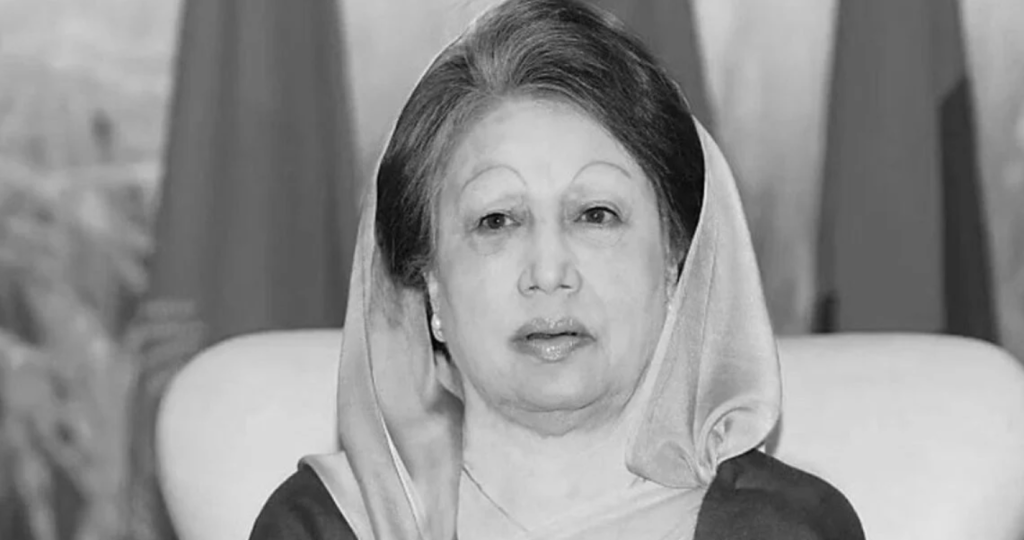
KATHMANDU: The passing of Begum Khaleda Zia, Bangladesh’s first female prime minister and long-time chairperson of the Bangladesh Nationalist Party (BNP), marks the end of an era in South Asian politics. Zia breathed her last at Dhaka’s Evercare Hospital, following a prolonged battle with multiple health issues.
Zia remained a central figure in Bangladesh’s politics for over three decades. Her life revolved around home, politics, power, opposition, imprisonment, health struggles, and intense rivalries. Her journey reflects the complexities of Bangladesh’s democracy—deeply personal, conflict-laden, and often unstable—and underscores why the region as a whole has struggled with political cohesion.
Born Khaleda Khanam Majumdar in 1945 in Dinajpur, then part of undivided India, she married Captain Ziaur Rahman in 1960, before Bangladesh gained independence from Pakistan. Although she was widowed at a young age, she carved a place for herself in a male-dominated Muslim society.
Despite her health conditions, Zia was preparing to contest three parliamentary seats in the elections scheduled for February 2026. Her nominations were registered via proxy, according to local media reports.
Zia’s entry into politics came after a personal tragedy. Her husband, Ziaur Rahman, a hero of Bangladesh’s 1971 Liberation War, later became army chief and then president. He was assassinated in a military coup in Chattogram in 1981. It was this loss that propelled Zia into politics. She became BNP vice chairperson in early 1983 and was elected party chairperson in May 1984. She played a key role in restoring parliamentary democracy and served as Prime Minister from 1991 to 1996 and from 2001 to 2006. During her tenure as executive head of the government, she focused on education, social welfare, youth empowerment, employment, rural development, and national security.
Her political journey, however, was not a smooth sail. Despite a significant win in the controversial 1996 election, she was forced to resign amid allegations of voter suppression. Although she returned to power in 2001, she continued to face allegations of corruption, Islamist extremism, and deep political polarization. Despite this, her grassroots support and party structure remained strong.
In the 1980s, Zia emerged as the main opposition figure against General Hussain Muhammad Ershad’s military rule. Through repeated arrests, crackdowns, and street protests, she established herself as a “warrior for democracy.” This struggle culminated in the BNP’s victory in the 1991 elections, where she was elected as Bangladesh’s first female prime minister. One of the major achievements of her government was the abolition of the presidential system and the reinstatement of parliamentary democracy.
Her leadership also symbolized the enduring rivalry with Sheikh Hasina of the Awami League. The rivalry, described as the ‘Battle of the Begums’ by the press, was more personal than ideological. The rivalry defined Bangladesh’s modern politics for decades. Both leaders perceived each other as existential threats, which led to election boycotts, street violence, and retaliatory actions. Bangladesh’s modern politics cannot be understood without the rivalry between Zia and Sheikh Hasina. For nearly three decades, political competition turned into a personal vendetta between Bangladesh’s two most powerful and influential women. This struggle weakened democratic institutions and left the country deeply divided.
Zia was sentenced to 17 years in prison in two separate corruption cases. She was released from the hospital due to poor health conditions in 2020, but was not allowed to leave the country for treatment. Liver, diabetes, heart, and lung complications further weakened her. She was fully cleared of legal charges in early 2025.
Zia’s political journey offers parallels and contrasts with Nepal’s democratic experience. In both countries, leadership often overshadowed institutions, resulting in polarized politics. While political transitions in Nepal were largely negotiated and mediated through dialogue, Bangladesh’s power struggles were more confrontational—election boycotts, street violence, and judicial battles were routine affairs.
Zia’s death leaves Bangladesh without either of its ‘Begums’, as the 2024 protests unseated her rival, Hasina, from power and forced her into a political exile in India.