 Himal Press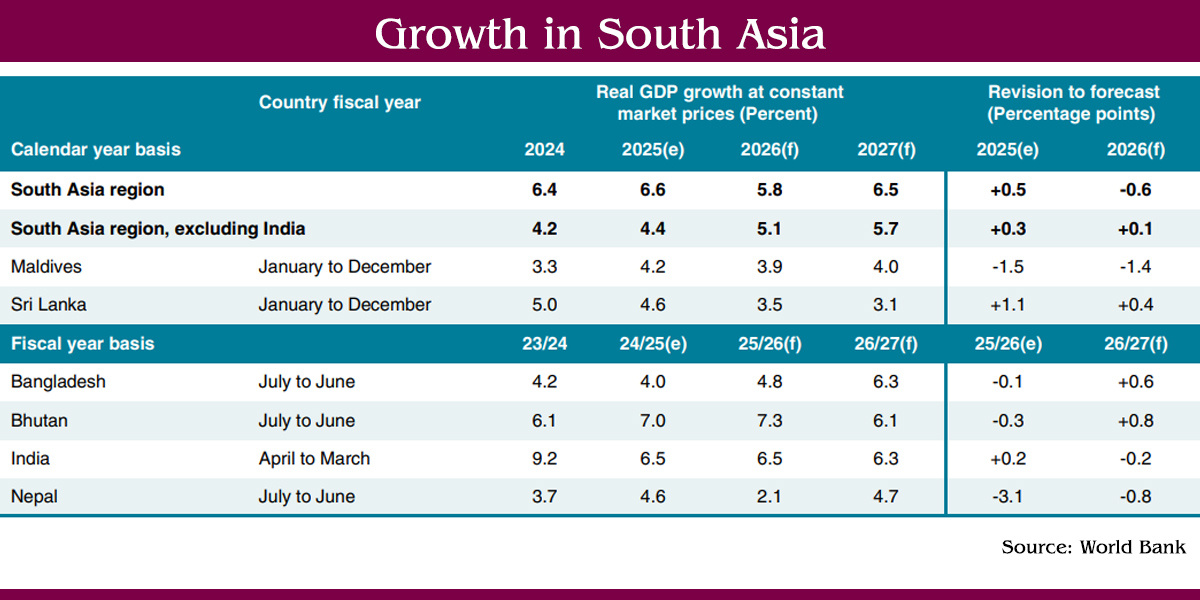
KATHMANDU: The World Bank has forecast a robust 6.6% growth for South Asia this year. The latest South Asia Development Update – Jobs, AI and Trade, however, warns that a significant slowdown looms on the horizon.
Reforms to promote trade openness and technology adoption could help the region create jobs and catalyze growth, the World Bank said in its twice-a-year regional outlook.
The report projects growth in the region to slow to 5.8% in 2026, a downward revision of 0.6 percentage points from the April forecast. Downside risks include spillovers from the global economic slowdown and uncertainty around trade policy, socio-political unrest in the region and labor market disruptions posed by emerging technology such as artificial intelligence (AI), it added.
“South Asia has enormous economic potential and is still the fastest-growing region in the world. But countries need to proactively address risks to growth,” said Johannes Zutt, World Bank Vice President for South Asia. “Countries can boost productivity, spur private investment, and create jobs for the region’s rapidly expanding workforce by maximizing the benefits of AI and lowering trade barriers, especially for intermediate goods.”
South Asian countries rank among the least open to international trade and finance, according to the report. The region’s high tariffs protect sectors where employment opportunities are shrinking. “High tariffs also severely impede the manufacturing sector, which faces tariffs on intermediate goods—components and raw materials needed for production—that are more than double those in other emerging market and developing economies,” it added.
The report also recommends harnessing the potential of AI to boost productivity and incomes. “The rapid development of AI is transforming the global economy and reshaping labor markets. South Asia’s workforce has limited exposure to AI adoption due to the predominance of low-skill, agricultural and manual jobs,” it added.
The report has recommended measures like streamlining size-dependent regulations that discourage firms’ growth, better transport and digital connectivity, more transparent housing search options, upskilling and job matching, as well as providing safety nets for affected workers to help accelerate job creation.
According to the report, recent unrest and heightened political and economic uncertainty is expected to cause Nepal’s growth to decline to 2.1% in FY25/26. “International tourist arrivals are expected to decline sharply and asset losses will affect the insurance industry,” it said. “Weaker investor confidence is expected to impede private investment and non-hydro construction. Delayed rainfall in a major rice-producing province will hamper the agricultural sector.”
The World Bank, however, sees reconstruction efforts supporting the recovery in 2026/27.