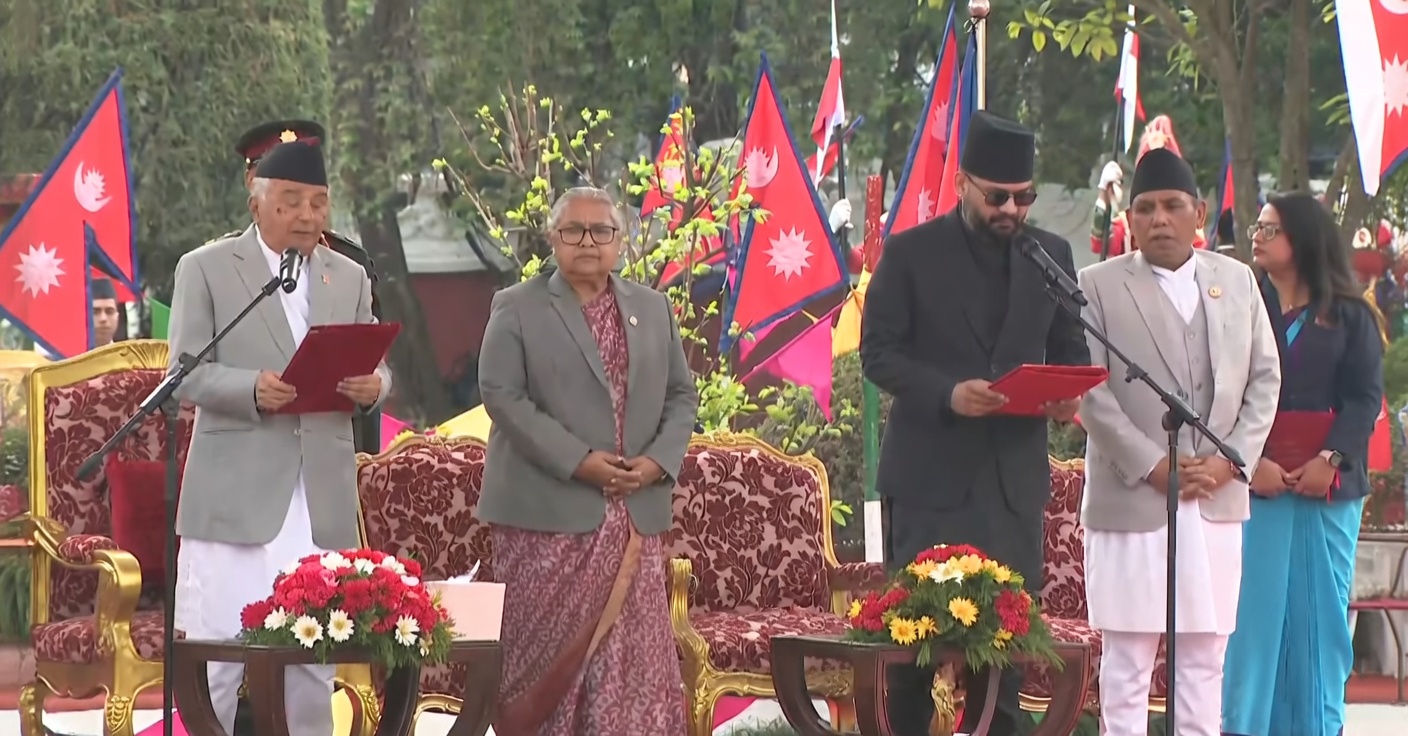

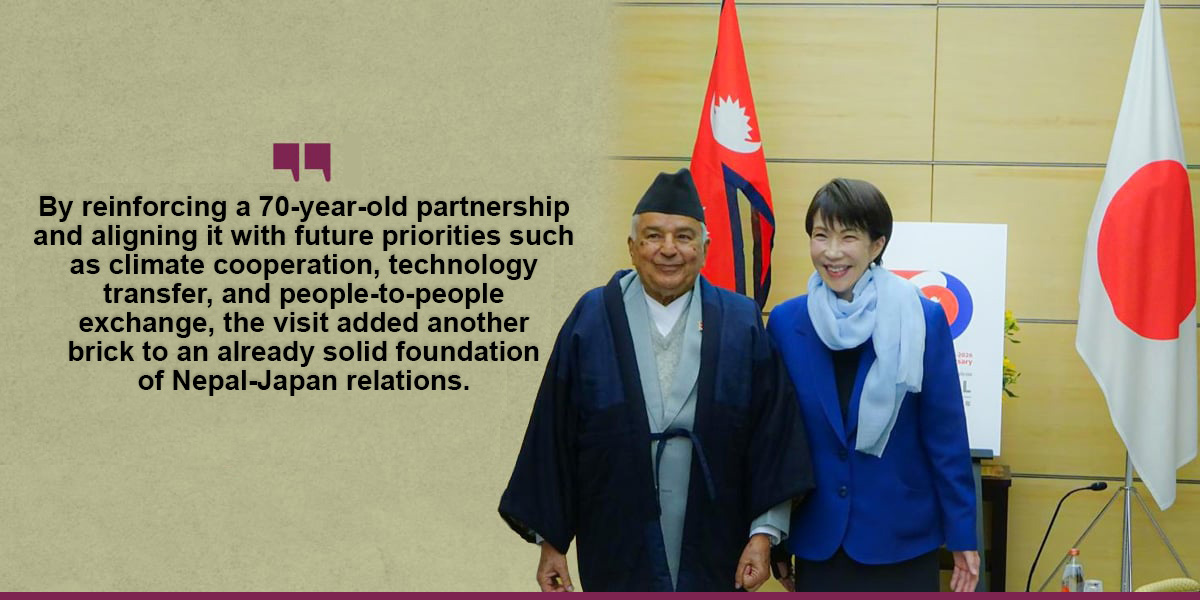
KATHMANDU: President Ram Chandra Paudel returned home on Wednesday after concluding a four-day official visit to Japan. The visit was undertaken to mark 70 years of diplomatic relations between the two countries.
More than a ceremonial engagement, the visit underscored the depth, continuity, and evolving relevance of Nepal–Japan ties at a time of global uncertainty and domestic political transition.
Nepal–Japan relations are not the product of a single era, government, or political system. They are rooted in a long history of mutual respect and people-to-people connections that predate formal diplomacy. In the early 20th century, Nepali students traveled to Japan for higher studies. Reformist Rana Prime Minister Dev Shumsher had decided to send 17 students to Japan instead of Europe. The students traveled to Japan during the reign of Chandra Shamsher in 1902.
Likewise, Japanese engagement with Nepal dates back even further. Buddhist monk Ekai Kawaguchi visited Nepal in the late 19th century. He spent some time in the Kathmandu Valley and traveled to Tibet via Mustang.
Nepal and Japan established formal diplomatic relations on September 1, 1956. Nepal opened its embassy in Tokyo in 1965, and Japan opened its mission in Kathmandu after two years. Since then, Japan has emerged as one of Nepal’s most reliable and trusted development partners. Unlike many external actors, Japan’s engagement in Nepal has been marked by an absence of overt political interest. Political changes, shifting power equations, and regional geopolitical tensions have had little impact on the consistency of the bilateral relationship.
President Paudel’s visit, coinciding with the 70th anniversary of diplomatic ties, carried symbolic and strategic weight. Japan had long expressed its desire for a high-level Nepali visit to mark the milestone, and the presence of Nepal’s head of state has fulfilled that expectation. Meetings with Emperor Naruhito, Prime Minister Sanae Takaichi, and senior Japanese officials highlighted the warmth and maturity of the relationship.
Japan’s approach to Nepal has often been described as one of “quiet diplomacy”—saying less but doing more. Over seven decades, this has translated into tangible contributions across sectors. Through the Japan International Cooperation Agency (JICA), Japan has played a major role in Nepal’s infrastructure, education, health, disaster management, and human resource development. Landmark projects such as the Arniko and BP highways, the Melamchi drinking water project, hydropower projects including Kulekhani and Kaligandaki, post-earthquake reconstruction, the Nagdhunga tunnel, restoration of irrigation systems, and health infrastructure upgrades stand as enduring symbols of this partnership. Even in recent crises, such as the Jajarkot earthquake, Japan’s support for school reconstruction and scholarships has continued.
The timing of President Paudel’s visit—amid preparations for elections in both countries—was also significant. High-level visits during electoral periods are often questioned in diplomacy. However, such visits convey an important message: that state-to-state relations transcend governments and electoral cycles. As the constitutional head and a symbol of continuity, the president’s engagement reassured both sides that policies and friendships would remain stable despite political uncertainty. In this sense, the visit functioned as an institutional assurance and helped reinforce Nepal’s image as a mature and reliable diplomatic actor.
The broader international context gives the visit added relevance. Global diplomacy is unstable at present due to conflicts in Ukraine and Gaza, intensifying US–China rivalry, BRICS, the Indo-Pacific strategy, and the reconfiguration of the Global South. Japan is no longer only an economic power; it is positioning itself as a proactive diplomatic and security partner, particularly in the Indo-Pacific and South Asia. Rising Chinese influence, supply chain security, and regional stability have prompted Tokyo to take a keener interest in the Himalayan region.
Although geographically small, Nepal occupies a sensitive strategic space between India and China. This reality has elevated its importance in Japan’s regional outlook. Japanese media commentary linking President Paudel’s visit to Himalayan stability reflects this perspective. Prime Minister Takaichi put emphasis on Nepal’s role in regional stability and on the importance of free, fair, and inclusive elections.
The visit also demonstrated Nepal’s growing emphasis on public diplomacy. Interactions with Nepali communities and workers in Japan strengthened people-to-people ties, while meetings with Japanese business leaders allowed President Paudel to invite investment in priority sectors such as hydropower, agriculture, tourism, information technology, and services. These engagements complemented Japan’s own “soft power” approach and projected Nepal as open, stable, and investment-ready.
During his recent visit to China, then-Prime Minister KP Sharma Oli participated in a parade that was perceived as demeaning to Japan. Before attending the event, Nepal had issued a statement in line with China’s position. Japan has conveyed a message that such actions should not be repeated. Japan does not express such concerns directly, but it signals them in subtle ways that are easy to understand.
One notable aspect of the visit was its success despite Nepal’s embassy in Tokyo being without a full ambassador. Traditionally, such high-level visits are considered difficult to manage without an ambassador in place. However, the effective coordination by the acting head of mission, Harihar Kanta Paudel, demonstrated institutional capacity within Nepal’s foreign service. The episode subtly reinforced the argument that diplomacy depends not only on positions but also on professionalism, experience, and institutional strength.
Historically, the Japanese imperial family’s close engagement with Nepal has added a unique dimension to bilateral ties. From visits by Emperor Akihito and Empress Michiko to Nepal, to Emperor Naruhito’s earlier journey as crown prince, these interactions have nurtured goodwill that extends beyond formal diplomacy. Emperor Naruhito’s brother Crown Prince Akishino and his consort Kiko, and Late Princess Chichibu also visited Nepal in the 1990s and 1980s, respectively.
In conclusion, President Paudel’s visit was neither about spectacle nor immediate political gain. It was a reaffirmation of a long-standing friendship built on trust, consistency, and mutual respect. If SAARC had not become inactive, Japan, as an observer, would have been carrying out various initiatives in this region through the organization. There is an example of a Japanese prime minister, while on a visit to India, coming to Nepal even for a few hours, when there was a strong diplomatic initiative. But there have also been times when, due to weak initiative, Nepal was left out, and Bhutan was chosen instead. Japan views Nepal not just as an aid recipient, but as a development partner and an emerging strategic friend in the Himalayan region.
At a time when Nepal is navigating electoral uncertainty, regional sensitivities, and global tensions, the visit signaled balance, continuity, and credibility in its foreign policy. By reinforcing a 70-year-old partnership and aligning it with future priorities—climate cooperation, technology transfer, and people-to-people exchange—the visit added another brick to an already solid foundation. It showed how a relationship shaped by history can be preserved in the present and confidently guided toward the future.