 Himal Press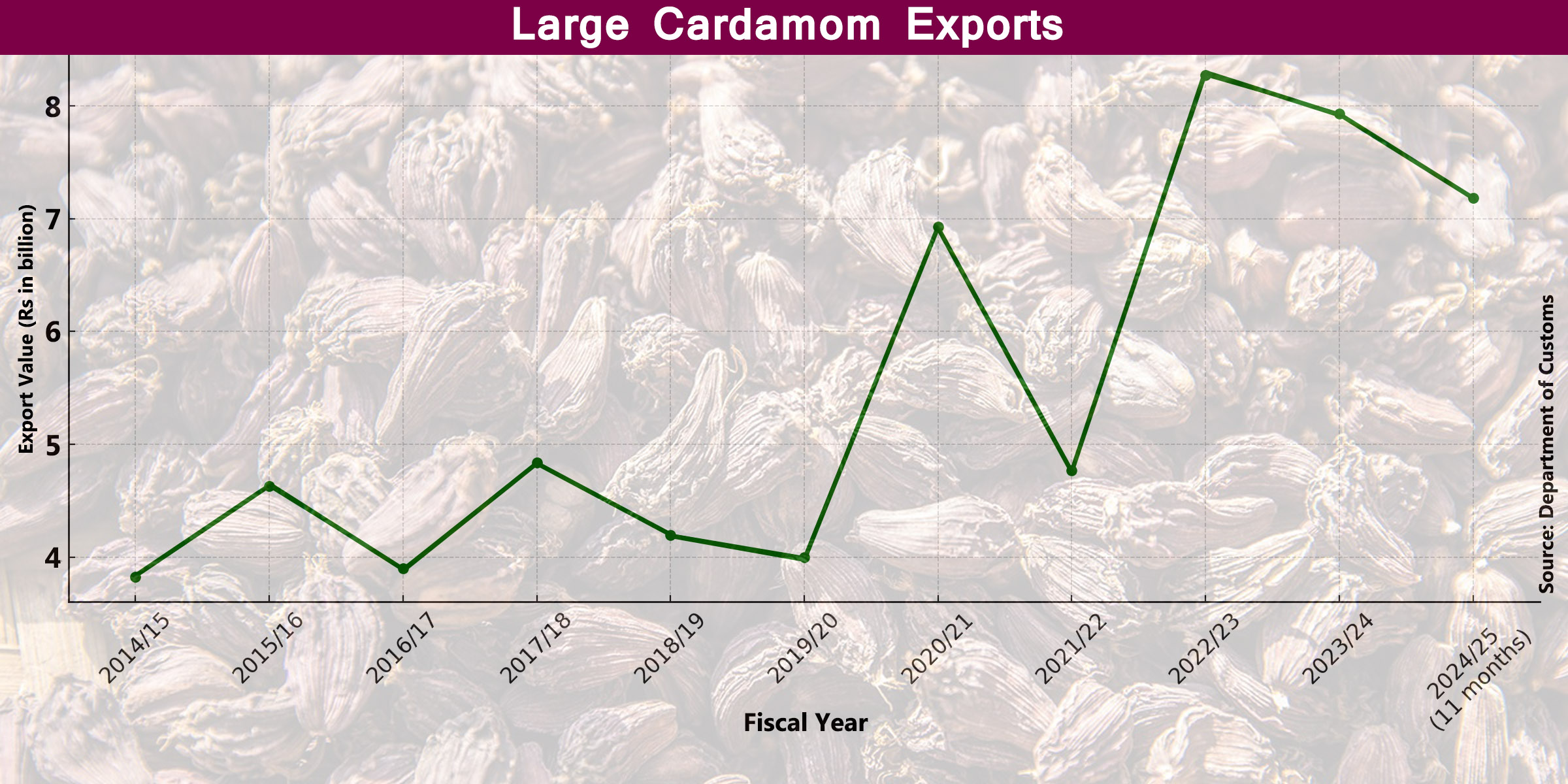
KATHMANDU: Large cardamom, also known as black cardamom and alaichi in Nepal, a vital source of income for rural households in the eastern hills, continues to post strong export earnings despite enduring structural bottlenecks and limited value addition. In the first 11 months of fiscal year 2024/25, the country exported 3,989 tons of large cardamom, earning Rs 7.18 billion, according to the government trade data.
This marks a slight decline from the previous fiscal year 2023/24, when Nepal exported 5,017 tons worth Rs 7.93 billion. Despite the lower volume this year, the average price rose to Rs 1,800 per kg from Rs 1,582 last year, indicating continued global demand for Nepal’s high-quality, organic product.
Large cardamom exports displayed considerable volatility, fluctuating between Rs 3.83 billion and Rs 4.63 billion of annual exports. Export earnings fell to Rs3.83 billion in 2014/15, surged to a peak of Rs 4.63 billion in 2015/16 and then declined again to Rs 3.9 billion the following year.
In contrast, the period from 2017/18 to 2019/20 was marked by relative stability, with annual export values consistently exceeding Rs 4 billion. The highest earnings during this stretch came in 2017/18, reaching Rs 4.84 billion, before easing to Rs 4 billion by 2019/20. A significant spike occurred in 2020/21, when export revenues soared to Rs 6.93 billion. Although earnings slipped to Rs 4.77 billion in 2021/22, they rebounded strongly and reached an all-time high of Rs 8.27 billion in 2022/23.
India has remained the dominant buyer for the past many years, absorbing more than 99 percent of Nepal’s large cardamom exports. The southern neighbor then re-export the spice to higher-paying markets in Pakistan and the Middle East. The re-exported Nepali spice fetches international prices of up to $28 per kg.
Large cardamom is cultivated in 53 districts of Nepal, primarily in the eastern mountainous and hilly districts of Taplejung, Ilam, Sankhuwasabha, Panchthar and Tehrathum. These regions account for over 80% of national production.
Nepal is the world’s largest producer of large cardamom, accounting for more than 55% to the global annual production of around 12,000 tons, according to a 2017 report. The crop is prized not just for its culinary uses, but also for its medicinal properties in treating respiratory and digestive ailments.
The history of large cardamom cultivation in Nepal dates back to 1865 when Nepali laborers are believed to have brought the plant from Sikkim, India, to the eastern hills. Organised cultivation began in 1975 with the establishment of the Cardamom Development Centre in Fikkal, Ilam, followed by targeted expansion in key districts during the 1980s.