Out of the 32 House of Representatives constituencies in Madhesh, five are expected to witness particularly intense contests this time. These include Saptari-2, Dhanusha-3 and 4, and Sarlahi-2 and 4.
With the entry of both veteran political heavyweights and new candidates, these constituencies are almost certain to see fierce competition. Saptari-2, in particular, is expected to be highly competitive. This constituency drew significant attention in the 2022 elections as well, and it is once again being closely watched.
In the previous election, this was the constituency where the long-standing electoral dominance of Janata Samajwadi Party (JSP) Nepal Chairperson Upendra Yadav ended. Dr. CK Raut, chairperson of the Janamat Party, who had entered electoral politics for the first time, defeated Yadav by more than double the number of votes.
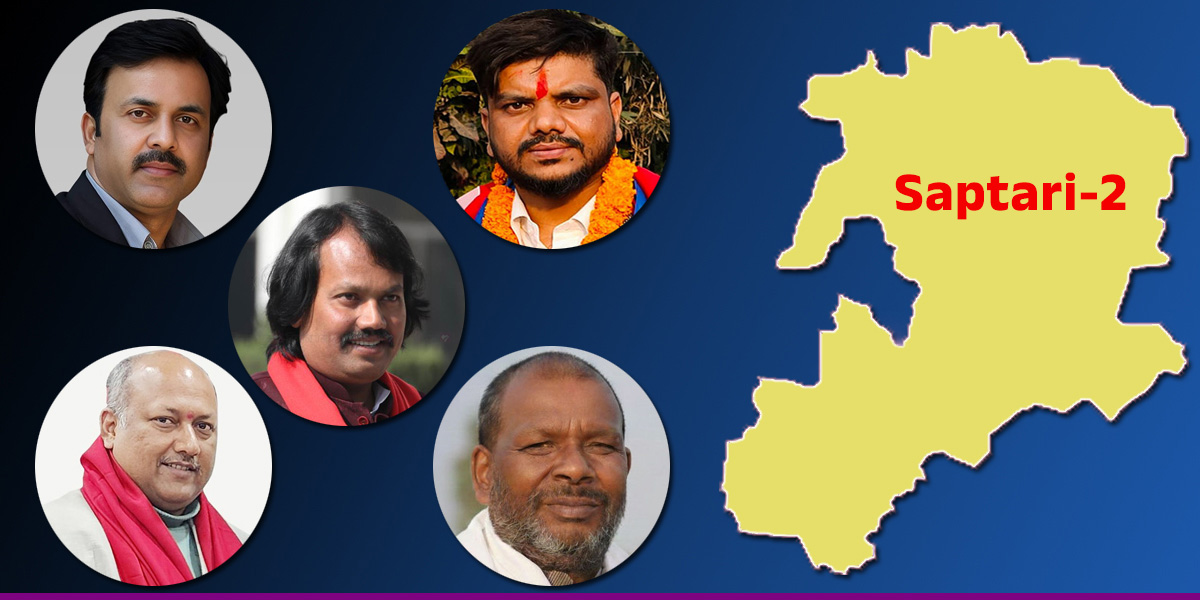
This time as well, Janamat Chairperson Raut is contesting from the same constituency. Although JSP Nepal Chair Upendra Yadav is not contesting against him this time, the race in Saptari-2 has become more intriguing with Raut’s former close associates entering the fray.
Satish Kumar Singh, whom Raut himself had appointed chief minister of Madhesh, and Sharad Singh Yadav, the former spokesperson of the Janamat Party, are now competing against Raut. Singh had been elected as a provincial assembly member from the Janamat Party in the 2022 election and was later made chief minister by Raut.
During the Gen Z protests, Singh announced his resignation via social media but did not step down from office. Following this, Raut directed him to resign. When Singh defied the instruction, relations between the two deteriorated. After falling out with Raut, former chief minister Singh left the Janamat Party and has now entered the electoral race.
Although Singh’s name initially appeared on the CPN-UML candidate list, he filed his nomination from the Swabhiman Party. It is reported that he registered this party under the leadership of his brother while tensions with Raut were ongoing within the Janamat Party.
Similarly, Sharad Singh Yadav was once considered one of Raut’s trusted aides. Raut had appointed him as the party’s spokesperson. Even as many Janamat leaders left Raut to join other parties, Sharad remained loyal and stayed in the party. However, following the Gen Z protests, his relationship with Raut also soured. He recently formed the Jana Adhikar Party under his own leadership and has filed his candidacy from Saptari-2 representing his party.
With former allies surrounding Raut in the electoral arena, he will also have to face JSP Nepal, his closest rival in the previous election. JSP Nepal has fielded former irrigation minister Umesh Yadav as its candidate in this constituency. A central committee member of the Nepali Communist Party (NCP), Yadav joined JSP Nepal only a few days ago.
Umesh Yadav had been elected from Saptari-3 in the 2013 Constituent Assembly election representing the then Unified Maoist party. However, in the 2017 election, he was defeated by Upendra Yadav in this very seat.
This time, JSP Nepal has fielded him in Saptari-2. Local voters say that with former chief minister Singh, former party spokesperson Sharad, and other former associates entering the race, it will not be easy for Raut to replicate the comfortable victory he achieved in the last election.
Meanwhile, the Rastriya Swatantra Party (RSP) has fielded young candidate Ramji Yadav in this constituency. Locals say voter interest in Ramji has increased after senior party leader Balendra Shah (Balen) addressed a public gathering in Janakpurdham on January 19.
Local resident Hem Kumar Singh says a highly competitive race is expected in Saptari-2. He believes the March 5 election will see a three-way contest among JSP Nepal, the Janamat Party, and the Rastriya Swatantra Party.
“Based on the current situation, we anticipate a three-way contest,” he says. “Janamat and JSP Nepal are long-time rivals, and this time RSP has also entered the race. There appears to be a favorable environment for them as well, so a three-way competition is likely.”
Janamat Party Chairperson Raut, however, claims that he will have no trouble winning again this time. He says voters will support him because of his work on constituency development and addressing public issues. Raut has claimed he will secure victory with more than 55,000 votes.
Raut has also said that the entry of former colleagues into the race makes no difference to him. “They are not enemies,” he says. “We are all here for political competition. It should be taken positively.”
Despite Raut’s claim of winning over 55,000 votes, the race will certainly not be easy for him. Locals say that former chief minister Singh and former spokesperson Sharad draw support largely from Janamat Party voters. Since the votes they receive will split Janamat’s base, it will not be as easy for Raut as it was last time.
Although Upendra Yadav lost previously, JSP Nepal is still considered to have a strong base in Saptari-2. Locals say that the entry of former Janamat colleagues into the race will benefit JSP Nepal candidate Umesh Yadav. It is also said that the votes RSP is expected to receive—despite its limited performance last time—will largely come from Janamat’s voter base.
In the 2022 election, Janamat Party Chairperson Raut was elected with 35,042 votes, while JSP Nepal Chairperson Upendra Yadav received 16,979 votes. The vote margin between them was 18,063. In that election, the then Loktantrik Samajwadi Party (LSP) Nepal, led by Mahanta Thakur, had fielded a separate candidate. LSP candidate Jay Prakash Thakur came third with 7,347 votes. As LSP was in alliance, the Nepali Congress did not field a candidate in that election.
This time, however, the Nepali Congress has nominated Ram Kumar Yadav. Similarly, Mohammad Ziaul Rahman is contesting from the CPN-UML. In the previous election, UML—then in alliance with JSP Nepal—had not fielded a candidate in this constituency.

 Himal Press
22 Jan 2026
Himal Press
22 Jan 2026