
 Himal Press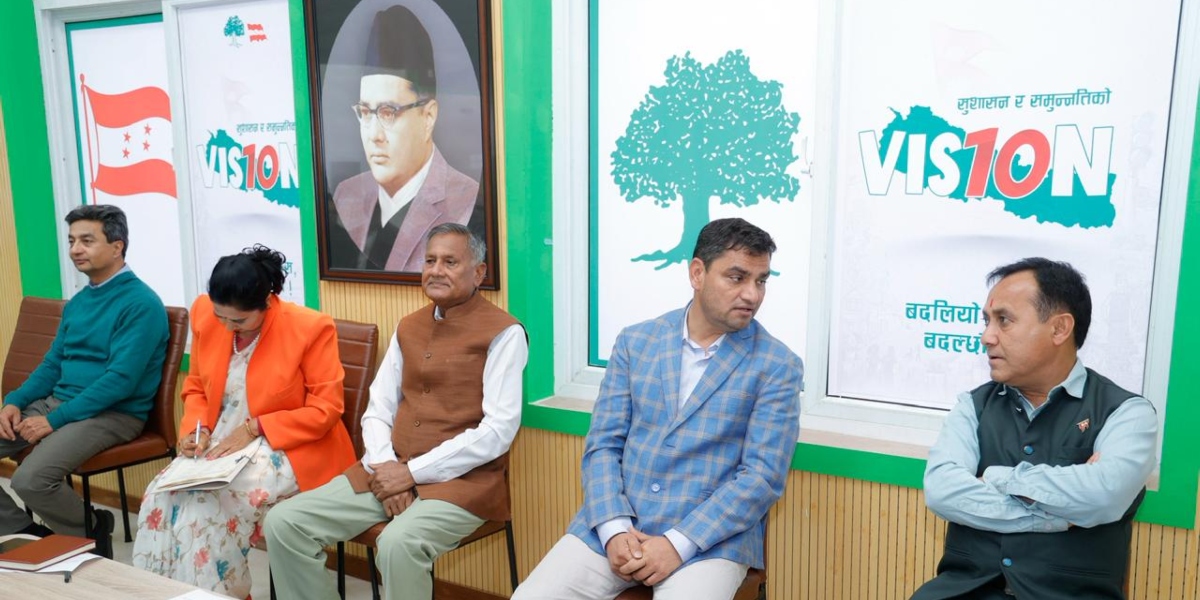
KATHMANDU: An internal review of the Nepali Congress (NC) has identified a range of structural, political, and organizational weaknesses behind the party’s poor performance in the March 5 parliamentary elections.
Party Vice President Bishwo Prakash Sharma presented the review report at the Central Working Committee (CWC) meeting, which began in Lalitpur on Friday.
Describing the outcome as a clear and harsh reality, the party acknowledged growing public dissatisfaction, repeated leadership, coalition politics, a weak opposition role, and even the impact of social media algorithms as major reasons behind the setback. Despite the loss, the NC said it had accepted the results in line with democratic norms. It added that the party remains committed to playing the role of a constructive opposition in the coming days.
The report states that although people had expected a new style and transformation in politics after the promulgation of the constitution, political parties, including the NC, failed to reform themselves in line with those expectations. It also pointed to long-standing political instability as Nepal has not had a prime minister complete a full five-year term in 75 years, while 25 governments have been formed in the past 34 years. “Voters, frustrated by instability, extended their support to an alternative force that promised stability in the latest elections,” the party said in its review report.
The repetition of the same leadership faces in government further alienated voters, Sharma’s report said, adding that frequent changes in government failed to ensure policy stability, which fueled public discontent.
Sharma acknowledged in the report that the coalition formed to protect the constitution became unpopular when it was extended into electoral alliances. “This caused dissatisfaction both within the party and among voters,” the report added.
The NC has admitted to inconsistency in its political stance, forming alliances with different parties at different times, which, it said, created confusion and eroded public trust. “The failure to remain either firmly in government or in opposition weakened our credibility,” it said.
The report further stated that the absence of a strong opposition voice in Parliament, following its decision to form a government with CPN-UML, the second largest party in the dissolved parliament, allowed public grievances to spill onto the streets. “Other forces capitalized on these grievances,” the party stated in the report.
The party also criticised its own governance performance, saying that expectations rose sharply when major parties formed a government together, but delivery remained average. “Policy missteps, including decisions related to social media ban without proper consultation, also fuelled public anger, particularly among younger voters,” it added.
Sharma also said the NC failed to communicate its achievements to the public effectively. “Outdated organisational structures and internal factionalism further weakened the party,” the report added.
It also highlighted excessive politicization across various sectors, erosion of meritocracy, and growing public frustration with corruption and bureaucratic inefficiency as major issues that affected the party’s electoral prospects.
The continued dominance of older leadership figures, without a clear transition plan, was identified as another key factor in the report.
Global trends such as the rise of populism also affected the party’s performance in the elections, as voters were keen on “trying something new”. “The influence of social media algorithms, which shape public opinion and behaviour, was a significant modern challenge that we failed to address,” Sharma said in his review report.
The report also pointed to the issue of foreign employment, saying that political actors failed to communicate honestly about its continued necessity, which may have influenced voter perceptions.
The party also acknowledged a lack of sufficient time to translate leadership changes made during the special general convention into voter confidence. It also accused some leaders, who were denied tickets, of either remaining inactive or engaging in activities that undermined official candidates.
![HoR approves nominations of members in thematic committees [With names]](https://en.himalpress.com/wp-content/uploads/2026/04/DP-aryal-savamukh.jpg)

![CAN announces dates for two CWC League 2 tri-series [With fixtures]](https://en.himalpress.com/wp-content/uploads/2026/04/WCL-2-triseries.jpg)