KATHMANDU: Madhesh-based political parties that had dominated politics in Madhesh Province since 2007 have been swept away by the “Balen wave” in the House of Representatives election held on Thursday.
For nearly two decades, parties that emerged from the Madhesh movements had maintained strong influence in the province, from the first Madhesh uprising in 2007 following the success of the 2006 political change to the protests surrounding Nepal’s constitution-making process. From the 2008 Constituent Assembly elections to the 2022 parliamentary polls, Madhesh-centric parties consistently retained significant political clout in the region.
However, these parties failed to win a single seat in this election. They lost all 32 constituencies in the province to other forces, mainly the Rastriya Swatantra Party (RSP).
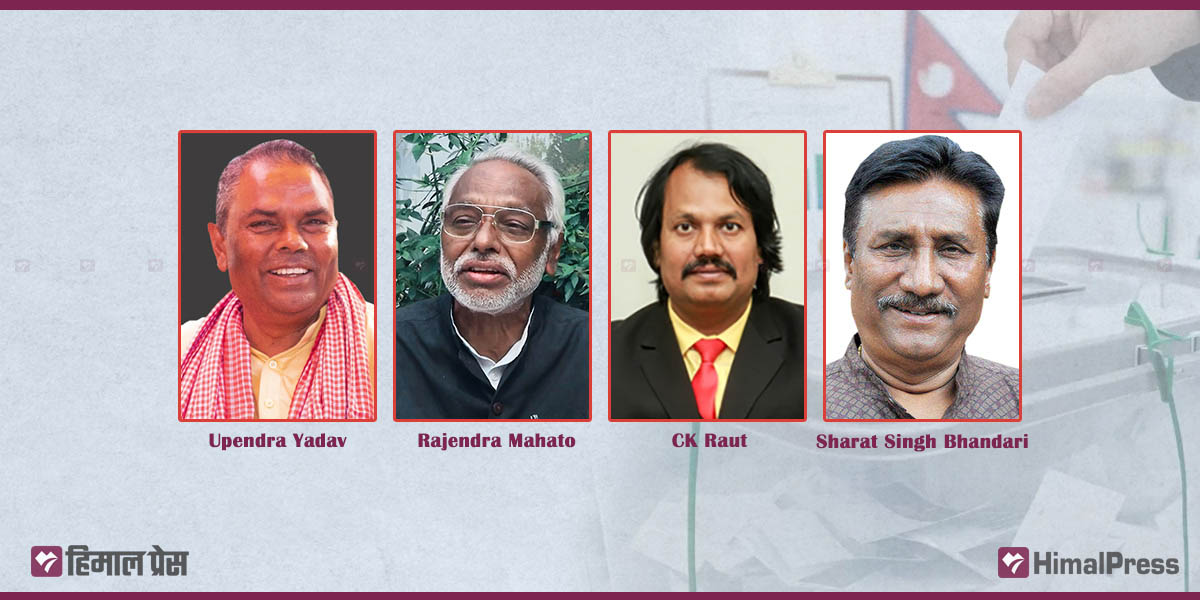
The election also saw the defeat of several prominent Madheshi leaders who had long positioned themselves as champions of the region’s political agenda. Among those defeated were Janata Samajbadi Party (JSP) Nepal Chairperson Upendra Yadav, Janamat Party Chairperson CK Raut, and Rastriya Mukti Party (RMP) Chairperson Rajendra Mahato.
Other senior figures, who have served multiple times as ministers, such as Sharat Singh Bhandari, Raj Kishor Yadav, and Surendra Yadav, also suffered defeat.
Although Upendra Yadav had lost the 2022 election from Saptari-2 to CK Raut, he later contested a by-election from Bara-2 after persuading his party colleague Ramsahaya Prasad Yadav to resign. Ram Sahaya subsequently became Vice President. This time, however, the political tide has shifted, and his party has failed to secure even a single seat.
Rajendra Mahato, who earlier won from Dhanusha-3 in 2017, was defeated in his home district of Sarlahi-2. In the 2022 election, he lost to Mahendra Rai Yadav. This time, both Mahato and Mahendra Yadav were defeated by RSP candidate Rabin Mahato.
Veteran leader Sharat Singh Bhandari, who has contested elections since 1981 and served as minister multiple times, was seeking his eighth electoral victory. However, the senior leader of JSP Nepal was also swept away by the wave of political change.
The ongoing proportional representation (PR) vote count also suggests that Madhesh voters have largely turned away from the region’s traditional parties. None of these parties is on track to meet the 3% threshold in the vote count that would gain them a ‘national party’ status and PR seats.
Analysts say these parties lost public trust after drifting away from their original agendas and focusing more on power struggles and political interests.
Madhesh-centric parties had achieved significant success in the first Constituent Assembly election in 2008. The Madhesi Janadhikar Forum Nepal won 54 seats, the Tarai Madhesh Democratic Party secured 21 seats, and the Sadbhavana Party won nine seats in the election.
However, internal divisions and power struggles soon fractured these parties. By the 2013 Constituent Assembly election, their strength had sharply declined. The Madhesi Janadhikar Forum Nepal dropped to just 10 seats, the Tarai Madhesh Democratic Party to 11, and the Sadbhavana Party to six.
Although these parties regained some influence after the 2017 elections and even led the government in Madhesh Province, analysts say their lust for power and the tendency to switch coalitions repeatedly to join the government gradually eroded their credibility among voters.
Brishesh Chandra Lal, chairman of the Tarai Madhesh Democratic Party, said the election results reflect public frustration. “Madheshi parties carried important agendas, and people had high expectations from them,” Lal said. “But their representatives failed to deliver according to those expectations, and corruption and other negative tendencies appeared. As a result, voters have punished them.”
He added that attempts to unite Madhesh-based parties through platforms such as the Federal Democratic Front failed due to internal disputes and a lack of serious commitment from party leaders.
“Even though there was talk of correcting past mistakes through unity, the leadership did not show genuine commitment,” Lal said. “This election result is a strong lesson from the people.”
The dramatic transition in Madhesh is widely attributed to the rise of Balen Shah, the former mayor of Kathmandu Metropolitan City and the RSP’s prime ministerial face. During the campaign, Shah delivered a speech in the Maithili language at a rally in Janakpur. The speech resonated strongly with voters in the region who supported the RSP in the hope of seeing a Madheshi figure as Nepal’s prime minister for the first time.
Professor Vijay Mishra, an expert on Madhesh politics, said voters believed Shah could represent change and deliver better governance. “People in Madhesh wanted someone from the community to become prime minister,” Mishra said. “They saw Balen Shah as a potential candidate who had demonstrated integrity while serving as Kathmandu mayor.”
He added that many voters also believed giving Shah a strong mandate could increase the chances of amending the constitution—another long-standing demand in the region.
“Whenever Madhesh parties joined the government, they forgot about constitutional amendments and only raised the issue when they were out of power,” Mishra said. “Voters felt they were being misled.”
Less than two decades after their rise, Madhesh-based parties are now facing their biggest political setback. Not only did they fail to win any seats, but in several constituencies their candidates even lost their deposits.
Political observers say the election result signals a major transformation in Madhesh politics, with voters abandoning traditional regional parties in favour of a new national political force.