 Himal Press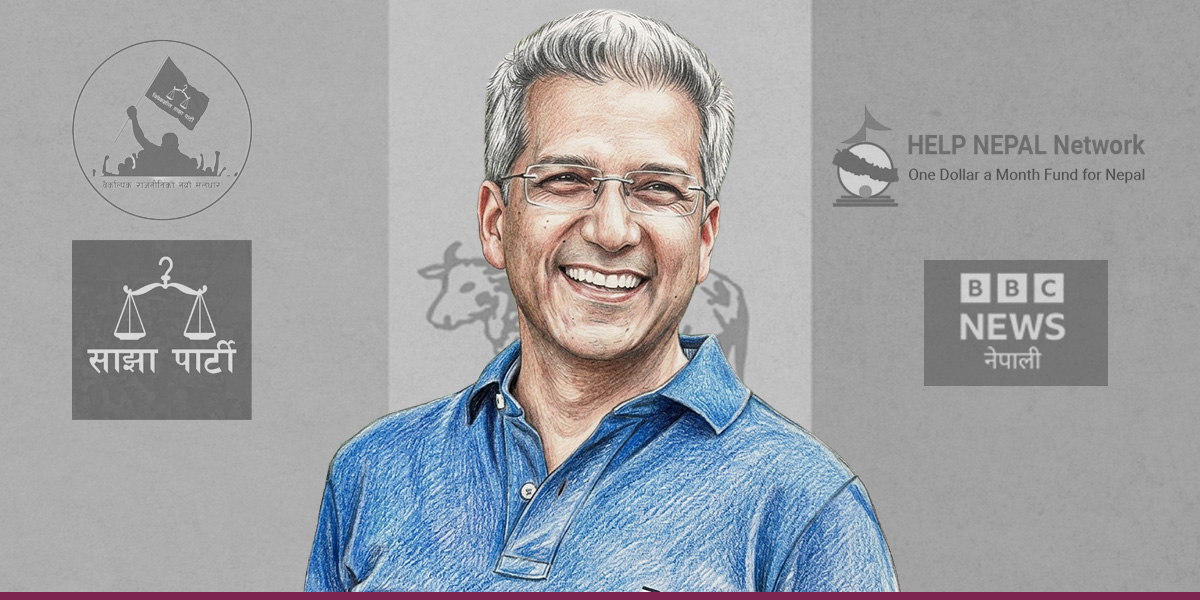
KATHMANDU: For Rabindra Mishra, who once inspired hope through journalism, intellectual debate, and the narrative of “alternative politics”, Kathmandu-1 has once again proved to be a harsh political reality.
Mishra, a candidate of the Rastriya Prajatantra Party (RPP), was confined to third position in the 2026 House of Representatives elections. With this, he completed a hat-trick of defeats in the constituency.
Ranju Darshana of the Rastriya Swatantra Party (RSP) emerged victorious with 15,455 votes. Prabal Thapa of the Nepali Congress finished second with 6,364 votes. Mishra, who is also the senior vice chairperson of the RPP, secured only 3,972 votes.
Kathmandu-1 is not a new battleground for Mishra. The constituency has become something of a laboratory for his continued political experiments and ambitions. However, he seems to have failed to connect with the voters.
Mishra is a well-known name in Nepali society. After working for many years with the BBC Nepali Service, he became a well-known figure in journalism. With his courteous language, clear presentation, and commentary on contemporary issues, he built a distinct image among readers and listeners. This very image later established him as a symbol of an “alternative possibility” in politics.
Earlier, Mishra had also been active in social work. In 2001, he founded a social organisation called Help Nepal Network (HNN), which, he claims, has been running health and education projects in rural Nepal by mobilizing support from Nepalis around the world. Besides this, he has said that he donated royalties earned from his three books to the HNN.
On 28 February 2017, Mishra resigned from BBC Nepali to enter politics to “create a common platform to bring together honest and capable Nepalis from all walks of life for the sake of clean politics to transform Nepal.” He formed the Sajha Nepal Party. A few months later, he merged the party with Bibeksheel Nepali Party, founded by late Ujjwal Thapa, to form the Bibeksheel Sajha Party.
Mishra suffered his first electoral defeat in 2017 as a Bibeksheel Sajha Party candidate when he lost to Prakash Man Singh of Nepali Congress (NC) in Kathmandu-1. Singh received 10,936 votes, while Mishra got 10,118.
The Bibeksheel Sajha Party split on January 11, 2019, as internal disputes heightened, and merged again on December 9, 2020. Following the merger, Mishra became the party’s chairperson. After less than two years, he left the party and entered the pro-monarchy Rastriya Prajatantra Party (RPP) and became its senior vice chairperson.
His second electoral defeat came in 2022 when he again lost to NC’s Prakash Man Singh by 132 votes. While Singh received 7,143 votes, Mishra could get only 7,011.
The recent election, however, proved harsher than his previous experiences. The RSP, which has emerged as a new force, made a significant impact among Kathmandu’s urban voters. Ranju capitalized on that momentum. Amid competition between traditional parties and the new force, Mishra’s vote base shrank, and he slipped to third place.
Ahead of the 2026 polls, Mishra had campaigned extensively for the restoration of the monarchy. He urged people and political parties to reach a ‘new consensus’ by reinstating the monarchy in a ceremonial role. But voters rejected his agenda. In a politically aware and competitive constituency like Kathmandu-1, image and speeches alone are not enough to secure victory. Strong organization, long-term political patience, and a clear ideological path are essential.
While Mishra’s supporters argue that his political chapter is not yet over, critics say his political story in Kathmandu-1 will end with three straight defeats if he cannot bring clarity both in direction and organisation.