 Himal Press
KATHMANDU: Hundi-related transactions accounted for 10.6% of all suspicious transaction and suspicious activity reports filed between January 2025 and July 2026, according to a recent report prepared by the Financial Intelligence Unit (FIU) under the Nepal Rastra Bank (NRB).
According to the report, nearly 90% of such reportings were made by commercial banks.
The report, which examines the trends, methods and risks associated with hundi, analyzed 1,672 hundi-related suspicious transaction reports (STRs) and suspicious activity reports (SARs) filed between January 2, 2025, and July 16, 2026. This represented 10.6% of the 15,815 STRs/SARs received during the period.
Hundi, traditionally used for trade and remittance settlements, has evolved into an increasingly organized and digitally coordinated channel for moving illicit funds across borders, the report says.
Unlike conventional money transfers, hundi moves value across borders without physically transferring the money. Operators settle their accounts through mechanisms such as netting, trade mis-invoicing, cash couriers, mule accounts and virtual assets, it added.
The report identified diverted migrant remittances, under-invoiced imports, Nepal’s long and porous border with India, a large cash-based economy and demand for prohibited virtual assets as major factors driving hundi transactions.
Hundi is a criminal offence under Section 125A of the National Criminal Code and is also prohibited under the Foreign Exchange (Regulation) Act. It became a predicate offence under the Asset (Money) Laundering Prevention Act on January 2, 2025.
Madhesh Province accounted for more than half of reported cases, with 53% of subjects located or registered in the province, mostly in border districts that are major sources of migrant workers. According to the report, 84% of individuals linked to hundi-related reports were male, while 65.5% were in the 25-44 age group.
Students and housewives also appeared among those reported. This suggests that criminal networks may be using money mule accounts to move funds through the formal banking system.
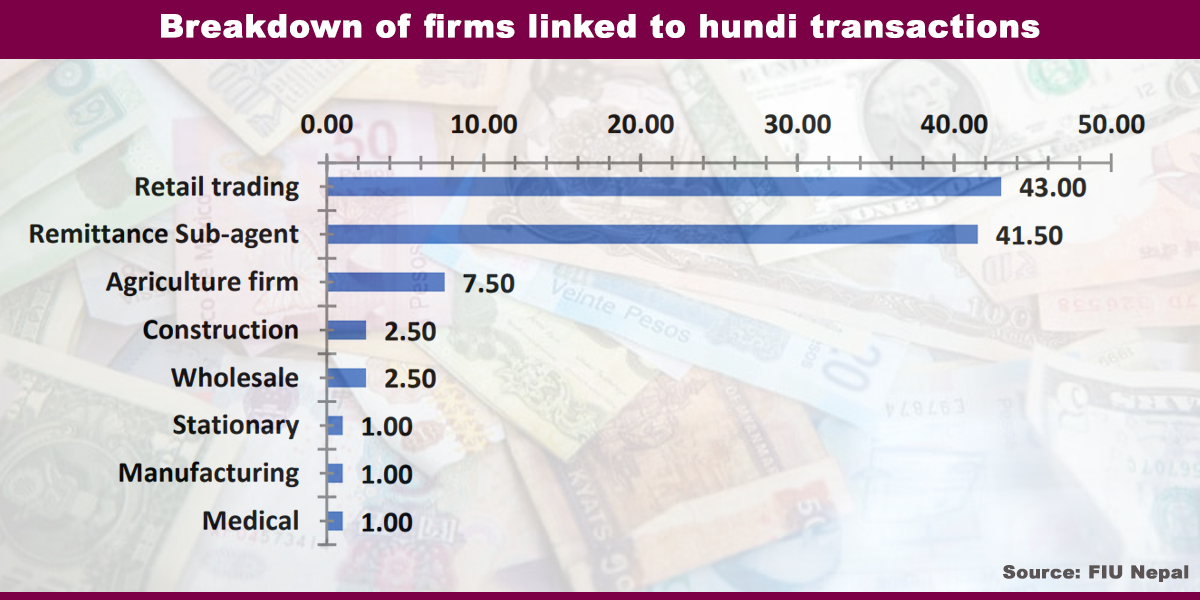
Retail traders accounted for 43% of the businesses reported, while remittance sub-agents made up another 41.5%. Together, the two categories represented 84% of the businesses linked to suspicious hundi transactions.
The analysis also found that around 40% of suspicious transaction reports involved accounts opened less than a year before the reports were filed. This suggests that newly opened bank accounts are being used for hundi-related activities.
Nepal Police data showed a rise in investigations into hundi-related cases from 18 in 2021/22 to 60 in 2024/25. Over these five years, Rs 2,736.2 billion was confiscated in connection with such cases. The average number of persons involved in each court verdict increased from 1.9 to 3.5. This suggests investigations involved larger networks rather than individual operators.
The report identifies eight major methods used to facilitate hundi transactions in Nepal. They include use of money mule accounts; structured cash deposits and transfers through multiple bank accounts; use of legal entities, including front and shell companies; use of cryptocurrency; physical transportation of cash; digital coordination combined with traditional settlement methods; use of remittance sub-agents; and links with gold smuggling.
To control hundi, the FIU has asked banks and other reporting institutions to strengthen ongoing transaction monitoring, identify structured cash deposits and money mule accounts, implement enhanced customer due diligence, and use device and geolocation tracking to detect suspicious activities.
They have also been advised to improve the quality and timeliness of suspicious transaction and activity reports, regularly train employees, raise public awareness and conduct periodic reviews of their monitoring systems.
Likewise, financial sector supervisors have been asked to strengthen oversight of digital wallets, remittance agents and cooperatives, promote artificial intelligence-based transaction monitoring, and introduce additional monitoring criteria for high-risk activities.