
In Nepal–India relations, trade, transit, and economic cooperation carry just as much importance as political and diplomatic dialogue. Prime Minister Balendra Shah’s upcoming official visit to India needs to focus not only on formal meetings, improving bilateral political ties and economic cooperation, but also on practical issues that make trade with third countries easier.
Transit has always remained a vital issue in relations between Nepal and India. For landlocked Nepal, India’s seaports, airports, railways and road networks are major gateways to international trade. Therefore, it is not enough to confine relations with India to a narrative of political goodwill and traditional friendship. A government led by younger leadership must show greater urgency in linking this traditional cordial relationship to Nepal’s economic transformation, production growth and expanded access to international markets.
Prime Minister Shah’s upcoming visit to India is all the more significant from this perspective. Alongside this rapid political rise, the government must take note of India’s positive outlook toward Nepal and its development vision. If practical trade and transit problems cannot be prioritized alongside traditional bilateral issues during the visit, even this high-level trip could end up as a mere formality. Rather than raising new issues this time, what Nepal needs to push for is implementing old agreements and opening additional options for trade.
This issue should also be included in the vision document where Nepal and India pledge mutual understanding. Alongside India’s other assistance and goodwill for Nepal’s development, transit facilitation holds equal importance. Nepal’s trade with third countries depends on Indian transit and infrastructure. The Kolkata and Haldia ports have long been Nepal’s trade gateways, while use of the Visakhapatnam port has added some alternatives.
Railway expansion has also brought ease to commercial freight movement. However, having to rely on a single port or a single mode of transport exposes Nepali businesses to risks around vessel schedules, container availability, port congestion and freight costs. Therefore, Nepal’s priority should be opening more options for transit and making existing options regular and reliable.
Kolkata and Delhi Options for Air Cargo
The first issue Nepal should raise with India is resuming air cargo transit via Kolkata Airport. Such an arrangement can be useful for importing heavy machinery, project equipment and essential goods that cannot be transported on regular passenger flights available in Nepal. Likewise, it would create conditions for Nepali exporters to use international cargo flights out of Kolkata.
To make this work, Nepal and India need a permanent standard operating procedure (SOP) for transporting cargo by road from Kolkata Airport to Nepal under customs control. This is not merely a matter of air cargo; it is a facility tied to Nepal’s industrial and infrastructure development. Nepal should also put forward a proposal to use Delhi Airport as an additional air cargo gateway.
By utilizing Delhi’s cargo flight network, specialized goods, heavy equipment and items requiring specific safety and technical standards can be transported. Initially, such an arrangement could be operated on a pilot basis through agreed border crossings.
If these two proposals are implemented, Nepal will gain access beyond the limited air cargo options available in Kathmandu. In particular, this can bring practical ease to importing equipment needed for major projects and industrial production.
Road Corridors Also Crucial
Nepal should urge India to bring the agreement on transporting containers by road from Visakhapatnam port to Bhairahawa and Nepalgunj into regular operation. When moving goods by train, problems can occasionally arise due to wagon availability and schedules. In such situations, road transport can serve as an alternative mode.
For this, a joint procedure must be drafted covering the transport of sealed containers, required documentation, customs inspection, and clearance processes. Rather than leaving the agreement on paper, it would be even better to have clear provisions on which border point is used, what process applies and within what timeframe goods are moved.
Similarly, road transit from Kolkata and Haldia needs to be shifted to a digital system. The experience of electronic processes already in use on rail routes can be extended to road freight as well. If online information is available on customs transit declarations, required documents and cargo status, procedural hassles can be reduced. This holds the potential to lower both transit time and cost.
Another important issue is granting permission for commercial trucks with Nepali license plates to reach Indian ports. Currently, in many cases, transferring goods to another vehicle near the border increases time and cost. Nepali trucks meeting specified standards can be allowed to reach the Kolkata and Haldia ports.
This requires clear provisions on vehicle standards, insurance, permits, approved routes and customs monitoring. If such an arrangement is put in place, Nepali businesses will gain greater flexibility in logistics, and Nepal’s direct participation in transit will also increase.
Access to Dhamra and Mundra Ports
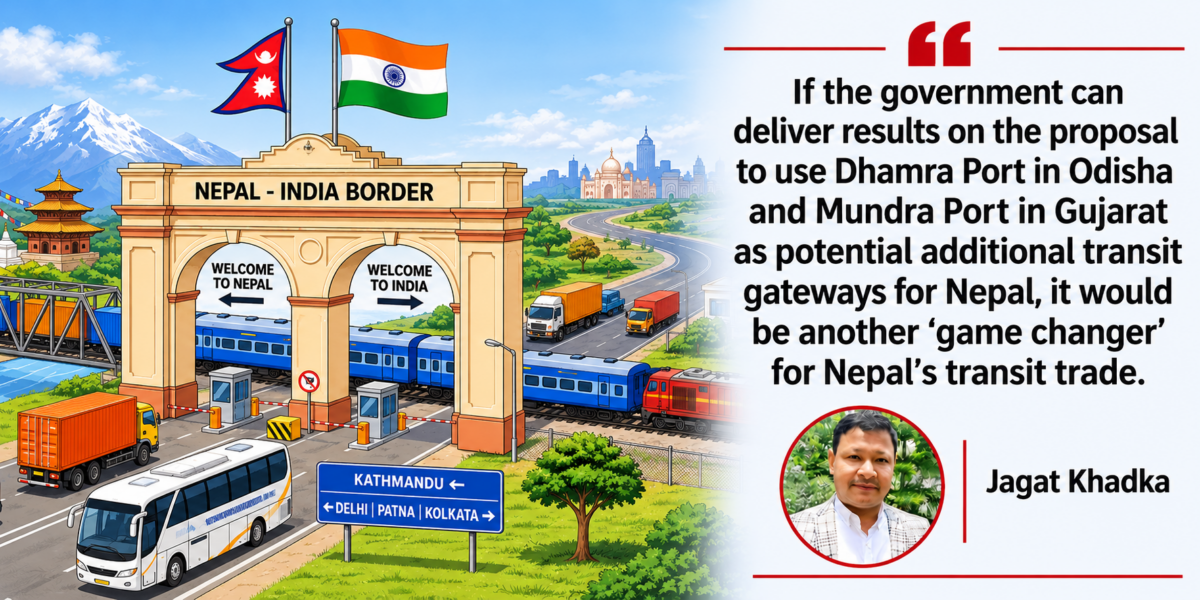
Another long-term issue Nepal should raise this time is expanding access to India’s Dhamra and Mundra ports. If the government can put forward a proposal to use Dhamra port in Odisha and Mundra port in Gujarat as potential additional transit gateways, it will be another game changer in transit.
The feasibility of reaching these ports by both rail and road should be studied. Both countries can conduct a joint study on which route costs less, which port offers suitable services for Nepali trade and what the state of vessel movement and cargo handling looks like.
Simply adding ports does not automatically make trade cheaper and easier. For that, ocean freight, port charges, inland haulage costs, customs procedures and the total cost to Nepal must be compared. Only then can a decision be reached on which port is suited to which type of trade.
Nepal’s aim is not to seek alternatives to India’s existing ports to make relations competitive. Rather, it is to use India’s own infrastructure to give Nepali trade more options, competition, and flexibility. That can benefit businesses in both countries.
Focus on Implementation
The most crucial aspect of all these proposals is implementation. Nepal and India have reached agreements on trade and transit repeatedly in the past. Even when understandings are reached on certain issues, implementation is often delayed because operating procedures are not drafted or coordination among relevant agencies is lacking. Therefore, rather than adding new commitments during the Prime Minister’s visit this time, it is necessary to set timelines for implementing old agreements.
These matters should be clearly included in the agreement or joint minutes of the bilateral meetings during the visit. Afterward, responsibility for implementation can be assigned to the intergovernmental sub-committee on trade and transit of both countries.
It would be appropriate to set a timeline for that sub-committee to draft the necessary operating procedures within 90 days and submit them to both governments. This can move issues out of indefinite discussion and into the implementation phase. It will also clarify which agency does what, which procedures need to change, and where policy decisions are required.
Reaching such an agreement with a timeline during the Prime Minister’s visit to India would itself be a major achievement. Because the problem in Nepal–India relations is not only a lack of agreements, but also of mechanisms and accountability to turn agreements into practice. In this sense, Prime Minister Shah’s visit can be elevated beyond traditional diplomatic meetings and tied to economic diplomacy outcomes.
It is natural for the Prime Minister to raise issues of political trust, mutual respect and bilateral cooperation with the Indian leadership. Along with that, however, the Prime Minister must also raise the logistics problems Nepali traders are facing, the difficulties industrialists encounter importing equipment and the procedural hassles exporters face reaching international markets. On this, it is essential to listen to those who experience these challenges firsthand. Relying solely on bureaucrats sometimes makes things look good and top-notch only on paper.
For Nepal, the importance of its relationship with India does not lie solely in open borders, cultural proximity, and political dialogue. It also lies in the ability to connect the Nepali economy to global markets by utilizing India’s infrastructure. To that end, transit facilities are not merely a technical matter; they are the foundation for expanding Nepal’s economic independence and competitiveness.
A joint statement issued after the Prime Minister’s visit may contain plenty of positive words about the relationship. However, its real evaluation must be based on whether cargo transport from Kolkata has resumed, whether Delhi Airport has become an additional gateway, whether the road route to Visakhapatnam has come into regular operation and whether Nepali trucks have gained access to the ports.
Nepal must not just ask India for facilities; it must also ask for timelines to put agreements into implementation. The success of the Prime Minister’s visit should be seen not in the wording of a joint statement, but in the tangible results of how much the cost, time and hassle of Nepali trade have decreased.
(The author is a promoter of Nepal Shipping Company and an established figure in the cargo sector.)