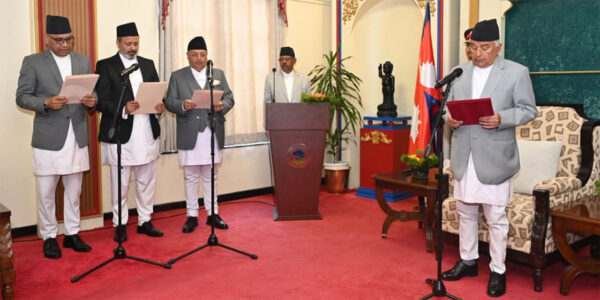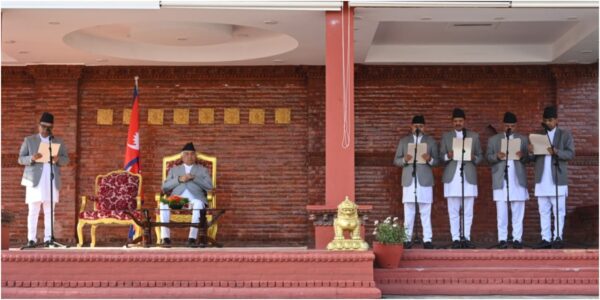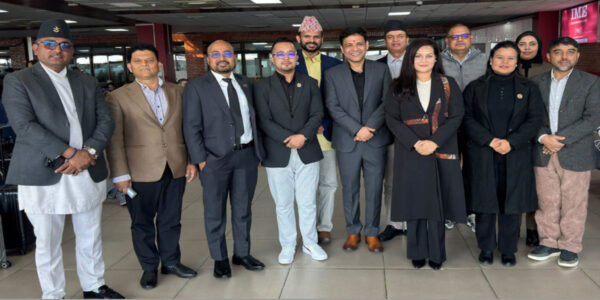
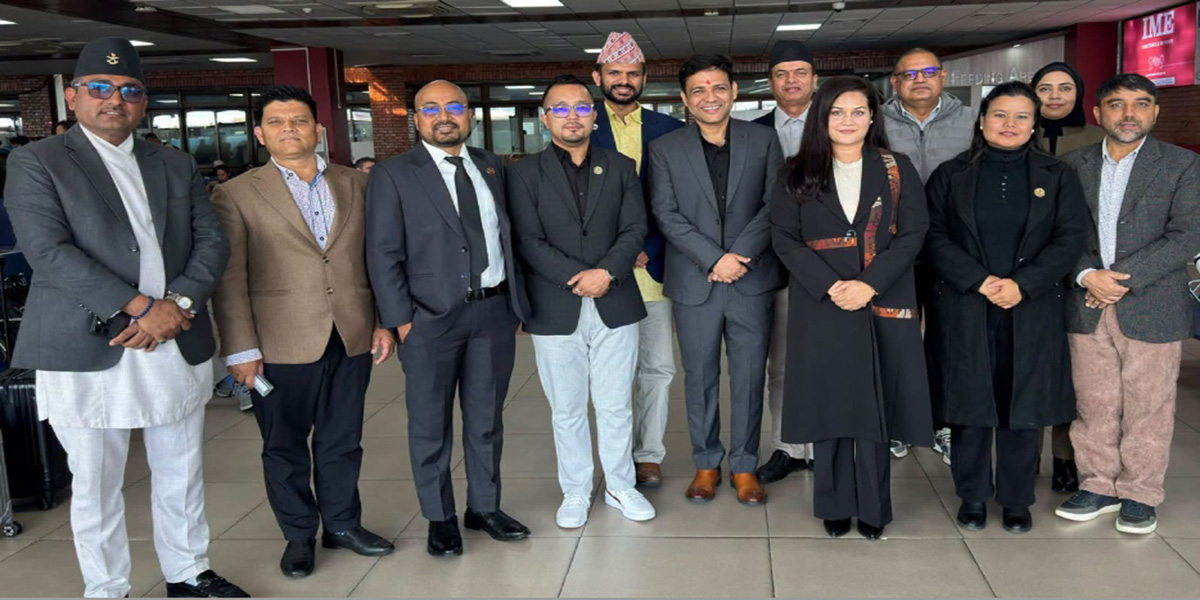
 RSP lawmakers at the Tribhuvan International Airport before their departure to China. Photo Courtesy: RSP lawmaker Reema Bishwkarma
KATHMANDU: The Rastriya Swatantra Party (RSP), which previously criticized leaders and lawmakers from other political parties for traveling abroad in large groups, is now facing similar criticism itself.
As more ministers and lawmakers travel overseas, questions are emerging within the party about the purpose of these trips, their costs and the benefits they bring to the country. RSP leaders and lawmakers have begun raising these concerns publicly.
A large Nepali delegation, including five ministers, lawmakers and government officials, traveled to Turkey to attend the UN Climate Change Conference (COP31). A separate group of 20 lawmakers is currently in China at the invitation of the Communist Party of China. Two RSP lawmakers are attending the Asian Women Parliamentarians’ Caucus in Malaysia, while another is preparing to travel to the Philippines for a conference on ending violence against children. Dr. Ojaswi Sherchan, a lawmaker and chair of the parliamentary Education, Health and IT Committee, is in Israel to attend the Edunation Forum.
A series of foreign visits seems to have caused discontent within the RSP. Lawmakers from the party are demanding answers not only about the number of people traveling but also about the purpose, cost and outcomes of the visits.
Tika Sangroula (Jwala), an RSP central committee member and lawmaker, has questioned why party leaders who once opposed group trips by politicians from other parties are now following the same practice.
“Traveling abroad in large groups goes against the interests of the country and its people, colleagues. Where does it say that something wrong when others did it yesterday becomes right when we do it today?” she wrote on social media. “If the host country has invited a certain number of lawmakers, including experts, and is covering all the expenses, that is fine. But if we are traveling at the expense of the state, this practice was wrong yesterday and is wrong today.”
Another RSP Central Committee Member and lawmaker, Ganesh Karki, has called on those attending COP31 to publicly disclose whether their trips are being funded by the government.
“As always, there is a long queue of people heading to COP this year as well. Perhaps because I am an environmental studies student and a lawmaker, I see many colleagues already in Turkey or preparing to travel there for the conference,” he wrote. “Those attending should publicly declare whether they are traveling at government expense. They must do so.”
He added: “There is a great deal to see and learn at COP. But that does not give anyone the right to pursue personal interests using public funds.”
RSP lawmaker Ashika Tamang has also questioned how many times lawmakers can travel abroad at the expense of the state.
“How many times can a lawmaker travel abroad using public funds? Forget the public; even other lawmakers within the same party have no idea why their colleagues have gone abroad,” she wrote.
She said greater transparency was needed about the purpose and outcomes of such visits.
“Lawmakers belong to different parliamentary committees. They quietly leave the country on trips organized through their committees and quietly return. Yet even other members of the same committees know nothing about these visits. Why do lawmakers travel abroad? What do the public and lawmakers gain from overseas trips that cost the state hundreds of thousands of rupees?” she asked.
Lawmaker Rajunath Pandey has also criticized the tendency among politicians to prioritize foreign travel after assuming positions of responsibility.
“Once you get a position or a seat of power, going abroad seems to become the priority. How strange! Even shame seems to feel ashamed!” he wrote on social media.
RSP lawmaker Shreeram Neupane said on his social media page that he had declined an invitation to attend COP31. He said the Prime Minister’s Office and the Ministry of Forests, Agriculture and Environment had approached him about joining the conference.
“I had made my position clear. I said I would join the trip only if I was guaranteed an opportunity to deliver a presentation and take a leading role on behalf of Nepal at a side event on the energy sector scheduled for November 10, and if I could attend at my own expense,” he wrote. “I had made it clear that I would pay for the trip myself, not use public funds. Otherwise, I would not participate.”
Neupane said he decided not to go because the opportunity to make a presentation could not be formally guaranteed and he had to attend a previously scheduled public dialogue.
A 20-member delegation of RSP lawmakers has traveled to China for an 11-day visit at the invitation of the Communist Party of China. The delegation is led by party General Secretary Bipin Kumar Acharya and includes Joint General Secretary Hari Dhakal, Deputy Leader of the Parliamentary Party Ganesh Parajuli, Chief Whip Kabindra Burlakoti and other lawmakers. The group is scheduled to visit Beijing, Hangzhou and Sichuan, among other places.
RSP spokesperson Jagadish Kharel, who saw off the delegation at Tribhuvan International Airport, said the visit will not cost the Nepali state treasury anything.
“It is an official trip at the invitation of the Communist Party of China. The Chinese side will manage all logistical arrangements, from our departure to our return. Therefore, the visit will not incur any expense for the Nepali state treasury,” he said.
Acharya said questions raised within the party about foreign travel should not be interpreted as opposition to such visits.
“My understanding is that lawmakers are not opposing foreign travel itself. They are questioning its purpose, the proper use of public funds and whether the right people are being included,” he said. “It is natural and necessary to ask about the objectives of any visit and the expenses involved.”
Nepal’s delegation to COP31, which is underway in Antalya, Turkey, includes Foreign Minister Shishir Khanal, Environment Minister Gita Chaudhary, Finance Minister Swarnim Wagle, Education Minister Sasmit Pokharel and Health Minister Nisha Mehta, along with lawmakers and government officials. Other ministers and lawmakers have also traveled to the conference after arranging their own programs outside the official delegation.
However, the presence of a large delegation does not appear to have helped Nepal put its key climate concerns on the international decision-making agenda.
As a country highly vulnerable to the climate crisis, Nepal had aimed to bring mountain-related issues into the formal agenda, advance climate justice and secure grant-based support for compensation and adaptation.
But proposals jointly put forward by Nepal and Bhutan on “Mountains and Climate Change” and “1.5 Degrees Celsius Warming in Mountains” failed to secure support from major negotiating blocs and were not included in the formal agenda. A separate proposal from Kyrgyzstan met the same fate.
Foreign Minister Khanal himself has acknowledged that the proposals failed to win support from major negotiating blocs. Although there is an understanding to continue discussions with the conference presidency and Australia, Nepal has been unable to secure a separate agenda item or a permanent action plan of the kind it had sought.