

The house was once filled with laughter, lively conversations and warmth. School bags lay carelessly on the sofas, shoes were scattered near the doorway, and the kitchen was always filled with the comforting aroma of meals prepared for children rushing between school, college, dreams, and responsibilities.
Every corner of the house carried cherished memories—Father’s Day and Mother’s Day celebrations, family events, Dashain and Tihar festivities, family gatherings, late-night conversations, shared meals, childhood quarrels, weekly Friday sharing meetings, and countless hopes for a brighter future.
Those moments once felt ordinary. Today, the same house stands strangely silent.
This is because their children are now thousands of kilometres away—in the United States, Australia, Japan, the Gulf countries, Europe, or elsewhere—pursuing education, building careers and seeking better opportunities. Parents are deeply proud of their children’s achievements and of the sacrifices that helped make those opportunities possible.
Yet beneath that pride lies a quieter reality: loneliness.
For some parents, the economic benefits of migration coexist with emotional separation, reduced companionship, and growing uncertainty about who will support and care for them as they grow older.
This is the human cost of migration that economic statistics rarely capture.
Two Undergoing Shifts
Nepal is undergoing two significant demographic and social transformations at the moment: population ageing and large-scale migration. The 2021 National Population and Housing Census recorded approximately 2.97 million people aged 60 years and above, representing about 10.2% of Nepal’s population—nearly three times the number recorded in 1991. At the same time, the Census reported 2,190,592 people absent and living abroad, which is equivalent to approximately 7.5% of the total population.
These figures tell an important story: Nepal is ageing while its younger population is becoming increasingly geographically dispersed.
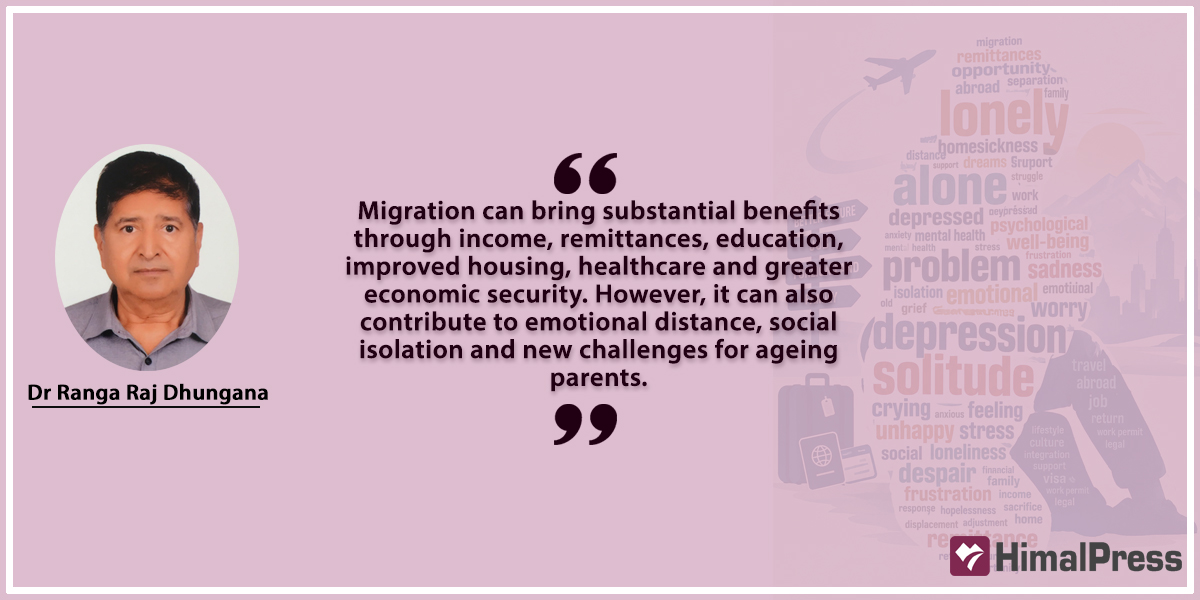
As adult children migrate abroad for education, employment and better opportunities, traditional multigenerational family structures and caregiving arrangements are changing. Migration can bring substantial benefits through income, remittances, education, improved housing, healthcare and greater economic security. However, it can also contribute to emotional distance, social isolation and new challenges for ageing parents.
The public-health question, therefore, is not whether migration is inherently good or bad. The more important question is: How can Nepal protect the mental health, dignity, social connectedness, and overall well-being of older parents as families increasingly live across borders?
For many parents, each morning begins much the same way. A father may wake early, open the gate, sweep the yard, read the newspaper and check his phone, hoping for a message or missed call from his children.
A mother may prepare tea for two instead of four or six. Yet she may still cook more food than necessary because, deep inside, she has not fully accepted the emptiness of the family dining table.
The children’s rooms may remain untouched for months or even years. Old books gather dust, while school uniforms, childhood belongings, trophies, certificates and photographs remain carefully preserved—quiet reminders of another time.
The Cost of Separation
A 2026 mixed-method study of 140 older parents in Kathmandu Metropolitan City whose children had migrated abroad found that 49.29% had depressive symptoms, based on the Geriatric Depression Scale. Approximately 30% had mild, 14.29% moderate and 5% severe depressive symptoms. The qualitative findings also highlighted loneliness, fear, emotional distress, and increased psychological difficulties during festivals and periods of illness.
The study found that marital status was an important factor, with widowed, divorced or separated older parents more likely to experience higher levels of depressive symptoms than those living with their spouses.
An earlier study offers a similarly nuanced perspective. A community-based study of 260 older adults in Krishnapur Municipality of Kanchanpur found that households with at least one adult migrant child had higher odds of perceived loneliness, although significant associations were not observed across all health outcomes.
These findings highlight the importance of responsible public-health communication. Migration should not be portrayed as the sole cause of loneliness or depression. Rather, it should be understood as one factor within a broader social, economic, demographic, health, and psychological context influencing the well-being of older parents.
The National Mental Health Survey, conducted during 2019–2020 among more than 15,000 participants, estimated that 4.3% of adults had a current mental disorder, while 10% had experienced a mental disorder at some point in their lifetime. Major depressive disorder was estimated at 2.9% lifetime and 1.0% current prevalence among adults.
The survey also demonstrated a significant treatment gap. Only a minority of people experiencing mental-health problems had received appropriate treatment, with stigma, lack of awareness and barriers to accessing services contributing to unmet need.
For older adults, these challenges can become more complicated because mental-health problems may occur alongside chronic disease, disability, bereavement, financial insecurity, reduced mobility and dependence on others.
Loneliness is therefore not merely an emotional inconvenience. It can become a public-health concern.
Migration can bring significant economic benefits. Remittances may help families improve housing, education, nutrition, healthcare, and financial security. A household may become considerably more prosperous than before.
However, financial security does not automatically eliminate loneliness. A larger house does not guarantee companionship. A comfortable home cannot remove the fear of ageing alone. A bank balance cannot replace a reassuring hand during illness, immediate support in an emergency, or the comfort of having a loved one nearby.
This is one of the central paradoxes of migration: a family’s material circumstances may improve while its emotional well-being becomes more vulnerable.
Children Abroad Also Struggle
The emotional burden of migration does not fall on parents alone. Children living abroad may also experience guilt, anxiety, and emotional conflict.
Many sons and daughters work long hours in foreign countries while worrying about their ageing parents at home. They may be building careers, repaying migration-related debts, supporting their families, obtaining legal residency, or seeking better opportunities for their own children.
At the same time, they know that their parents are growing older. They miss festivals, birthdays, family gatherings, illnesses, funerals, weddings, and countless ordinary moments that can never be recovered.
This creates a painful paradox. Parents may feel abandoned even when their children are working hard to secure the family’s future, while children may feel guilty even when they are sacrificing their own comfort to support their parents.
In Nepali culture, parents are often expected to be resilient, endure hardship, and remain selfless. They may feel that expressing their struggles is selfish or that asking their children for emotional support could interfere with their careers and responsibilities. As a result, loneliness may remain hidden behind culturally valued qualities such as patience, sacrifice, and selflessness.
But resilience should not be confused with silence. A parent can be strong and still need support. A parent can be proud of a child’s success and still miss them deeply. A parent can be financially secure and still feel lonely. A parent can love their children unconditionally and still experience sadness, anxiety, or depression.
These realities can coexist. Recognizing them is not a sign of weakness; it is an important step toward compassion, connection and mental well-being.
If parental loneliness is to be addressed effectively, Nepal must move beyond the idea that mental health is solely the responsibility of specialist psychiatric services.
Older adults experiencing loneliness, depression, or anxiety should be identified early and supported through community-based, primary healthcare, and family-centred approaches.
This direction aligns with Nepal’s evolving mental-health policy. The World Health Organization reports that Nepal has been strengthening its mental-health system, including efforts to expand community-level services, develop municipal mental-health tools, and strengthen suicide-prevention initiatives.
In 2025, the Ministry of Health and Population, with WHO support, developed the Community Mental Health Program Guidance for Local Level (Model Municipality Toolkit) to help municipalities promote mental health and prevention beyond clinical services. Pilot municipalities implemented activities such as awareness campaigns, community outreach, well-being programs and collaboration among health services, local governments, educational institutions and community organizations.
A comprehensive public-health response should operate at multiple levels, from primary healthcare and communities to families and national policy. An older person seeking care for hypertension or diabetes may also be experiencing significant loneliness or depression. Physical and mental health should therefore be assessed together.
Strengthening community-based psychosocial support, training frontline health workers, developing migration-sensitive family health programs, establishing local emergency and support networks and including older parents in migration policy can be of great help.
Migration affects more than migrants. It also affects spouses, children, parents, caregivers, and communities. Nepal’s migration and diaspora policies should therefore consider the social, emotional, and psychosocial consequences of family separation, alongside employment, remittances, and migrant-worker protection.
A family-sensitive approach to migration can help ensure that economic mobility does not come at the cost of emotional well-being and healthy ageing.
Measuring What Really Matters
Migration should not be reduced to a debate over whether children should stay or leave.
For many Nepali families, migration is a pathway to education, employment, economic security, and social mobility. Children leave in search of a better future, while parents support them out of love and hope. Remittances can transform households and communities.
But economic gains should not make us overlook the emotional costs of family separation.
Nepal has rightly recognized the economic importance of migration. The next step is to recognize its human and psychosocial dimensions.
Remittances can pay a medical bill, but they cannot accompany a parent to the hospital. A new house can provide shelter, but it cannot eliminate loneliness. A smartphone can connect two faces, but meaningful connection requires time, listening, and emotional presence. A successful child living abroad can be a source of immense parental pride. But that success should not come at the cost of parents suffering silently.
The challenge for Nepal, therefore, is not to prevent migration. It is to ensure that migration does not become emotional abandonment—and that economic mobility is accompanied by family connection, social support, and healthy ageing.
(Dhungana holds a PhD in mental health)













![Yosin pole raised as Indrajatra festival begins in Kathmandu [In Pictures]](https://en.himalpress.com/wp-content/uploads/2026/09/Indrajatra-5-600x300.jpg)