During a recent visit to Japan, I was having a casual conversation with a Non-Resident Nepali (NRN) who has been doing business there for two decades. Nearly 60 years old himself, he brought up a younger entrepreneur named Hari Pandey, referring to him respectfully as “Hari Dai” (elder brother Hari). Surprised by the deference to a younger man, I asked about their age gap. “I am older in years,” he explained, “but he is our Hari Dai. He is an elder brother to us all.”
The next day, another veteran Nepali businessman talked about Pandey and called him the same. Later, at a hotel table in Shin-Okubo, a Tokyo neighborhood known for its Nepali restaurants, I asked a group of older restaurateurs about Pandey’s prominent business presence. Before I could finish, one interrupted: “He is our guardian; he is Hari Dai for everyone.”
In Nepal, terms like dai are assigned by birth order. In Japan’s Nepali community, however, I felt that respect is earned through one’s work. One earns such respect only through experience, character and the ability to support others in times of trouble.
Pandey completed hospitality training in India and headed to Japan to launch his own enterprise. Today, his businesses in Japan employ more than 100 Nepalis and foreign nationals.
Pandey, one of the earlier Nepalis to settle in Japan, used his own experience to pave the way for newcomers. He has trained workers, offered business opportunities, and supported those in difficult times. Older peers call him Hari Dai out of respect; younger ones do so naturally. To some, he is an old friend or business mentor; to others, a generous lifeline. This respect best describes his 32-year journey in Japan.
Pandey grew up in Pithuwa, in present-day Ratnanagar Municipality-14 of Chitwan. After attending Janajagriti Secondary School, he left for India to study and build a future. Born into a prosperous family, he could have lived a simple, luxurious life in his village itself. However, he felt he should do something on his own. Pandey completed hospitality training in India and headed to Japan to launch his own enterprise. Today, his businesses in Japan employ more than 100 Nepalis and foreign nationals.

When Pandey arrived in Japan, he faced an unfamiliar language, culture and business environment. Rather than being intimidated, he saw opportunity. He opened hotels and restaurants and gradually expanded his business. Although his businesses faced setbacks during the COVID-19 pandemic, he managed to keep them afloat. He is currently associated with nearly a dozen establishments across Japan, including brands like Masala Dining, Masala Station, Lotus Lounge, Lotus Garden, Colonial Lounge, Colonial Garden, and Oriental Terrace Lotus. Several of his venues operate within APA Hotels, one of Japan’s prominent hotel chains, including Oriental Terrace Lotus on the first floor of the APA Hotel Kabukicho Chuo in Shinjuku, Tokyo.
Pandey always avoids self-promotion. He does not keep count of his ventures, rarely gives out business cards listing all his properties and avoids boasting about his investments. “Business grows naturally as you work,” he says. “It should be treated normally.”
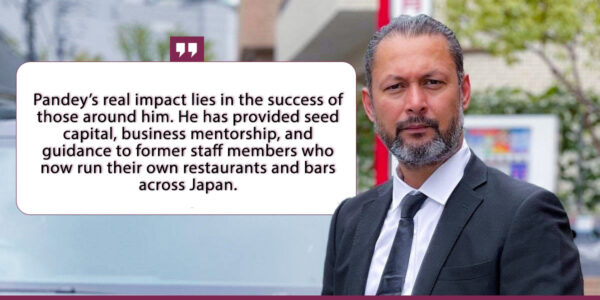
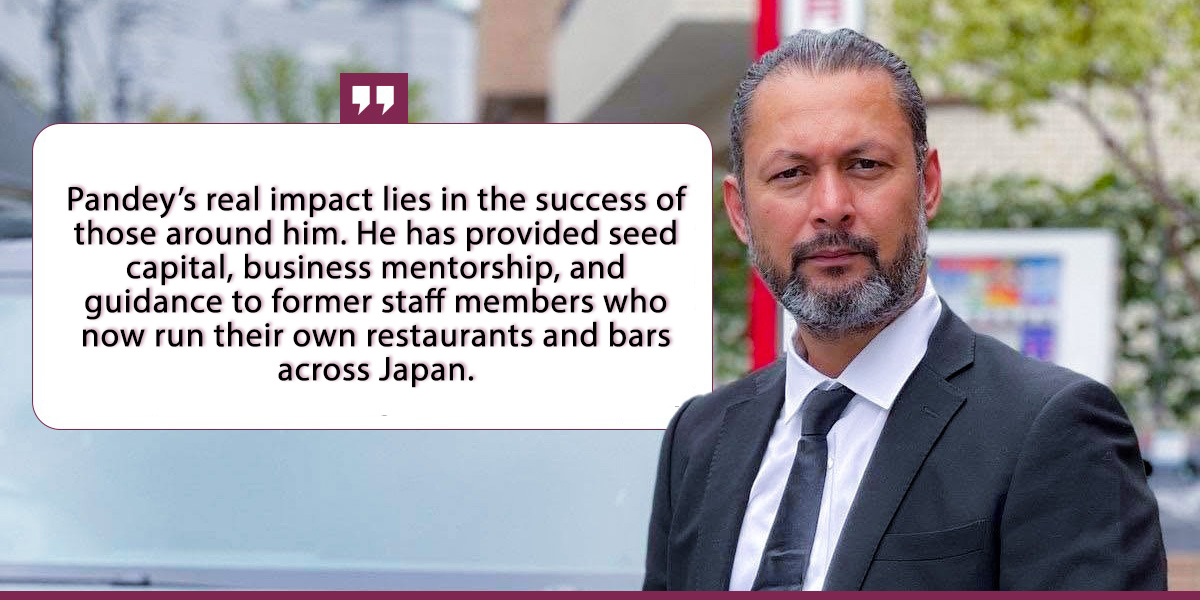
Pandey’s real impact lies in the success of those around him. Unlike typical employers who view departing staff as a loss, Pandey encourages employees to become independent. He has provided seed capital, business mentorship, and guidance to former staff members who now run their own restaurants and bars across Japan.
As the Nepali diaspora grew, Pandey’s network expanded to include school friends, family members, and newly arrived immigrants whom he helped employ or support. High-profile visitors from Nepal, including business leaders, artists, politicians, former ambassadors, and government officials, meet him when they are in Japan. But he doesn’t like to take photos with dignitaries and share them on social media.
Pandey has repeatedly received offers to invest in Nepal. He has accepted some of these proposals as well. It is said that he has investments in a few ventures in Nepal. However, he does not wish to disclose where or how much he has invested. “I am involved in a few projects in Nepal with my friends. But I am not really much of an investor; it is just collaboration and enthusiasm with friends,” he added.
Pandey’s legacy in Japan is measured not by the number of businesses he owns, but by the trust and respect he has earned across three decades.
He believes that work should speak for itself and one should not trumpet one’s own work. It is this nature that sets him apart from others. He is known for working hard himself and encouraging others to do the same. That is why many people who have worked with him still fondly remember him as “Hari Dai.” In that “Dai,” there is far more trust than mere age.
Regarding NRN affairs, Pandey rejects the notion that being a non-resident Nepali requires participating in diaspora politics. While he once played an influential role in supporting Bhawan Bhatta’s leadership within the Non-Resident Nepali Association (NRNA), he grew disillusioned with the organization’s internal politics and shifted his focus purely to his work and quiet community support.
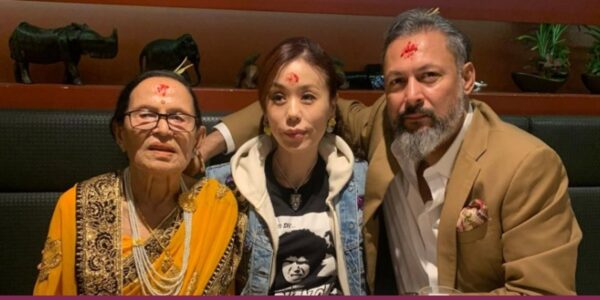
Having spent most of his life in Japan and marrying a Japanese citizen, Pandey views the country as his home. His life outside business is normal and simple: he reads, watches films, spends time with family, travels and pursues creative hobbies. Over the years, he has written songs and modeled in more than a dozen Nepali, Hindi, and Japanese music videos—often alongside prominent Nepali actresses. He has turned down offers to act in films to keep his acting as a light hobby. An avid traveler who has visited most of Nepal, he hopes to explore the far-western region in the future.
Pandey’s legacy in Japan is measured not by the number of businesses he owns, but by the trust and respect he has earned across three decades. This is why he chooses to remain simply as ‘Hari Dai’ to the Nepali community in Japan.