 Himal Press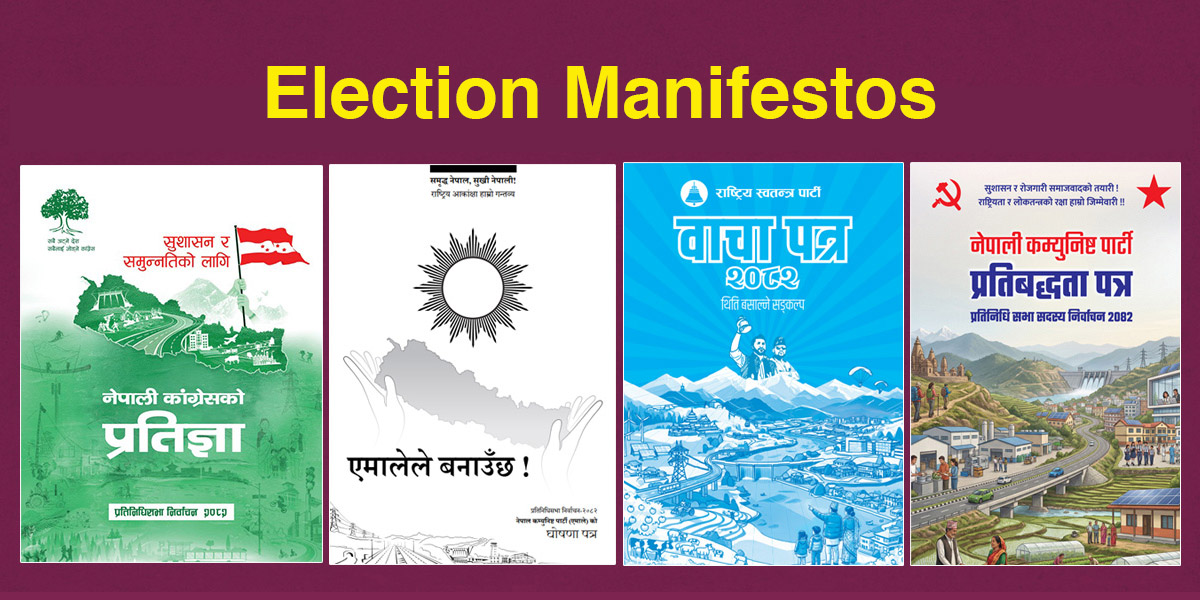
KATHMANDU: Major political parties have placed economic revival, investment growth, and job creation at the center of their election manifestos for the House of Representatives elections scheduled for March 5.
The CPN-UML, Nepali Congress, Nepali Communist Party (NCP), and Rastriya Swatantra Party (RSP) have each outlined distinct strategies to address sluggish growth, declining private investment confidence, and persistent unemployment.
The parties have expressed commitment to accelerating economic expansion and creating a more investment-friendly environment. However, they differ on the extent of state involvement and the role of the private sector. While the NC and UML emphasize private sector-led growth supported by policy stability, the RSP has focused on governance reforms to remove bureaucratic barriers. The NCP, on the other hand, has proposed a socialist-oriented approach that seeks to expand the public and cooperative sectors alongside private enterprise.
The Nepali economy is currently struggling with low capital expenditure, weak industrial output, and subdued investor sentiment. Political instability, regulatory uncertainty, and structural bottlenecks have slowed economic momentum in recent years. Parties have tried to address these issues in their manifestos.
CPN-UML
The CPN-UML has also emphasized the private sector as the main driver of prosperity. It has pledged to create a fear-free investment climate and protect businesses and investments.
The party has set a target of achieving 7–9% annual economic growth and expanding the economy to Rs 100 trillion within five years, with further expansion to Rs 200 trillion in the following five years. The UML has identified agriculture, energy, industry, tourism, infrastructure, information technology, forestry, and the environment as key sectors for state and private investment.
The party has also pledged monetary and governance reforms to promote industrial and commercial growth and expand public-private partnerships to accelerate development.
TheUML has set a target of creating 500,000 jobs annually. The manifesto states that jobs will be generated through agricultural modernization, commercial farming, food processing industries, infrastructure development, green industries, and the service sector. The UML has also pledged to provide secure housing with basic services to landless people, squatters, vulnerable groups, and low-income citizens. The party plans to establish a “Citizen Housing Fund” and promote housing development through public-private partnerships, to ensure that no citizen remains homeless.
The UML manifesto also includes plans to begin commercial production from the gas reserves in Dailekh and the Dhauwadi iron mine. The party aims to double the industrial sector’s contribution to GDP by expanding productive industries, mining, electricity, drinking water, and construction. In addition, UML has set a target of doubling exports within three years and tripling them within five years.
Nepali Congress (NC)
The NC has declared the next five years as a half-decade of economic revival. The party aims to expand the economy to Rs 115 trillion and raise per capita income to $2,500 within five years. The party expects a total investment of Rs 137.5 trillion is needed during the period. It plans to mobilize 80% of this investment from the private sector. It has said that the role of the state will be limited to that of a facilitator and impartial regulator.
The party has committed to building a pro-private, pro-growth, and pro-social justice economy based on liberal economic policies, productive capacity expansion, and equitable wealth creation. It also plans to attract domestic and foreign investment into productive sectors to generate large-scale employment.
Tax reforms form a key component of the NC’s agenda. The party has pledged to gradually reduce corporate income tax to 20%, maintain lower rates for export-oriented and IT industries, and reduce the VAT rate to 10% over time. It also plans to exempt personal income up to Rs 1 million from taxation and ensure long-term tax stability through legal guarantees.
The manifesto also promises a paperless digital system for business registration and renewal, fast-track commercial courts, strengthened special economic zones in each province, and an investment promotion and protection board.
The Nepali Communist Party (NCP) has proposed a socialist-oriented economic framework based on three pillars: public, cooperative, and private sectors. The party has pledged to gradually expand the public sector while ensuring coordination among all three.
The NCP has set ambitious targets, including achieving over 10% annual economic growth and reducing poverty from 20.15% to 5% within five years. It has pledged to utilize unused public and private land, natural resources, and financial capital for productive activities and employment generation.
The party has also proposed directing unused bank funds toward small and medium-sized enterprises and expanding access to credit beyond large business groups.
The party has pledged to create 500,000 jobs each year by mobilizing unused public and private land and natural resources for production. It plans to simplify procedures to attract and protect private investment, promote public–private partnerships in infrastructure and industry, and ensure a level playing field in the market.
Likewise, it has emphasized restructuring the economy to lower production costs, digitize economic systems, formalize informal sectors, and promote import substitution and export growth. The party has prioritized sectors like agriculture, tourism, hydropower, and IT, with a push for AI-based smart manufacturing and industries based on domestic raw materials. The party has also expressed commitment to expand cooperative-based enterprises, promote eco, adventure, and religious tourism, and offer special incentives to export-oriented and import-substituting industries.
Rastriya Swatantra Party (RSP)
The RSP has focused primarily on governance reform and removing systemic bottlenecks faced by businesses. The party has proposed setting fixed timelines for bureaucratic decisions, with automatic approval or accountability measures if deadlines are missed.
The party has pledged to limit the government’s role to that of a regulator and facilitator while allowing the private sector to lead job creation, investment, and service delivery. It has also committed to promoting industrialization based on productivity, skills, capital formation, and technology.
The RSP has pledged to simplify foreign investment procedures, promote innovation and entrepreneurship, and repeal around two dozen laws deemed barriers to economic growth. It has also expressed commitment to reduce the overall tax burden while ensuring revenue stability and avoiding retrospective taxation.