 Himal Press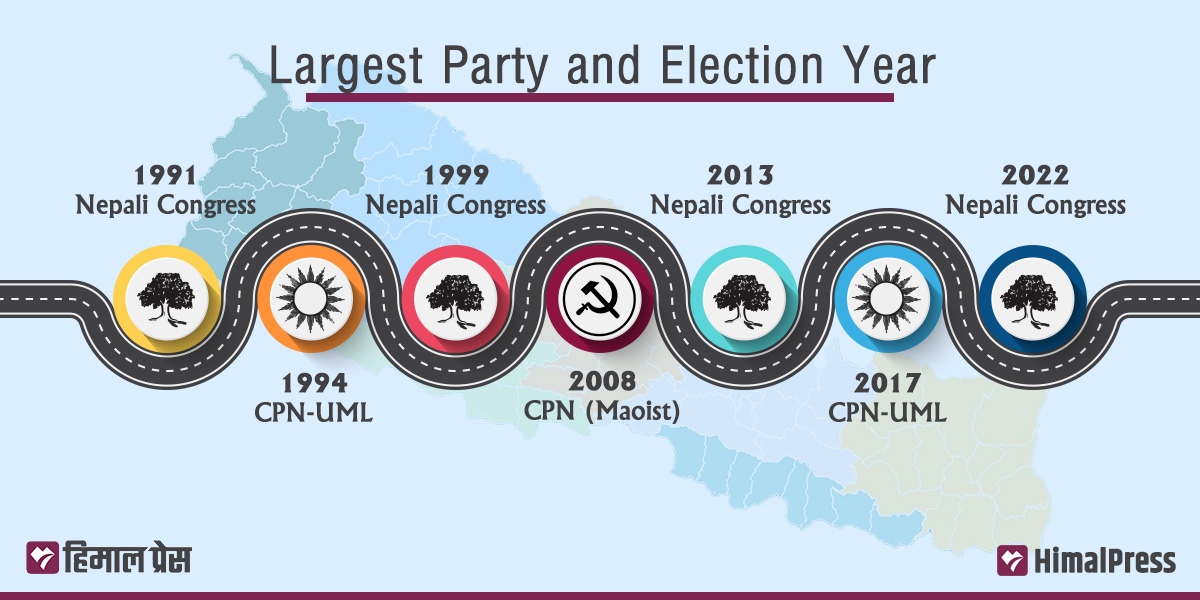
KATHMANDU: In the three-and-a-half decades since the restoration of the multiparty system, Nepal has seen seven parliamentary elections and countless power equations. Each election produced a new largest party. However, the defining feature of instability never changed.
Nepal has held seven elections and seen 27 prime ministers since 1991. During this period, Girija Prasad Koirala, Sher Bahadur Deuba, KP Sharma Oli, Pushpa Kamal Dahal, Surya Bahadur Thapa, and Lokendra Bahadur Chand served as prime ministers multiple times. No single party has been able to lead consistently across these elections, and no prime minister has completed a full five-year term. By 2022, the Nepali Congress (NC) had emerged as the largest party four times, the CPN-UML twice, and the Maoists once.
The NC won a majority in the first election held in 1991 after the restoration of multiparty democracy. However, internal rifts within the party led to a mid-term election in 1994. Although the UML emerged as the largest party in the mid-term elections, it lacked a majority. Nevertheless, UML formed the government and Nepal got its first leftist prime minister in Manmohan Adhikari. However, his government collapsed within nine months after a no-confidence motion was lodged by the NC.
After the fall of the UML government, Sher Bahadur Deuba of NC became prime minister. That period is known for unethical practices, such as horse-trading of lawmakers to maintain power. It was also during Deuba’s tenure that the flawed practice of forming jumbo cabinets began, with a 52-member cabinet formed. Later, Deuba broke his own record by forming a 64-member cabinet after the 2017 elections.
The power politics following the 1994 elections are remembered in parliamentary history as a period of dirty political games. During this time, the Rastriya Prajatantra Party (RPP) repeatedly came to power, despite winning a small number of seats, by forming coalitions alternately with the NC and the UML.
The NC again secured a majority in the 1999 general election. Krishna Prasad Bhattarai became prime minister for a few months but could not remain in office due to internal party conflicts.
Subsequently, Girija Prasad Koirala, Sher Bahadur Deuba, and Surya Bahadur Thapa each got the opportunity to lead the government. But their focus remained more on unsuccessful attempts to suppress the Maoist movement than on development or basic public needs.
It was during this period that the entire family of King Birendra was massacred in the infamous Royal Palace Massacre in 2001. King Birendra. King Gyanendra assumed power and adopted the flawed practice of direct rule. Meanwhile, the Maoists escalated violent politics. The conflict claimed the lives of more than 17,000 people and caused physical damage worth trillions of rupees. After King Gyanendra seized power, the then seven political parties and the Maoists came together, and the country gradually moved toward the peace process.
In the first Constituent Assembly election held in 2008, people opted for change and made CPN (Maoist) the largest party in the House of Representatives. The new government, led by CPN (Maoist) Chairperson Pushpa Kamal Dahal, declared Nepal a republican state. However, he was forced to resign after his controversial decision to remove Chief of Army Staff Rookmangud Katawal backfired.
The Constituent Assembly, entrusted with the responsibility of drafting the constitution, became engrossed in power politics. Madhav Kumar Nepal, who had lost elections in two constituencies, entered Parliament through a back door and became prime minister. Jhalanath Khanal and Baburam Bhattarai also got their turn in office. After failing to draft the constitution, Baburam Bhattarai dissolved the Constituent Assembly. An apolitical Council of Ministers was formed under the chairmanship of then Chief Justice Khil Raj Regmi to conduct the second Constituent Assembly elections in 2013.
NC emerged as the largest party in the Constituent Assembly election. The Maoists, who had emerged as the largest party in the previous election, slipped to third place, while the UML came second. The government led by then NC President Sushil Koirala promulgated the new constitution.
In the first House of Representatives election held after the adoption of the federal setup in 2017, the UML became the largest party. The UML and Maoists unified to become the Nepal Communist Party (NCP) after the election and established a nearly two-thirds majority. However, the party soon split as internal conflict heightened. NC’s Deuba then became prime minister with the support of the Maoists, which had since been rechristened as CPN (Maoist Center).
In the 2022 elections, NC emerged as the largest party, followed by the UML, the Maoists, and the newly formed Rastriya Swatantra Party (RSP). As voters had long been electing the same leaders from the NC, UML, and Maoists, the RSP’s landslide victories in some constituencies indicated a shift in public preference toward change.
For the 2026 House of Representatives elections scheduled for March 5, the RSP has intensified its campaign by projecting Balen Shah, former Kathmandu mayor, as its prime ministerial candidate. Similarly, the NC has put forward its President, Gagan Kumar Thapa, as its prime ministerial candidate. Dahal has consolidated the left parties to form the Nepali Communist Party (NCP) before the elections. As NC and RSP enter the electoral arena with new faces, UML chair KP Sharma Oli and NCP Coordinator Dahal are once again seeking a return to power.
Gagan’s rebellion in NC, RSP’s decision to project Balen as its PM candidate, Oli renewing his mandate through the general convention, and Dahal consolidating power ahead of the elections suggest the 2026 election battleground will be very interesting.