KATHMANDU: The merger of Energy Minister Kulman Ghising and Kathmandu Mayor Balen Shah into the Rastriya Swatantra Party (RSP) has unsettled leaders of the Nepali Congress (NC) and the CPN-UML. So much so, senior UML leaders have openly criticized the new political alignment.
Some leaders have publicly opposed the unity of RSP chair Rabi Lamichhane, Ghising, and Shah, while others have been claiming that the grouping is being influenced from abroad.
Ghising’s Ujyalo Nepal Party and leaders close to Mayor Shah are set to contest elections under the RSP’s electoral symbol, bell. The party has also reached a written understanding to project Shah as its prime ministerial candidate.
The consolidation of alternative political forces has sent shockwaves through traditional parties such as the NC and UML. Analysts say both parties now face uncertainty over their political strategy and future direction.
Neither party had anticipated that elections could be held as early as March. These parties, who were preparing for the 2027 polls, now appear headed for parliamentary elections nearly two years earlier than expected. It all happened because of the Gen Z protests of September 8 and 9 that toppled the NC–UML coalition government.
During the protests, then Prime Minister KP Sharma Oli was forced to leave Baluwatar on a military helicopter, NC president Sher Bahadur Deuba was physically attacked, and properties belonging to several leaders were set ablaze.
The unification of alternative forces has jolted leaders in both parties. Analysts say both parties currently lack a strong agenda to present to the public. That is why some leaders are already proposing an electoral alliance between the NC and UML.
Speaking at a discussion organised by the Madan–Ashrit Memorial Foundation, UML Vice Chairperson Ram Bahadur Thapa said the NC and UML should form an electoral alliance.
“We can safeguard democracy by either establishing the dominance of leftist and democratic forces in the new parliament or restoring the old parliament dominated by these two forces,” Thapa, who is considered the seniormost leader in the UML after Oli, said.
Analysts say the growing influence of new political forces will pose challenges to both these parties. That is why they think an electoral alliance of these two parties is likely. Political analyst Krishna Pokharel says such a decision would depend on how seriously the big parties perceive the threat. “If they feel pressured by the new forces, an alliance in the elections is possible,” he said.
UML leaders close to Oli say an electoral alliance is possible. “Let’s go for it—whatever the outcome is,” UML Central Committee Member Sher Bahadur Tamang, who is considered close to Oli, wrote in a social media post.
Some UML leaders have been saying that NC and UML should go to the election by sharing the 165 first-past-the-post (FPTP) seats equally.
UML Secretary Bhanubhakta Dhakal says such discussions have resulted from concerns about protecting democracy, not the fear of defeat. “The forces capable of safeguarding the country and democracy are the NC and UML. There are calls that these two parties should be on the same page, especially after the September unrest,” he added. “UML is not afraid of the new force. We are only saying that an alliance can be formed if needed to save the country.”
Similar debates are underway within the NC. Before the Gen Z protests, the NC and UML were in government under a written agreement for power rotation between Oli and Deuba.
Min Bishwakarma, chief of the NC’s Publicity Department, said that although the party is not in favor of a formal alliance, cooperation to safeguard the constitution is possible. “An electoral alliance would require both parties to sacrifice half of the seats. This could weaken their national presence,” he added.
The NC contested the 2022 elections by forming an alliance with the CPN (Maoist Center), CPN (Unified Socialist), and a few fringe parties. However, NC leaders concluded that the alliance was not beneficial for the party. Because of this, some leaders had suggested the party should clearly state in its statute that it won’t form electoral alliances.
Despite differing views on an electoral alliance, NC leaders have not ruled out the issue altogether. NC leader Ramhari Khatiwada said alliances may be necessary to protect democracy and national interests. “Not only the UML, but we should be ready to forge alliances with any party to safeguard national interests,” he added.
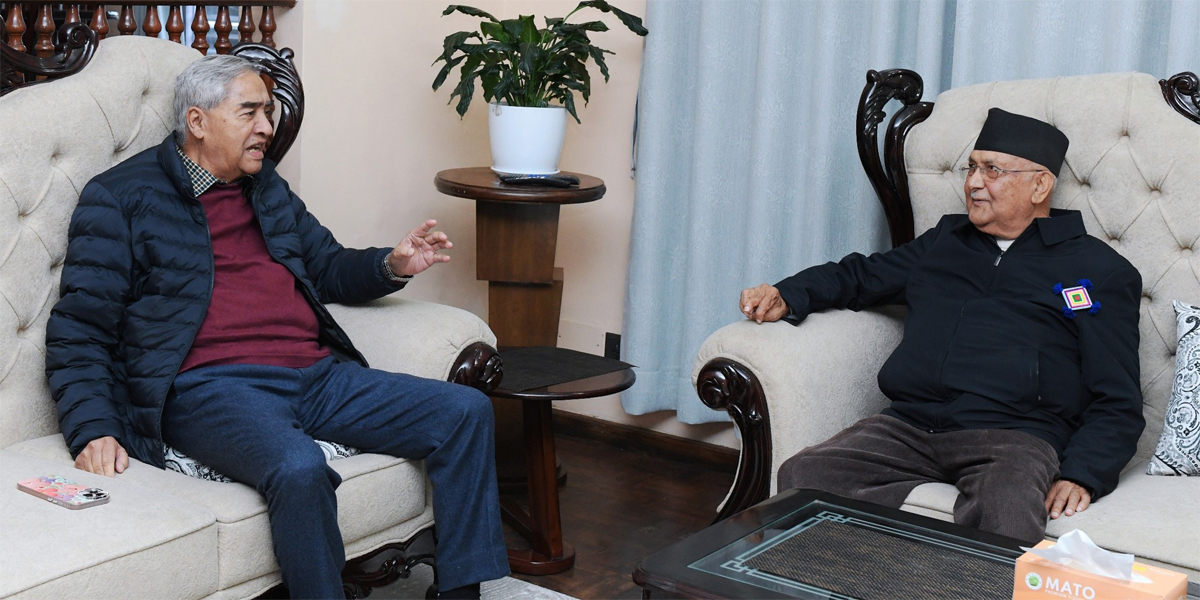
Although no official decision has been made yet, leaders say the possibility is alive given the cordial relations between Deuba and Oli.
Analyst Pokharel says whether the NC and UML will form an alliance hinges on the strategy of the RSP-led alliance. “RSP Chair Lamichhane has public sympathy, Balen Shah has strong youth support, and Kulman Ghising enjoys trust among households,” he said. “The big parties will have to adjust their strategy based on the impact of this new political wave.”