
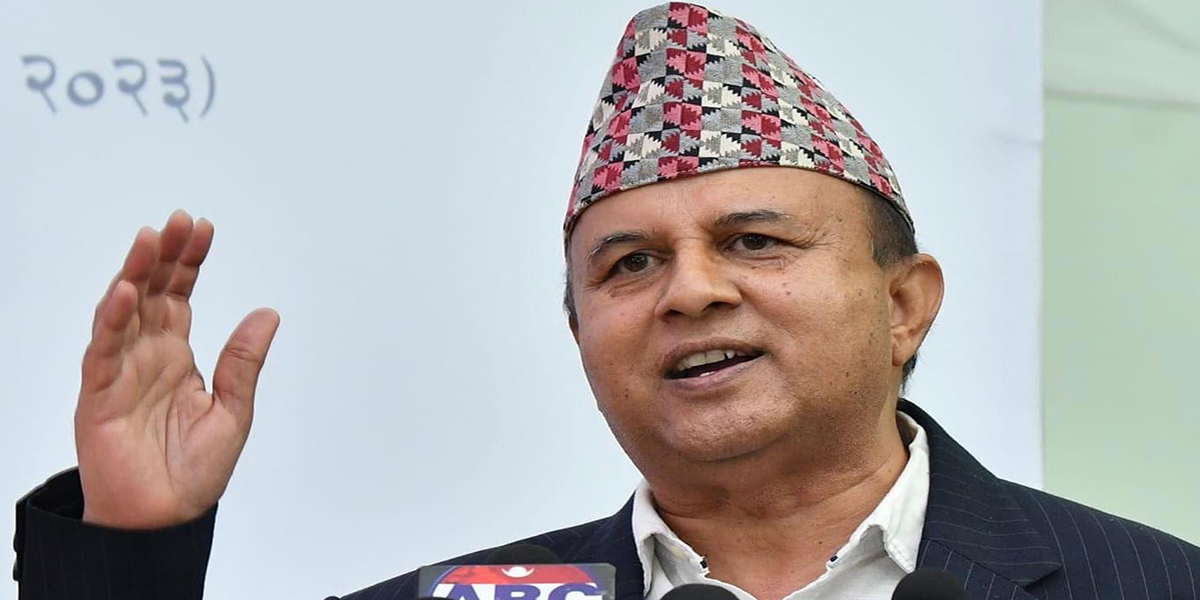
 File Photo
KATHMANDU: A social media post shared on Tuesday night by CPN-UML General Secretary Shankar Pokharel has raised serious questions. Pokharel wrote: “The plan for the simultaneous recall of ambassadors from major power nations indicates that Nepal’s geopolitics is in a highly sensitive state.”
The statement lays bare the shallow geopolitical awareness at the top leadership of major political parties in a country as sensitive as Nepal. This is not a question confined to personal criticism or debate. It is a serious issue tied to political culture, the conduct of the state, the protection of national interests, and long-term stability.
In today’s world, where competition among major powers is intense, Pokhrel’s statement suggests a lack of even basic understanding of the subject. He has failed to maintain balance and provide fact-based analysis in his public expression.
Pokhrel has interpreted the simultaneous recall of ambassadors of major powers—China and the United States—as a sign that Nepal is entering a serious geopolitical crisis. Such an interpretation is neither grounded in facts nor consistent with established diplomatic practice.
His assessment appears driven more by emotion and suspicion than by evidence. While it may energize party cadres, it has created unnecessary confusion at the national level. This is not merely an individual viewpoint. It reflects a broader tendency within Nepal’s political leadership, where remarks made for short-term popularity risk undermining long-term diplomatic relationships.
Diplomacy is based on tradition, international norms, long-term strategy, and institutional memory. Pokhrel’s comment suggests either a lack of understanding of the basic processes of ambassadorial appointments and recalls or a deliberate misrepresentation for political gain.
Many commentators have sharply criticized Pokhrel’s statement, with most accusing him of a poor grasp of diplomacy.
Geopolitics Is Not About Speculation or Suspicion
Geopolitics is grounded in historical continuity, clear procedures, and mutual respect. Major powers do not replace ambassadors simply because governments change, nor do they weaponize embassies to send short-term political signals. Pokhrel’s remarks appear to ignore this fundamental reality.
Turning to the issue of ambassadorial recalls, Chinese Ambassador Chen Song is completing his term and has been promoted to another important assignment. This is a routine diplomatic process. Similarly, US Ambassador Dean R. Thompson has completed a three-year term. Under US diplomatic practice, ambassadors are generally posted for around three years. This can sometimes extend to a maximum of four years.
Henry E. Stebbins (five years), Randy Berry (four years), Ralph Frank (around four years), and Julia Chang Bloch (around four years) were among the longest-serving US ambassadors to Nepal. Most others served three years or less in Kathmandu.
Twenty-seven US ambassadors have served in Nepal so far. Thompson’s recall is part of this regular cycle. The US government is recalling around 30 ambassadors and other diplomatic staff worldwide, and Thompson is among them. The Trump administration has described the recalls as policy-aligned decisions. They are not targeted at Nepal alone and do not signal dissatisfaction or crisis. The list of countries affected by the decision includes many across Africa, Asia, Eastern Europe, and South America.
India’s Ministry of External Affairs is also reviewing its diplomatic structure and preparing to recall several ambassadors and senior officials, including India’s ambassador to Nepal, Naveen Srivastava. Srivastava is nearing retirement at the end of his term, and a new appointment will naturally follow. This, too, is a routine administrative step.
Recent instances of ambassadorial recalls are a routine diplomatic cycle, clearing the path for fresh appointments and renewed engagement. However, Pokharel has interpreted these developments as a “joint signal” from major global powers. This is both factually tenuous and analytically incomplete.
His remarks conflate procedural diplomatic transitions with domestic political maneuvering. In Nepal, ambassadors are frequently recalled in the wake of government changes. While this has become a local practice, it is not an established international norm. Diplomacy is not defined by transient statements or short-lived rhetoric; it is anchored in long-term strategy, institutional continuity, and the slow cultivation of international trust.
Historical Context and Nepal’s Geopolitical Journey
Nepal’s geopolitical sensitivity is not something that emerged overnight. Since the time of Prithvi Narayan Shah, the country has maintained balance amid competition among major powers. Shah famously described Nepal as a “yam between two boulders,” referring to the need to balance between British India and Qing-era China.
From the British Empire to the Soviet Union, from Cold War-era US–China rivalry to today’s India–China–US triangle, Nepal has preserved its independence through strategic balance. King Mahendra’s policy of non-alignment, BP Koirala’s democratic internationalism, and King Birendra’s Zone of Peace proposal were all strategies crafted with a deep understanding of Nepal’s geopolitical realities. These leaders knew when to speak, when to remain silent, and when to strike a balance.
In recent years, Nepal has managed sensitive issues such as the Lipulekh–Kalapani border dispute with India, China’s Belt and Road Initiative (BRI), and the Millennium Challenge Corporation (MCC) agreement with the United States with relative balance. These examples demonstrate how geopolitical awareness can strengthen national interests. However, developments this year have strained that balance.
September 8 and 9 protests led by Gen Z, following social media restrictions, resulted in at least 75 deaths. At the same time, renewed demands for the restoration of the monarchy have pushed the country toward internal instability. Suspicions of external involvement in such events—such as Pokhrel’s claim in September that Nepal was becoming a “laboratory of the deep state”—have further complicated geopolitical discourse. This reflects a key weakness among leaders: remaining silent when they should speak, and making unnecessary remarks when silence is required. Leaders who understand geopolitics know how to speak wisely—or how to maintain balance through restraint.
Leaders with an understanding of geopolitics should possess the courage to speak; while those who cannot speak must maintain a strategic balance.
While Pokhrel may have received applause from party supporters in the short term, his remarks are certain to push the country backward diplomatically in the long run.
Paths to Reform
As one of Nepal’s oldest and most prominent political organizations, the CPN (UML) is expected to maintain a high standard of diplomatic literacy, particularly within its top leadership. If top leaders lack even basic knowledge of diplomatic processes, it raises serious concerns regarding the depth of policy-making and strategic thinking within the party.
Even more troubling is the support Pokhrel’s statement received on social media. The fact that followers amplify these statements without basic fact-checking reflects a political culture that remains dangerously personality-driven and devoid of objective scrutiny. A culture must develop where supporters prioritize factual accuracy over partisan loyalty.
While the UML possesses capable individuals who understand the nuances of international relations, they often remain hesitant to intervene. This gap could be addressed through internal discussions, training programs, and workshops with international relations experts. Geopolitics should be treated as a strategic responsibility, not a propaganda tool exploited for short-term popularity.
When dealing with major powers such as India, China, and the United States, every word and signal must be carefully weighed. Even talking points for meetings require prior preparation. However, in Nepal, foreign ministers have been seen lobbying for labor quotas or pressuring for visas. These actions reflect a lack of professionalism.
Unnecessary suspicion and exaggeration will only weaken the country and expose the shortcomings of its leadership. It is no secret that both the US and China pursue their interests in Nepal. What matters is whether Nepal’s leaders are capable of safeguarding national interests amid those competing agendas. Rather than viewing this purely as personal criticism, our leaders could treat it as an opportunity to broaden their knowledge through engagement with international diplomatic institutions and experts. This would strengthen understanding and judgment.
Conclusion
Pokharel’s statement highlights a significant intellectual and analytical deficit within Nepal’s political leadership. However, this shortcoming presents an opportunity for introspection. Geopolitics is an enduring reality; it is as relevant today as it will be tomorrow. Public discourse grounded in a profound understanding of global dynamics can strengthen the nation and reinforce its diplomatic credibility.
True leadership is not merely the act of speaking, but the wisdom of knowing when and how to speak. Remarks informed by geopolitical realities serve the national interest, and history honors those who exercise such strategic restraint. Leaders must commit to reading, learning, and reflecting before addressing complexities beyond their immediate expertise. Refining this approach is essential to navigating Nepal’s geopolitical journey and represents the highest form of patriotism.