
KATHMANDU: Once limited to a distant emotional bond, the Nepal–Australia relationship has expanded remarkably over the last two decades. In the early phase, Nepal’s ties with Britain brought it closer to Commonwealth countries—including Australia—spread across the Asia-Pacific, Africa, Europe, the Americas, and the Caribbean. But today’s closeness is of a different character.
The Australia that was once portrayed as an “open prison” is now among the world’s leading destinations for hardworking people. That is exactly why it has become a top choice for Nepalis. Nepalis have reached every corner of Australia. It feels as though thousands of Nepali dreams now flutter along the shores of the southern hemisphere.
The open prison era
Australia has its own layered history. The Dutch arrived first. The place mapped by Dutch explorer Abel Tasman later became known as Tasmania. Tasman first reached there in 1642. Since Dutch traders were the first to reach Australia, the smallest continent was once called “New Holland.”
The British later declared the eastern part of Australia their colony. Though the British reached the Australian shores in 1770, Australia became a formal British colony only in 1788. Aboriginal communities lived across vast deserts, coasts, and dense forests. British convicts and demobilized soldiers went there seeking new lives. They reshaped Australia’s societies and cultures, while Indigenous peoples paid the price under often harsh and unjust conditions.
After 1850, people from around the world began to arrive in Australia, chasing their dreams of wealth. Towns grew, railways expanded, and Australia gradually moved toward a multicultural future. Indigenous communities continued to shrink. Soon, Australia became known as a country of immigrants. In 1901, the colonies unified to form the Commonwealth of Australia. Free of colonial shadow, Australia built its own identity. Since then, despite economic ups and downs brought by wars, migration, and colonial transitions, it has not looked back.
With new partnerships, Australia completed its evolution into a modern state—now a symbol of diversity, good governance, and opportunity. The thousands-year journey that began with its Indigenous peoples, however, does not neatly align with modern Australia. This reminds us that history is never truly past. Known as the “land of kangaroos,” Australia has embraced the kangaroo—found only there and nearby islands—as a national symbol and a global tourism icon.
Diplomatic relations
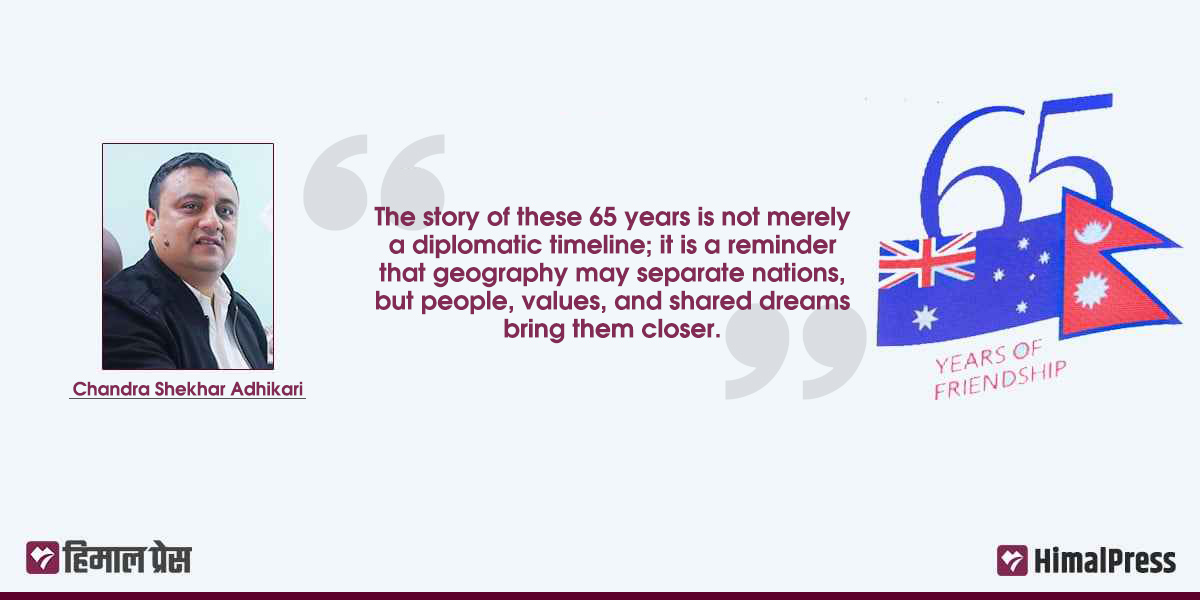
Nepal and Australia established diplomatic ties in February 1960. Australia— a landmass inhabited by humans for an estimated 65,000 years—marked the 65th anniversary of relations with Nepal last Saturday.
The visit of King Mahendra and Queen Ratna to Australia in the 1970s strengthened bilateral ties. King Birendra ascended the throne following his father’s demise in 1972.
King Birendra received Australia’s Governor General, Sir John Kerr, during his 1975 coronation. In early 1985, the Australian foreign minister visited Nepal, followed by a visit to Australia by King Birendra and Queen Aishwarya later that year. It was during this decade that the relationship began to grow closer.
Although diplomatic relations began in 1960, Australia opened its embassy in Kathmandu only in 1984. Initially headed by a chargé d’affaires, it was later upgraded to ambassador level in two years. Nepal opened its embassy in Canberra in 2007 to serve the growing Nepali community of students and professionals. Nepal also began with a chargé d’affaires and later upgraded to an ambassador.
However, except for Rudra Prasad Nepal, no ambassador has completed a full four-year tenure in Australia—reflecting Nepal’s political instability.
Sir Edmund Hillary, who placed the first human footprint on Everest together with Tenzing Norgay Sherpa, was from the region of Australasia. Several development initiatives in Nepal’s Himalayan region are named after him. Australia’s first development partnership with Nepal focused on community forestry, now a global model, and continues through Australian Aid.
During earthquakes, pandemics, and crises, support from Australia has come not only in the form of relief supplies but also through the efforts, emotions, and contributions of Nepalis living there. These contributions are evident in the return of students, the success stories of migrant families, and flights carrying aid. Those educated in Australia now hold influential roles across Nepal.
Cooperation and goodwill
Australia has long regarded Nepal as a reliable development partner. From school construction and disaster relief to safe drinking water and women’s empowerment, Australia has maintained a steady presence in Nepal. Its support—from rebuilding schools after the 2015 earthquakes to supplying medical materials during the COVID-19 pandemic—has given Nepalis both relief and confidence, thereby deepening goodwill between the peoples of both countries.
In 2023, Australia provided Nepal with annual development assistance worth 27.1 million Australian dollars. That support was for projects spanning federalism, climate resilience, social inclusion, and other priority areas. For Nepal, Australia has become not just a development partner but a trusted friend—one that steps forward in moments of need and stands alongside Nepal in its long-term aspirations.
Australia’s cooperation has also extended to governance reform, health, education, and climate adaptation. Its programs have focused on strengthening local government, empowering women and marginalized communities, improving learning outcomes, and building resilience against natural disasters. These efforts have strengthened Nepal’s institutional capacities and contributed to more equitable development.
Beyond government-to-government ties, people-to-people relations are now the beating heart of Nepal–Australia friendship. The growing Nepali diaspora—comprising students, professionals, and families—has brought the two societies closer than ever. Their achievements in education, business, health, hospitality, sports, and community leadership have enhanced Nepal’s visibility and built bridges of goodwill.
Today, as the two countries mark 65 years of diplomatic relations, the partnership rests on mutual respect, friendship, and shared values: democracy, diversity, opportunity, and progress. What began as distant recognition on opposite sides of the world has evolved into a multidimensional relationship shaped by history, migration, education, development, and human connection.
Looking ahead, Nepal and Australia are poised to deepen cooperation—whether in climate action, education, technology, skilled migration, or development. The story of these 65 years is not merely a diplomatic timeline; it is a poignant reminder that geography may separate nations, but people, values, and shared dreams bring them closer.