
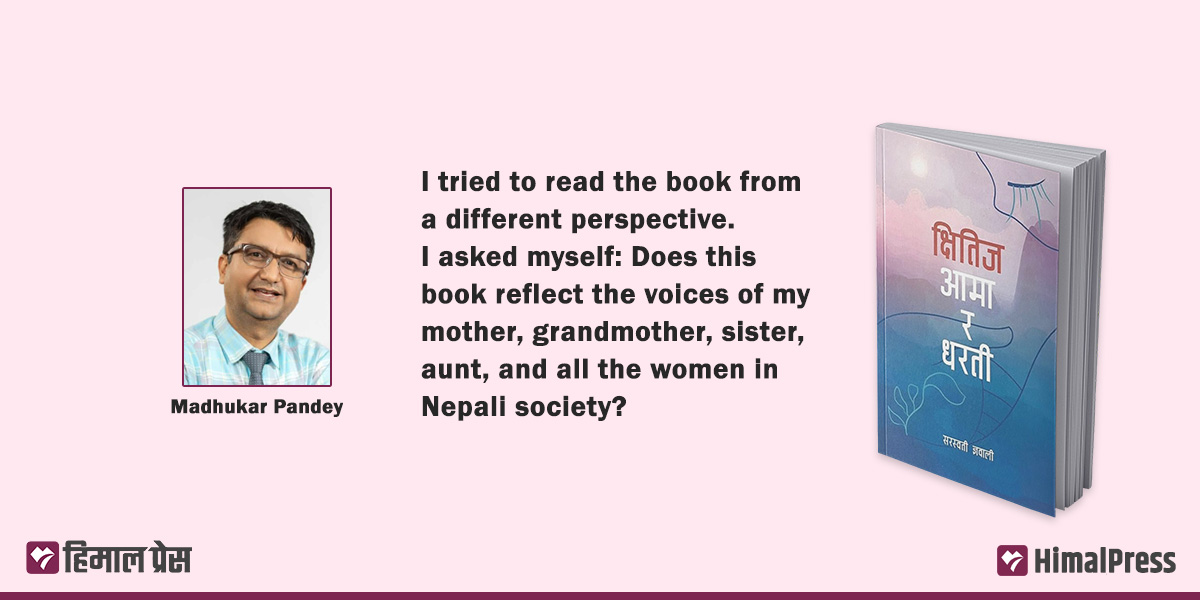
As I was flying from Kathmandu to the United States, I had a 13-hour layover in South Korea and wondered how I would spend such a long stretch of time. Since I had purchased a very cheap ticket, I did not have access to any comfortable lounges or resting places. So, I decided to carry a book as my best companion during the wait. Recently, I had bought Kshitij, Aama and Dharti by Saraswati Gnawali. About six years earlier, I had read another book by the same author called Laltin ko Ujjyalo, and now I chose this new work for my transit. On the plane, I met some Nepali students, and I felt reassured and happy to connect with them, knowing I would not be entirely alone during the long layover.
Once I began reading, I found the content mesmerizing. It is divided into different sub-sections that flow seamlessly into one another. I found the book to be a testimony of a mother’s unconditional love for her differently abled child — a love greater than her love for herself. The story appears to be based on the real experiences of a mother who endured the struggles of her disabled daughter even before she was born. The beauty of the book deepens when the mother, despite knowing everything about her daughter, still does not know anything about her child and yet expresses an unbreakable motherly love. This love, which she carried before the baby was born, remains unchanged even now.
The book beautifully captures the essence of maternal love. A mother can understand the pain and suffering of her children; she feels their happiness, and feels their hunger and sorrow as her own. Since a mother is omnipresent for her child, she is also omniscient.
While reading the book, I found myself asking: Is the author trying to depict the struggle of every Nepali middle-class mother? Because, after the birth of her child, the mother’s life remained a constant fight for survival. Even now, there has been no significant change in her lifestyle, despite her husband serving as a cabinet minister twice.
To gain a deeper understanding, I tried to read the book from another perspective. I asked myself: Does this book reflect the voices of my mother, grandmother, sister, aunt and all the women in Nepali society?
In their pursuit of happiness, the Gyawali family migrated from Gulmi to Butwal, and later from Butwal to Kathmandu. While in Gulmi, the author lived many lives at once — as a daughter-in-law, mother, teacher and a political change-maker — with a deep desire to transform the country’s political system. Her struggle resonates with those of countless Nepali mothers who continue to fight for freedom, happiness and a better life.
The book also portrays the author’s husband as a political figure who devoted his entire life to the betterment of the country. In this context, I was reminded of many men from middle-class families who leave for the Middle East to provide for their households. As a result, the lives of many women become defined by absence—they shoulder the burdens of family life, good or bad, while their husbands only hear of these struggles from afar.
Another striking element is the use of language. The language flows as smoothly as the Ridi River that flows through Gulmi. There is no artificiality in tone or expression. Being familiar with the language of Gulmi, the book transported me almost 30 years back, into the society and mindset of that time. The authenticity of the local dialect makes the narrative deeply rooted in local culture. Through this language, the author captures women’s daily hardships— such as walking long distances just to fetch a gallon of water, while also depicting the healing role of Ayurvedic practitioners who have supported the community in times of illness.
At its heart, the book offers powerful lessons on love, patience and collective resilience in difficult times. The real struggle began when she fell off the ladder. She knew that her daughter was suffering from a disease that could not be cured in the world, but her motherly instinct always led her to believe that there might still be some solution. Therefore, in search of a cure, they came to Kathmandu and discovered that it was an incurable disease. She visited many places, but the outcome was the same—there is no cure.
Even though she knew the truth, her heart and mind remained open to every possibility. She never says, “I cannot do it”. This unyielding hope allows her to carry on with her own life while giving strength to her daughter’s.
I offer my respects to the author and all mothers who dedicate their entire lives to the betterment of their children.
(The author can be reached for comment at: [email protected])