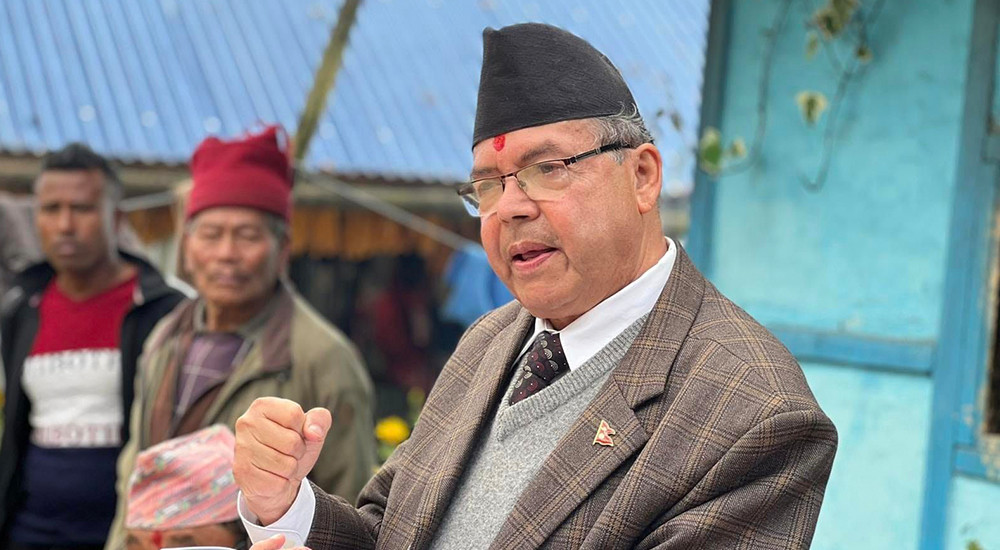
KATHMANDU: A leadership dispute has erupted within the CPN (Unified Socialist) after senior leader and former Prime Minister Jhala Nath Khanal publicly questioned the ideological justification of the party’s split from CPN-UML four years ago.
In a recent television interview and follow-up comments to the media on Saturday, Khanal said the party has failed to meet the objectives that initially drove the split from the CPN-UML, primarily, to fight right-wing opportunism and steer the country toward a socialist revolution.
“The ideological, political, and theoretical struggle we envisioned never took off,” Khanal said in an interview with Himal Press. “There is no clear articulation of what constitutes right-wing deviation, nor has there been any organized effort to counter it. The responsibility to lead that effort lay with the party chairperson.”
Khanal’s remarks drew a sharp response from party Chairperson Madhav Kumar Nepal, who said Khanal could leave the party if he was dissatisfied with its direction. The exchange has brought long-simmering tensions between the two veteran communist leaders into the open.
Rejecting any intention to resign or quit the party, Khanal said he had never imagined leaving the party he helped create through a rebellion. “The objective now is to ideologically and structurally strengthen it, not abandon it based on the words of a single leader,” he added.
Khanal said the chairperson lacked the ideological, theoretical, and practical ability required to lead the party effectively. He also expressed concern over ideological drift within the party, particularly the lack of commitment to scientific socialism. He also questioned the reliance on Janatako Bahudaliya Janabad (People’s Multiparty Democracy), calling it outdated and irrelevant to current revolutionary goals. He also argued for a leadership change and a renewed push to build a “genuinely Marxist-Leninist, revolutionary, and socialist party.”
He added that their ultimate goal is socialism. “To achieve that, we need to build the party in a new way. People’s Multiparty Democracy is a thing of the past—it no longer serves the purpose,” he added.
He dismissed claims that former Deputy Prime Minister Bamdev Gautam was brought into the party to counter him. “He has made significant contributions to Nepal’s communist movement. I am hopeful that he will help guide the party toward revolutionary socialism,” Khanal added.
Still, he acknowledged potential future ideological clashes with Gautam, especially if the latter pushes for the people’s multiparty democracy as the party’s ideology. “If that happens, we will debate through ideas, not personal attacks,” he added.