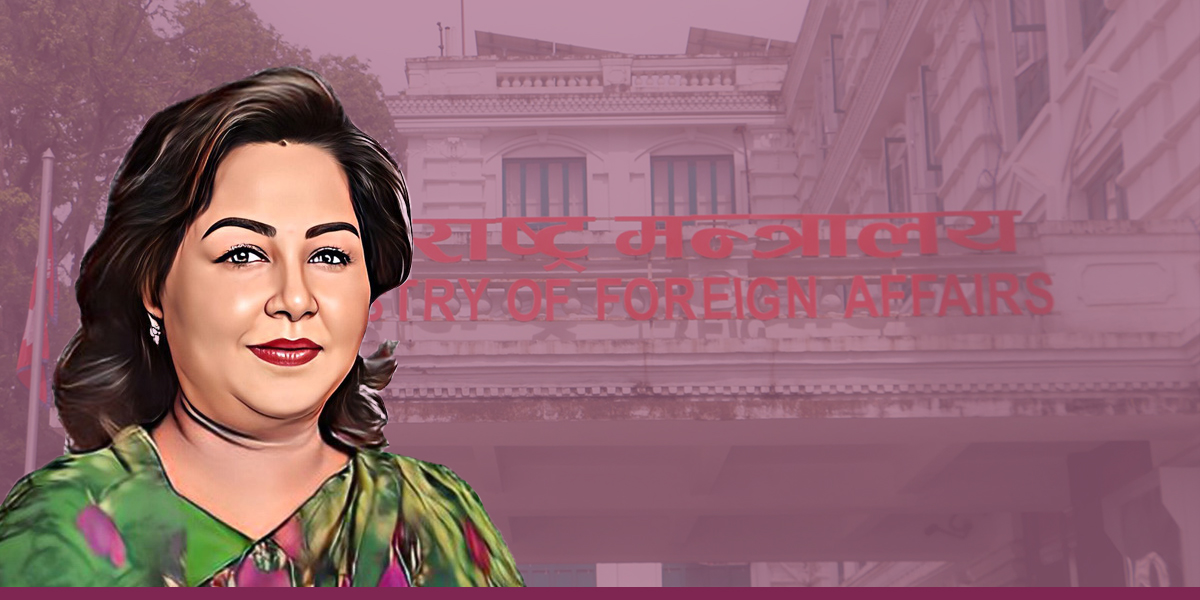
KATHMANDU: The Secretariat of Minister for Foreign Affairs Arzu Rana Deuba last week released a report card claiming significant achievements in the foreign ministry’s restructuring, diplomatic engagement and high-level outreach over the past year. The report highlights what it describes as Minister Rana’s accomplishments during her tenure. However, nearly all of the claims appear to be misleading or outright false. Many details in the report are not only inaccurate but also appear illogical and, at times, even laughable.
When Rana assumed office a year ago, there was a sense of optimism; both within the ministry and among diplomatic circles. As someone with considerable experience interacting with western diplomats during her time in the non-governmental sector, hopes were high that she would bring positive changes to Nepal’s foreign relations. But her performance over the past year suggests otherwise.
There has been little to no effort in strengthening foreign relations, while internal reforms within the ministry have not been a priority. Instead, her focus has been limited to issues such as awarding passport printing contracts, overseeing foreign postings to favor her close associates, and concentrating on how many Nepali youths can be sent abroad for employment. This narrow focus has led to friction between the Ministry of Foreign Affairs and the Ministry of Labour, Employment and Social Security, with tensions spilling over into embassies. A growing lack of coordination and increasing disputes between ambassadors and labour attachés in foreign missions are, in large part, a result of Minister Rana’s weak leadership.
Soon after taking office, she hastily created new positions within the ministry without proper planning. As a result, three joint secretaries are currently without assignments. One of them is expected to fill a vacancy left by a retiring official in the coming days. Despite existing provisions to appoint foreign ministry officials as consuls general in four cities abroad, three joint secretaries have been left without any responsibility.
The statement released by Minister Rana’s office claims she has made notable strides in diplomacy during her first year in office. But on closer examination, no such progress is visible. No notable diplomatic achievements have been recorded during Rana’s tenure so far. One of her most critical responsibilities, strengthening relations with neighbouring India, remains unfulfilled. Her second visit to India only reinforced doubts about her diplomatic capabilities.
When Rana first visited India on August 18, shortly after assuming office, the respect she received was initially seen as a positive signal. She met Indian Prime Minister Narendra Modi, and the level of access she was granted led many to believe she was working to improve bilateral ties. However, it soon became apparent that the reception was less a reflection of her role as foreign minister and more a courtesy extended to her as a senior Nepali Congress (NC) figure and the spouse of a former Prime Minister. This perception led to quiet discussions in diplomatic circles about her weak political standing and lack of diplomatic weight.
According to diplomatic experts, the delay in Prime Minister KP Sharma Oli’s visit to India and the lack of reciprocal high-level visits from India and China have further cemented Rana’s reputation as an ineffective foreign minister. Her second India visit only added to the criticism. Coming directly from Europe, she reached New Delhi without a clear agenda. As a result, she spent nearly a week in India without any high-level engagement and ultimately returned citing medical reasons. A controversial interview at the Raisina Dialogue further affected her credibility.
Her engagement with China has also been underwhelming. During her visit to the northern neighbor, she reportedly relied on then-Acting Foreign Secretary Amrit Bahadur Rai for updates on the Belt and Road Initiative (BRI). With strong resistance to the BRI within the NC, then-Prime Minister Oli kept Rana sidelined and delegated the task of finalising the agreement to his trusted foreign secretary. Oli hailed the agreement as a major diplomatic achievement, but Rana was not even present at the signing.
The report also highlights diplomatic efforts taken by the ministry to secure the release of Bipin Joshi, who was taken hostage by Hamas in October 2023, as an achievement. However, Rana has failed to provide any updates on his condition. The report claims that formal requests were made to Egypt, Qatar, the United States, and Israel, but in practice, Nepal’s missions in those countries acted independently. Similarly, the ministry cites the return of some Nepalis from Iran during the Iran-Israel conflict as an achievement. In reality, these evacuations were carried out by India as part of its regular repatriation efforts, which often include Nepali citizens. Aside from receiving updates from Nepal’s embassy in Iran, Rana’s office made no substantial contribution.
By contrast, former Foreign Minister NP Saud responded to a similar crisis in Israel with urgency and decisiveness. He personally visited the conflict zone and arranged flights to evacuate Nepalis.
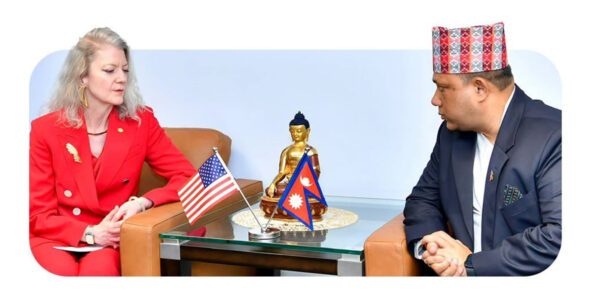
According to her own ministry’s report, Rana has spent nearly four months abroad during her first year in office. She claims these frequent trips have raised Nepal’s international visibility, yet the report provides no clear outcomes or evidence of such visibility. If social media photos of courtesy meetings with foreign dignitaries are what count as achievements, then the bar is remarkably low. She has met with counterparts, ministers and leaders from countries including Japan, Germany, New Zealand, Switzerland, Norway, Canada, Indonesia, Oman, Qatar, Israel, the Philippines, Iran, Mexico and others; but with no visible diplomatic results.
Rana has visited 16 countries so far. She visited India and Thailand thrice, and China and Germany twice. She has been accused of converting personal trips into official ones. Yet despite all this travel, there are no meaningful diplomatic accomplishments to show for it. She frequently posts photos of meetings with ambassadors on social media, proudly highlighting routine protocol interactions. This reveals a lack of understanding of basic diplomatic norms.
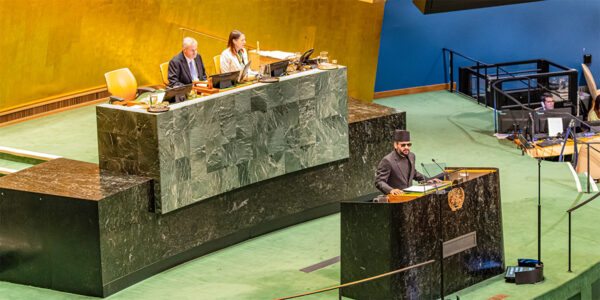
Rana has also developed a reputation for inviting foreign dignitaries to Nepal and then being absent during their visits. A striking example was the visit of UAE Deputy Prime Minister and Foreign Minister Abdullah bin Zayed Al Nahyan. Despite inviting him to Kathmandu, Rana was in Thailand attending a UN event, which coincided with personal travel. As a result, the UAE minister returned without any meaningful engagements. She also participated in the Conference on Social Isolation and Loneliness Among Older People, organized by the Foundation for the Welfare and Education of Asian People (FWEAP)—an event that falls under the jurisdiction of a different ministry.
Rana has long faced allegations of involvement in labor migration to Japan. After becoming foreign minister, officials claim she sought to expand her influence over worker placements to Europe, aiming to secure commissions without appearing directly involved. While she dismisses these as baseless accusations, many ministry insiders remain unconvinced, pointing to her continued interest in such activities.
Meanwhile, she has shown little to no interest in building the ministry’s institutional capacity. There have been no efforts to train foreign ministry staff as career diplomats, provide study opportunities, or enhance their skills. The ministry’s think tank, once envisioned as a hub for policy analysis, now serves primarily as a retirement post for former officials.
Rana has also been embroiled in controversy over the Non-Resident Nepali Association (NRNA), a matter currently under review by the Supreme Court. Her communications with embassies regarding the NRNA have sparked disputes.
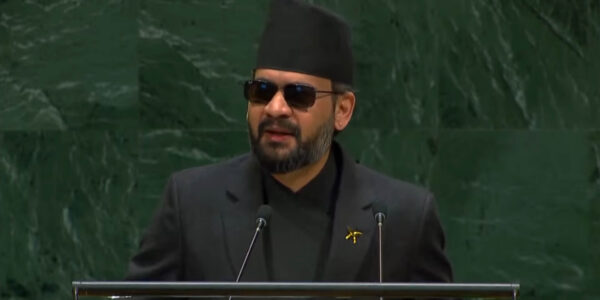
As a foreign minister, Rana has addressed various multilateral forums, as her predecessors did. However, she has struggled to engage meaningfully in bilateral meetings, often failing to initiate substantive dialogue with her counterparts. Her priorities appear to lean more toward personal interests than national ones.
The ministry has announced plans to open new embassies and consulates general in several countries, citing the presence of large Nepali populations. However, these decisions have been made without adequate studies. Key considerations—such as necessity, efficiency and alignment with state priorities—have been largely ignored. While consulates in Dallas, San Francisco and Dubai may have been justified, their execution has been poor. Consuls have spent months living in hotels due to the absence of proper office setups. Rather than deploying lower-level staff to coordinate with ambassadors and arrange logistics in advance, posts are hastily created, and appointments are made before any infrastructure is in place.
The passport issuance process remains outdated and burdensome due to a lack of proper technology and data management. If an individual’s details are already in the system, why is duplicate data entry required? The process could be streamlined by allowing citizens to submit old passport copies and receive new passports via courier in their respective countries. Yet embassy teams continue to carry cameras and laptops to mobile camps—a laborious and outdated practice in today’s digital age.
Foreign direct investment in Nepal remains far below expectations, and exports have not come close to replacing imports. Despite two-and-a-half decades of rhetoric around “economic diplomacy,” tangible results have not been seen. While Nepal aspires to graduate from least-developed country status in 2026, it lacks the necessary policy direction and drive for implementation. At home, critical issues like poor waste management, river pollution, lack of transparency, and entrenched corruption persist. Yet Rana traveled to The Hague to speak on climate justice. Swedish international law expert Dr. Katak Malla rightly questioned what concrete steps Nepal has taken to justify the demand for compensation.
Claims made in the ministry’s report amount to self-praise and propaganda rather than meaningful progress. Nepal’s relationships with its two closest neighbours, India and China, suffer from a lack of political depth, and several bilateral agreements remain unimplemented. Ties with the United States and other friendly countries have also stagnated. Nepal’s most important diplomatic relationships, with India, China, and the US, require balance, trust and strategic engagement. Over the past year, however, these ties have neither been stable nor effective. Simply put, the foreign ministry under Rana has seen a year marked by failure—and she must be held accountable.