
KATHMANDU: The School Education Bill, 2023, has been stalled at the Education, Health, and Information Technology Committee of the House of Representatives. Although the Bill has reached its final phase of discussion, members of the committee say the Bill has stalled due to the vested interests of Minister for Education, Science and Technology Raghuji Pant and Nepali Congress (NC) Chief Whip Shyam Kumar Ghimire.
Political parties are also interpreting the Bill according to their own agendas, which has further delayed its passage.
The Bill appears to be more focused on addressing the professional demands raised by teachers. The Confederation of Nepalese Teachers (CNT) has consistently prioritized issues like job security, salary, grade and staff quotas over the overall quality of education. The bill is also of significant interest to private school operators. However, the private sector has not strongly pushed for its agenda in the Bill.
Some critics argue that the Bill is getting delayed because the NC and CPN-UML appear overly accommodating to the private sector. Some remarks made by Education Minister Pant seem to support this perception.
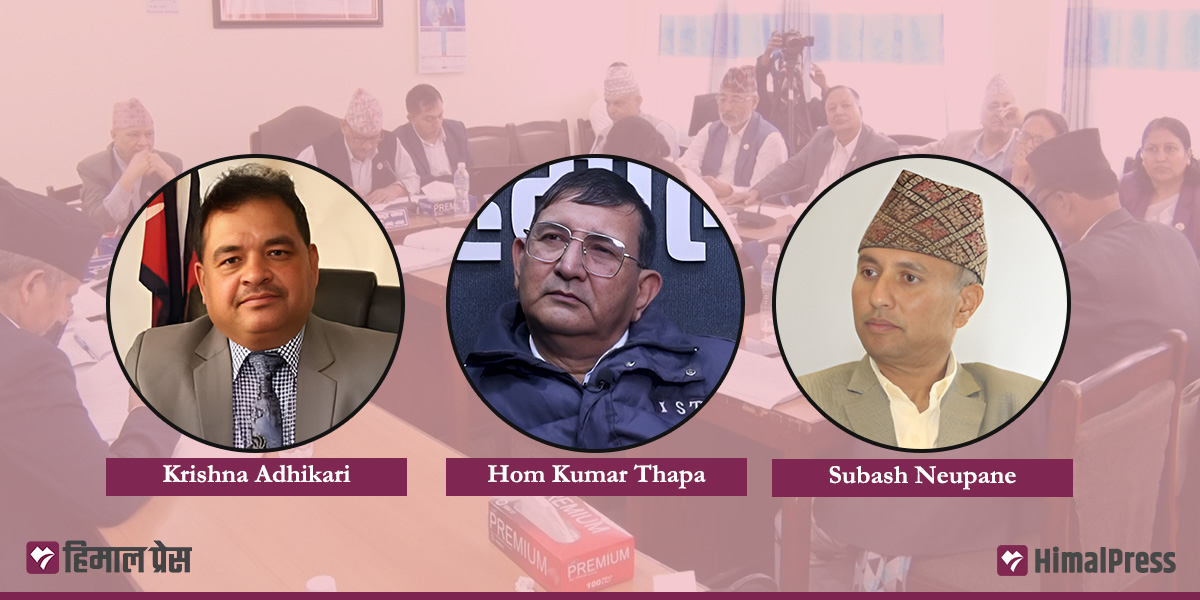
However, Krishna Adhikari, president of the Private and Boarding Schools Organization Nepal (Pabson), said the Bill does not contain specific demands of the private. He said private schools currently operating as companies should be allowed to continue in that form. “Schools running under a company model must be allowed to remain as such. If they want to convert to trusts later, that option should remain open,” he told Himal Press over the phone.
Adhikari also clarified that Pabson has no major objection to the government’s proposal to conduct the Secondary Education Examination (SEE) at the provincial level. He also said private schools were okay with allocating 10% of their total seats for scholarships. “We only say that the term ‘full scholarship’ should be removed from the Bill,” he said.
There is disagreement in the bill regarding the duration of Early Childhood Development (ECD) education. Pabson seems supportive of the two-year preschool program proposed by the House committee. “Young children should stay with their parents. If the law requires it, we are ready to admit them from Grade 1,” Adhikari said.
He, however, called for proper qualifications and recognition for ECD teachers. “This is because ECD teachers face more challenges than those teaching in higher grades,” he noted.
Adhikari said that the Bill has stalled mainly due to issues concerning community schools. “That is a matter the private sector is not in a position to comment on,” he added.
Subash Neupane, president of the National Pabson, also said the bill should aim for comprehensive reform and guarantee quality education. He warned that discriminatory laws would not be acceptable.
“We believe that private schools should be regulated under government rules. We will accept whatever rules are made, but they must not be discriminatory,” he said.
Neupane added that since both community and private schools educate Nepali students, the law must be the same for both. “The private sector plays a vital role in school education. It currently covers 34% of the sector,” he said. “The Education Act, which is coming after 54 years, should aim to uplift the entire education system. The law must offer clear guidelines to strengthen community schools.”
He also opposed efforts to push schools back into the trust model, stating that 99% of private schools currently operate as companies. “We were compelled to adopt the company model after amendments in 2001,” he recalled. “We have been operating as companies for 22 years. Reverting to the trust model is no longer feasible.”
Neupane said the law should allow for both company and trust models. “If schools wish to remain as companies, that must be guaranteed,” he added.
Regarding ECD, he emphasized the need to strengthen the structure from daycare to LKG and expressed willingness to implement a two-year ECD framework.
Neupane also criticized the narrow interests of donor agencies and certain lawmakers. “There seems to be donor and personal interest hidden in the upcoming education law,” he said. “The education sector can progress only if lawmakers adopt a broader perspective<” he added.
He urged lawmakers not to repeat in school education the mistakes seen in higher education. “Nursing colleges were shut down because of Dr Govinda KC’s protests. Students went abroad, and money flowed out of the country,” he warned. “If such a situation is replicated in school education, it would be unfortunate.”
Hom Kumar Thapa, president of the Institutional School Teachers’ Union (ISTU), said the Education Act must address the professional concerns of teachers and staff in private schools. “Although the nine-point agreement signed between the CNT and the government included a provision to bring private school teachers under the Social Security Fund, this provision has not been forwarded to the cabinet,” he said. “Now, they are saying that it would be incorporated in the upcoming act. But even the house committee seems unaware of which article will address this issue.”
Thapa said the committee has yet to discuss Article 147 of the bill. “It contains two key provisions: first, schools must obtain approval from the local government when drafting their internal regulations; and second, those regulations must align with prescribed salary structures and the Social Security Fund,” he explained. “Since it’s the federal government that should guide local authorities, these provisions need to be clearly defined in the federal education regulation or the Act itself.”
Thapa said his organization has no objection to whether private schools operate under the company or trust model.