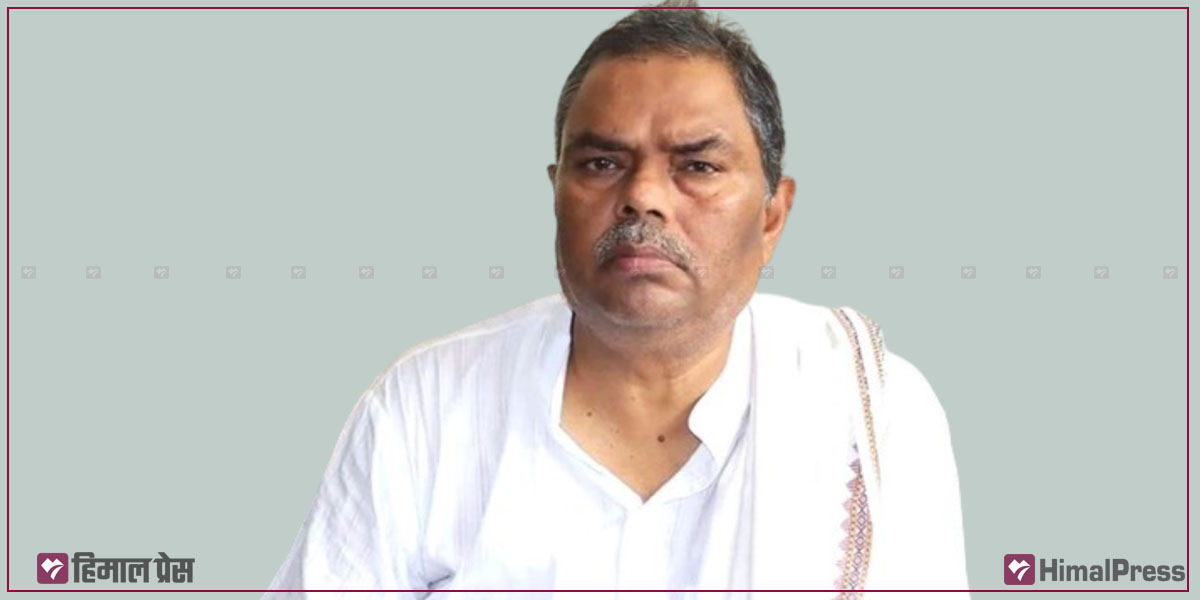
KATHMANDU: Janata Samajbadi Party (JSP) Nepal, which backed the KP Sharma Oli-led government of Nepali Congress (NC) and CPN-UML, is now set to move to the opposition.
A recent meeting of the JSP Nepal’s Central Executive Committee has directed its parliamentary party to reconsider the support it had extended to the government.
Despite supporting the government, the Upendra Yadav-led JSP Nepal did not get to share the spoils of power. The two major ruling parties did not see Upendra as worth accommodating in their power-sharing equation.
As a result, even while offering support, Upendra continued to criticize the government on every platform. Until now, his stance resembled that of neither a government ally nor a clear opposition figure. He spent the past year in this ambivalent posture. So, why did Upendra support the government in the first place? Why is he withdrawing support now? And why did he remain aligned with the ruling side despite being denied participation in government?
JSP Nepal leaders claim that they had supported the government with agendas such as constitutional amendment and good governance in mind. They say their trust was based on the belief that a strong government would be able to push forward those agendas.
But Upendra’s support was not entirely agenda-driven. Having held lucrative ministries several times in the past, he was undoubtedly hoping for a ministerial berth again. However, with the NC and UML forming a strong government on their own, smaller parties like his found themselves sidelined. This left Upendra with no option but to remain outside the power structure.
Why Did Upendra Support the Government?
JSP Nepal split in April 2024 when Upendra was in the government led by CPN (Maoist Center) Chairperson Pushpa Kamal Dahal. At that time, he was Deputy Prime Minister and Minister for Health and Population.
The split, while he was on an official trip to the US, under the leadership of Ashok Rai reduced the JSP Nepal from 12 seats to just 5 in the House of Representatives. Rai and others broke away to form a new party using the same name—JSP.
Following his return from the US, Upendra decided to quit the government.
At that time, Dahal was leading a government with a thin majority. UML, Rastriya Swatantra Party (RSP) and JSP Nepal, among others, were in the government. A withdrawal of support from any single party could have brought the government into a minority. The split in JSP Nepal could help avert that crisis.
Upendra still claims that the split was orchestrated by Oli and Dahal to save the government.
But Dahal’s government did not last long. Within two months of the JSP Nepal split, his government lost majority support and was ousted. A new coalition of NC and UML was formed.
The new government, led by Oli, favored JSP Nepal’s breakaway faction more. Currently, two ministers, Pradeep Yadav (Water Supply) and Nawal Kishor Sah Sudi (Women, Children and Senior Citizens), represent Ashok Rai’s JSP in the cabinet.
The legal dispute over the JSP Nepal split, however, is still ongoing. Upendra has filed a petition in the Supreme Court seeking to stop the division of the party. JSP Nepal leaders have accused the Election Commission of illegally registering the new party.
“The Election Commission registered a new party in an unlawful manner,” said JSP Nepal General Secretary Ram Kumar Sharma. According to leaders, Upendra had supported the new alliance, partly to prevent this split from gaining legal standing.
“The party was divided, but the legal process is not complete. We hoped the government would help prove the split illegitimate—but it didn’t,” said one JSP Nepal leader.
The case is still pending in the apex court.
Earlier, an ordinance had made it easier to split political parties by lowering the threshold to 20% representation in Parliament, from the constitutionally mandated 40% of both the central committee and parliamentary members. This ordinance had facilitated previous splits like that of CPN (Unified Socialist) from UML and Loktantrik Samajbadi Party (LSP) Nepal from JSP Nepal.
However, by the time the latest split happened, the ordinance had become defunct. Upendra has built his legal case around this.
Another reason for supporting the government was his refusal to align with rival parties. Upendra, who blamed Dahal for the party’s split, did not want to be seen on the same side as the Maoists after they moved into the opposition. Also, he had hoped to get support from the NC and UML to form a government under JSP Nepal’s leadership in Madhesh Province.
But when the federal government was formed, the ruling coalition backed the Janamat Party to lead the government in Madhesh.
JSP Nepal had long dominated politics in Madhesh, with Lalbabu Raut and Saroj Kumar Yadav serving as chief ministers. For the first time, Upendra lost influence in Madhesh’s provincial government.
Despite being a government ally, Upendra was never invited to coalition meetings. Both Oli and Deuba were ignoring him. According to JSP Nepal leaders, the party received nothing in terms of political appointments.
“I haven’t heard of our party getting an ambassadorship or any position,” said party leader Purna Basnet. “Nor have I heard of any leader receiving personal benefits.”
This exclusion clearly frustrated Upendra. Though nominally a supporter, he functioned like an opposition leader—playing spoiler at critical political junctures. For instance, his stance on a land ordinance forced the government to withdraw it.
Without JSP Nepal’s vote, the ruling coalition had only 29 votes in the 59-member National Assembly. The ruling coalition needed 30 votes to pass the ordinance. Upendra’s obstruction forced Deuba and Oli to retreat.
Upendra Looking to Rebuild Political Capital
Upendra Yadav, who rose to prominence through the Madhesh movement, is now in crisis. After the split, his party is weaker, and he lost his home constituency in the 2022 general elections. He later had to win a by-election in Bara after nominating Ramsahay President Yadav for Vice President.
His main challenge today is the rise of the Janamat Party. In the last election, Upendra was defeated in Saptari-2 by Janamat Party President CK Raut by over 18,000 votes.
According to Madhesh affairs analyst Roshan Janakpuri, Upendra is weaker than ever. “Frequent splits have reduced his party to just five seats and relegated it to third place in Madhesh,” he added.
Janakpuri believes Upendra is now seeking a new political movement to restore his standing. “Upendra always wants to stay in the spotlight,” he said. “He seems to be in search of a new political movement.”
Govt Loses Majority in National Assembly
Maoist Centre is the largest party in the National Assembly with 17 seats. NC holds 16, UML 10, Unified Socialist 8, JSP Nepal 3, LSP 1 and Rastriya Janamorcha 1, while three are nominated.
The ruling coalition (NC 16, UML 10, JSP Nepal 3, LSP 1) commands 30 votes. One nominated member, Anjan Shakya, is considered close to UML, bringing the total to 31.
The opposition—Maoist Center 17, Unified Socialist 8, Janamorcha 1—has 26 seats. Another nominated member, Narayan Dahal, who is currently the National Assembly Chairperson, is from the Maoist Center, which raises the opposition count to 27.