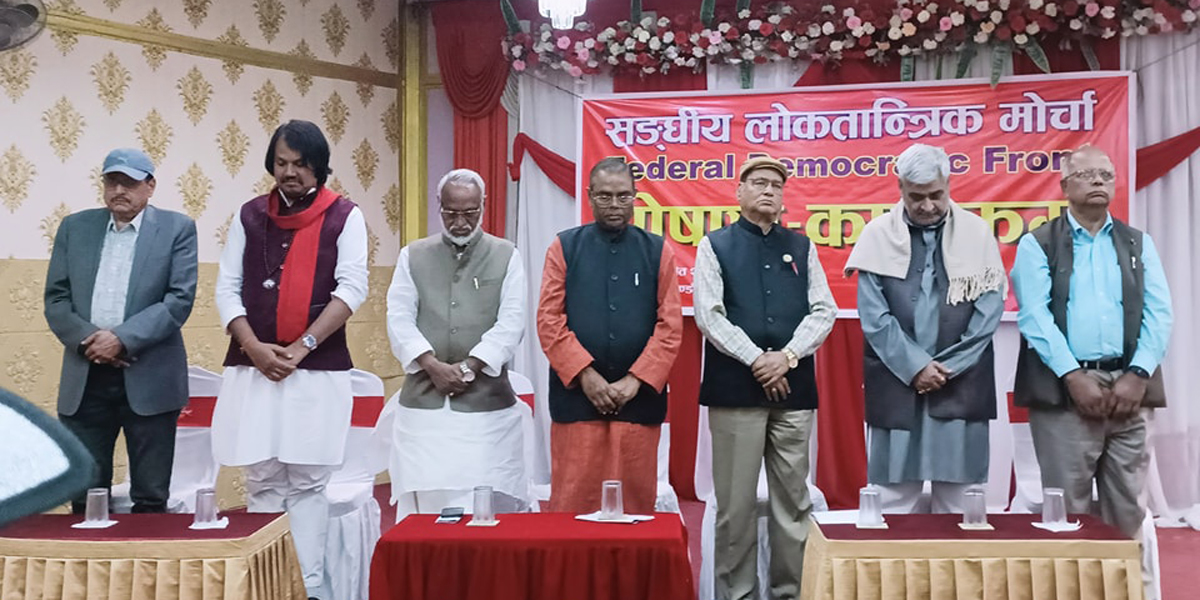
KATHMANDU: The Federal Democratic Front, which was formed by Madhesh-central parties with much fanfare to set a common voice on pressing issues, has not been able to hold its first meeting since its formation. Leaders from member parties say the Front has failed to gain momentum due to dissatisfaction and lack of coordination among its allies.
Seven Madhesh-centric parties gathered in New Baneshwar, Kathmandu, to formally announce the Front on April 3. During the launching ceremony, senior leaders of Janamat Party, Janata Samajbadi Party (JSP) Nepal, Loktantrik Samajbadi Party (LSP) Nepal, Nagrik Unmukti Party, Rastriya Mukti Party, Janata Pragatishil Party and Tarai Madhesh Loktantrik Party (TMLP) pledged to immediately establish a secretariat to give momentum to the Front. However, the secretariat has not been formed yet. The Front also has not held any formal programs since its launch. Leaders say the Front has become inactive due to the busy schedules of senior leaders of its member parties.
“There were problems from the beginning,” said JSP General Secretary Mohammad Istiyak Rai. “Disputes emerged over leadership roles even before the Front was officially announced.” He added that JSP pulled out of the alliance early, citing disagreements over the structure and direction of the Front.
“There was an attempt to form a loose forum rather than a solid front,” Rai explained. “We were ready to push agendas like Madhesh rights and the Lal Commission report, but when additional issues such as the Land Commission were added, consensus broke down.”
Rai added that the inability to focus on a unified agenda weakened the initiative. “We still stand firm on Madhesh-related issues, but we diverge on other current topics,” he added.
JSP Nepal General Secretary Ram Kumar Sharma admitted that his party could not devote time to the Front due to its ongoing internal activities. “We are currently holding district and provincial conventions. That is why we have not been able to move the Front forward,” Sharma said, adding that other parties are facing similar constraints.
Leaders from Janamat Party, the largest party in the alliance, attribute their lesser involvement in the Front to their focus on party unification with the Nagrik Unmukti Party (NUP). “As we focused on the merger process, the Front activities got sidelined,” said Janamat Party Secretary BP Sah.
LSP Nepal’s General Secretary Manish Mishra also said they were focused on party conventions. The party’s general convention is scheduled for mid-May, with district-level events already underway, he added.
Disputes from the Start
From its inception, the Front faced internal disagreements, particularly over leadership and agendas. These tensions resulted in JSP’s withdrawal and ongoing friction among the remaining parties.
“There was confusion about who would lead,” said one leader involved in the initiative. “Without clear leadership, the Front couldn’t move forward.”
Sources say that tensions flared during the announcement event itself, with JSP Chairperson Upendra Yadav and Janamat Chairperson CK Raut both vying for the coordinator role. Raut claimed leadership rights based on his party’s parliamentary strength.
Plans to establish a secretariat composed of three representatives from each party have also not materialized. Meanwhile, the Front’s 21-point commitment letter, which was unveiled during the announcement ceremony, also remains unimplemented.
Nevertheless, leaders insist that the initiative is not dead. “The Front will gradually gain momentum,” said JSP’s Sharma. “Our main agenda is constitutional amendment. Since the government has not addressed the issue, we have slowed down. But when the political need arises, we will activate the Front.”
Rastriya Mukti Party Coordinator Rajendra Mahato also said the Front will soon become active.
Why Was the Front Formed?
The Federal Democratic Front was created to defend and strengthen the federal democratic republic. Its stated goals include naming and structuring provinces based on capability and identity, ensuring clarity in the division of powers between federal and provincial governments, and promoting effective federalism.
The alliance has also pledged to advocate for fair distribution of revenue and resources, empower provincial governments to deliver public services and retain local governance under provincial jurisdiction.
Among its key demands were the immediate implementation of previous agreements between the government and various agitating groups—including 22-point, 8-point, and 11-point deals—as well as the release of the Lal Commission report and the release of political prisoners from movements such as the Madhesh Uprising, Tharuhat, Limbuwan and others.