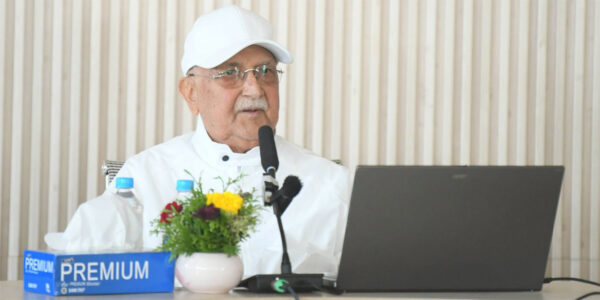
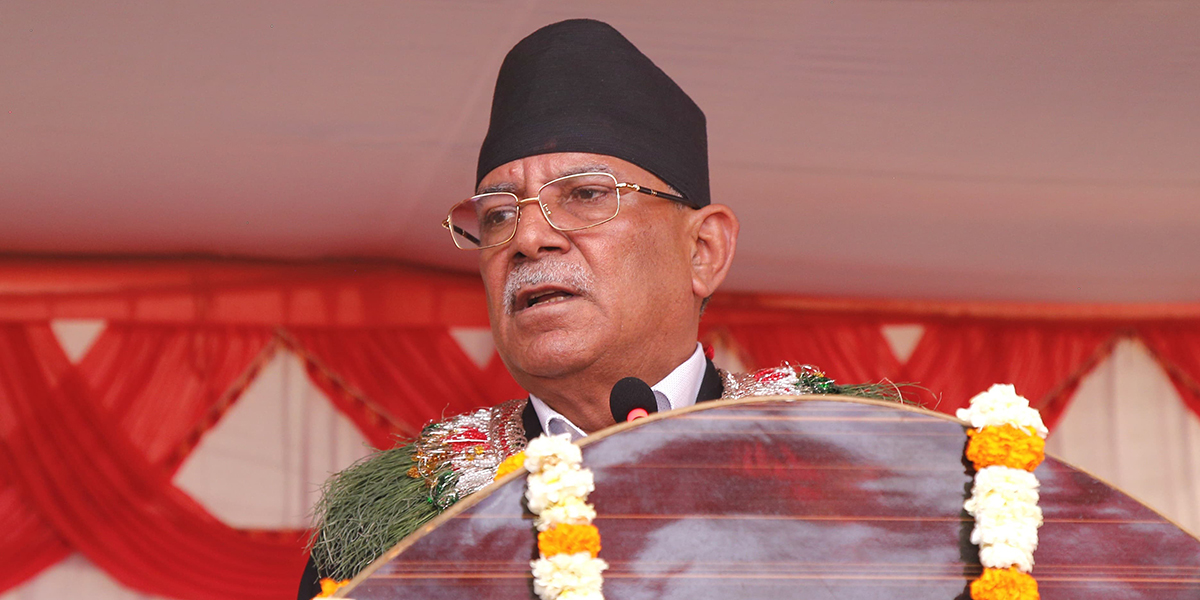
KATHMANDU: Many claim that CPN (Maoist Center) Chairperson Pushpa Kamal Dahal, whose government collapsed nine months ago, cannot stay out of power for long. Observers say it is natural for Dahal—whose party has held power the longest since 2006—to feel restless.
Dahal’s government fell in mid-July last year when the two largest parties in parliament, Nepali Congress (NC) and CPN-UML, formed a new coalition. Once in opposition, he began criticizing the UML-led government under KP Oli, calling it “brokered” and “formed on the condition of not prosecuting the guilty”.
While opposition leaders questioning the government’s performance is expected, Dahal’s recent aggressive stance has sparked rumors of an impending government change. His latest remarks against the Oli government include: “The government is collapsing under its own weight,” “It will fall within weeks,” and “The government’s foundation has shaken; it will crumble.”
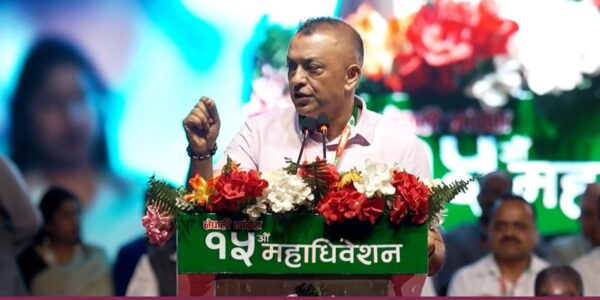
Dahal gained confidence after two NC general secretaries, Gagan Kumar Thapa and Bishwa Prakash Sharma, publicly expressed dissatisfaction with the Oli government. Public discontent toward Oli has also grown—not only have slogans been raised against him at events, but party workers have walked out during his speeches.
Some Maoist Center leaders claim Dahal proposed NC President Sher Bahadur Deuba as the next PM. However, both the Maoist Center leadership and Dahal’s secretariat have denied making such a proposal.
Despite Dahal’s claims that the government is falling, there is no sign of such political maneuvering gaining traction, nor has the NC-UML alliance fractured as he suggests. While tensions exist between NC and UML, party leaders say they are not as severe as portrayed. NC leaders (other than Deuba) have been unhappy with the government’s functioning, while UML leaders have stopped defending the Oli administration.
NC leaders claim Dahal is trying to exploit internal rifts within the NC to his advantage. “Dahal tried to play on our internal bitterness, but we saw through it,” said an NC office-bearer, adding that there is no serious issue in the NC-UML alliance.
Home Minister and NC leader Ramesh Lekhak has also denied any rift between the ruling coalition partners. Speaking at a program in Pokhara recently, Lekhak said the government is moving ahead with consensus. “Some say it will fall, but we keep saying it won’t,” he added.
However, dissatisfaction within NC over the Oli-led government’s performance is growing. Leaders like Shekhar Koirala have publicly criticized the coalition’s inefficiency. Even General Secretaries Thapa and Sharma are unhappy with Oli.
Dahal’s initial plan was to oust Oli and form a new government under Deuba, the leader of the largest political party in the House of Representatives. A Maoist Center leader told Himal Press that Dahal proposed Deuba lead the government, saying, “Run the government yourself, we will support you.” However, Deuba refused the proposal.
“Dahal has been talking about forming a new government from the beginning, but we won’t betray anyone,” said Min Bishwokarma, a close aide of NC President Deuba. “We want the government to function effectively, but we won’t let it be undermined from our side,” he added.
UML has officially dismissed Dahal’s claim that the government is falling. A recent meeting of the UML’s Secretariat concluded that Dahal’s statements stemmed from “frustration and bitterness of being out of power.” UML Spokesperson Rajendra Gautam said there is no possibility or relevance of a government change now. “Such talk reflects nothing but power lust,” he added.
Dahal’s prediction that a new government would be formed under the NC’s leadership prompted Oli to increase coordination with NC leaders. The main friction points were power-sharing disputes over the appointments of the central bank governor and AIGs of Nepal Police. Sources claim tensions have eased after Oli showed flexibility, allowing NC to pick its candidate for the central bank governor.